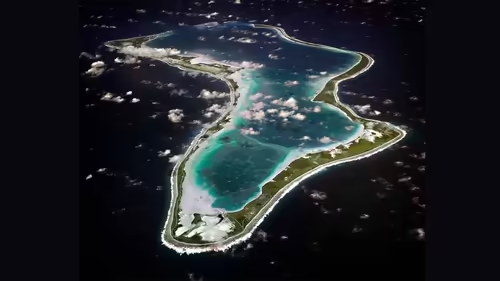
In a move that has sent ripples through diplomatic corridors from New Delhi to London, former President Donald Trump has shifted his controversial gaze from the icy expanses of Greenland to the sun-drenched coral atoll of Diego Garcia. This isn’t just another one of Trump’s offhand remarks; it’s a calculated spotlight on a linchpin of American military power in a region where India sees its own backyard. But what does this mean for India, caught between a long-standing ally and a resurgent great power ambition?
Table of Contents
- Why Diego Garcia is the World’s Most Strategic Atoll
- Trump’s New Indian Ocean Focus: A Power Play
- The Chagos Sovereignty Dispute: A Delicate Balance
- Diego Garcia and India’s Strategic Conundrum
- Conclusion: Navigating a New Geopolitical Reality
- Sources
Why Diego Garcia is the World’s Most Strategic Atoll
Forget its postcard-perfect beaches; Diego Garcia is a fortress. Nestled in the heart of the Indian Ocean, its location is nothing short of genius from a military standpoint. It sits astride vital sea lanes connecting the Middle East, Africa, and Southeast Asia—routes that carry a significant portion of the world’s oil and trade .
Since the 1970s, it has served as a joint UK–US military base, evolving from a Cold War outpost to counter Soviet influence into a critical launchpad for operations in Iraq, Afghanistan, and beyond [[4], [11]]. Its deep-water harbor can accommodate aircraft carriers, and its massive airfield can handle the largest military transport planes, making it an unparalleled logistical hub . In essence, it’s America’s unsinkable aircraft carrier in a region of growing strategic importance.
Trump’s New Indian Ocean Focus: A Power Play
Trump has repeatedly pointed to Diego Garcia‘s importance, arguing that control over such strategic nodes is what truly defines global power . His renewed focus is widely seen as a direct challenge to China’s expanding influence in the Indian Ocean Region (IOR), part of Beijing’s ambitious “String of Pearls” strategy. By amplifying the base’s significance, Trump is signaling a hardline stance on maintaining unchallenged US dominance in these waters.
This move also puts pressure on traditional allies. The UK, which has administered the island as part of the British Indian Ocean Territory (BIOT), is now in a complex negotiation with Mauritius over sovereignty. Trump’s public emphasis on the base could be a way to ensure that any future agreement guarantees the US military’s unfettered access, regardless of who holds the title deed .
The Chagos Sovereignty Dispute: A Delicate Balance
The story of Diego Garcia is also a story of displacement and a decades-long legal battle. In the 1960s and 70s, the UK forcibly removed the entire Chagossian population to make way for the US base—a dark chapter that has fueled international condemnation .
Mauritius, which claims the Chagos Archipelago as its own, has fought a long legal and diplomatic campaign for its return. In a landmark development on October 3, 2024, the UK agreed to hand over sovereignty of the islands to Mauritius [[21], [23]]. However, the deal includes a crucial caveat: the UK will retain a 99-year lease on Diego Garcia to maintain the US military base [[24], [26]]. This arrangement attempts to balance international law and justice with the harsh realities of global power politics.
Diego Garcia and India’s Strategic Conundrum
For India, the situation is fraught with both risk and opportunity. On one hand, a strong and permanent US presence at Diego Garcia acts as a powerful counterweight to China’s growing naval activities in the IOR, a region New Delhi considers its primary sphere of influence .
On the other hand, India is in a delicate position. It has historically supported Mauritius’s claim for the return of the Chagos Islands, aligning itself with the principles of decolonization and international law . Openly endorsing the US-UK military arrangement could damage this relationship and its own standing in the Global South.
Furthermore, while the US base provides a strategic hedge against China, it also represents a significant foreign military footprint right on India’s maritime doorstep. This creates a complex security calculus for New Delhi, which is simultaneously deepening its own defense ties with the US while trying to assert its own leadership in the region . As one analyst noted, India faces a conundrum where it must navigate the expected give-and-take of great power politics without compromising its core strategic autonomy .
Conclusion: Navigating a New Geopolitical Reality
Trump’s focus on Diego Garcia is more than just rhetoric; it’s a stark reminder of the Indian Ocean’s centrality in the 21st-century geopolitical contest. For India, the path forward is narrow. It must continue to support its friend Mauritius on the sovereignty issue while pragmatically engaging with the reality of the US base. The goal will be to ensure that the presence of this powerful foreign asset ultimately contributes to a stable and balanced regional order, one that secures India’s own interests and its vision for a free and open Indian Ocean. The stakes couldn’t be higher.
Sources
- Times of India: After Greenland, now Diego Garcia: Trump shifts focus to Indian Ocean; impact on India
- Brookings Institution: Diego Garcia and the United States’ Emerging Indian Ocean Strategy
- Stimson Center: Diego Garcia: The Eye of a Geopolitical Storm
- UK Parliament: UK-Mauritius treaty on the Chagos Archipelago
- Observer Research Foundation: Diego Garcia in India’s Security Calculus [[12], [16]]