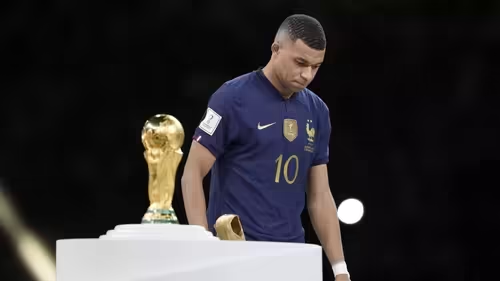
Could geopolitics derail the beautiful game? That’s the question swirling around the 2026 FIFA World Cup after U.S. President Donald Trump reignited tensions with his latest remarks about Greenland—a Danish territory that’s become an unexpected flashpoint in transatlantic relations. The controversy has raised eyebrows across Europe, prompting speculation: Will France boycott the 2026 World Cup?
The answer, at least for now, is a clear “no.” In a definitive statement, France’s Sports Minister Amélie Oudéa-Castéra shut down rumors of a potential boycott, reaffirming Paris’s commitment to participating in the tournament co-hosted by the United States, Canada, and Mexico. But her message came with a caveat: while sport and politics should remain separate, the situation “could evolve” .
So what’s really going on? And why is Greenland suddenly threatening to cast a shadow over the world’s biggest sporting event? Let’s unpack the diplomatic drama, its implications for international football, and what fans can expect as we inch closer to kickoff in 2026.
Table of Contents
- Trump’s Greenland Comments Spark Diplomatic Tensions
- France’s Official Stance on the 2026 World Cup Boycott
- The Principle of Separating Sport from Politics
- Historical Precedents: When Politics Interrupted Football
- What This Means for FIFA and the 2026 Tournament
- Conclusion: Watching the Clock as Diplomacy Unfolds
- Sources
Trump’s Greenland Comments Spark Diplomatic Tensions
Donald Trump’s fascination with Greenland isn’t new—he famously floated the idea of the U.S. purchasing the Arctic island during his first term, a proposal Denmark swiftly rejected. But recent remarks have revived the issue, with Trump suggesting renewed interest in asserting American influence over the strategically vital region due to its mineral wealth and proximity to Russia and China .
European allies, particularly Nordic and EU nations, view these comments as a breach of sovereignty and a troubling sign of U.S. unilateralism. France, a key NATO member and global diplomatic player, has expressed concern—but stopped short of calling for retaliatory measures in the realm of sports.
France’s Official Stance on the 2026 World Cup Boycott
In a direct response to mounting media speculation, French Sports Minister Amélie Oudéa-Castéra addressed the issue head-on. “We are not considering a boycott of the 2026 World Cup,” she stated unequivocally . Her comments were made during a press briefing where she emphasized France’s long-standing belief that major sporting events should transcend political disagreements.
However, Oudéa-Castéra didn’t entirely close the door. “Sport must remain independent from politics,” she said, “but we are watching the situation closely—it could evolve.” This carefully worded statement reflects the delicate balancing act European governments face: upholding democratic values while avoiding actions that could punish athletes and fans for decisions made by politicians.
The Principle of Separating Sport from Politics
The idea that “sport and politics don’t mix” is a noble ideal—but history shows it’s rarely that simple. From the 1980 and 1984 Olympic boycotts to South Africa’s exclusion during apartheid, politics has repeatedly intruded into the arena.
Still, FIFA and most national federations cling to the principle of neutrality. For France—a two-time World Cup champion—the stakes are high. A boycott would mean sidelining one of the world’s strongest squads, disappointing millions of fans, and potentially damaging relationships within global football governance.
Moreover, such a move could set a dangerous precedent. If nations begin boycotting tournaments over every diplomatic spat, the integrity and universality of events like the World Cup could erode. As noted by the Encyclopædia Britannica, the intersection of sport and statecraft is complex, but outright withdrawal is often seen as a last resort .
Historical Precedents: When Politics Interrupted Football
To understand the gravity of a potential 2026 World Cup boycott, it’s worth looking back:
- 1978 Argentina World Cup: Several countries criticized hosting the tournament under a military dictatorship, though no major team officially withdrew.
- 1986 Mexico World Cup: Originally awarded to Colombia, it was moved due to economic instability—showing FIFA’s willingness to relocate for non-sporting reasons.
- 2022 Qatar World Cup: Faced intense scrutiny over human rights, yet all qualified nations participated, highlighting the growing reluctance to boycott even amid serious concerns.
These examples suggest that while political pressure can influence discourse, actual boycotts are exceedingly rare in the modern era—especially among top-tier footballing nations like France.
What This Means for FIFA and the 2026 Tournament
FIFA, already navigating logistical complexities of a 48-team format across three host countries, can breathe a sigh of relief—at least for now. France’s participation is crucial not just for competitive balance but also for commercial and viewership success in Europe.
That said, the underlying tension remains. If U.S.-European relations deteriorate further—particularly over issues like defense spending, trade, or Arctic policy—pressure could mount on other nations to reconsider. Germany, the Netherlands, and Scandinavian countries may face similar questions in the coming months.
For now, fans can look forward to seeing Kylian Mbappé and the French squad compete on North American soil. But as Oudéa-Castéra hinted, nothing is set in stone. Keep an eye on our [INTERNAL_LINK:fifa-world-cup-2026] page for ongoing updates on qualifiers, venues, and geopolitical developments.
Conclusion: Watching the Clock as Diplomacy Unfolds
While France has ruled out a 2026 World Cup boycott in the immediate term, the door isn’t welded shut. The government’s position hinges on the trajectory of U.S.-Europe relations, particularly regarding sensitive issues like Greenland. For now, sport appears to be holding its ground against the tide of politics—but in today’s volatile world, that balance could shift overnight.
One thing is certain: as the countdown to 2026 continues, the beautiful game will remain entangled in the messy, unpredictable world of global diplomacy.
Sources
- The Times of India. “Trump shadow over FIFA WC: Will France boycott event over Greenland row?” https://timesofindia.indiatimes.com/sports/football/top-stories/donald-trump-shadow-over-fifa-world-cup-will-france-boycott-us-event-over-greenland-row-sports-minister-reveals/articleshow/127000218.cms
- Reuters. “Trump renews interest in Greenland, raising eyebrows in Europe.” https://www.reuters.com/world/us/trump-renews-greenland-interest-2026-01-20/
- Encyclopædia Britannica. “Sport and Politics.” https://www.britannica.com/sports/sport-and-politics