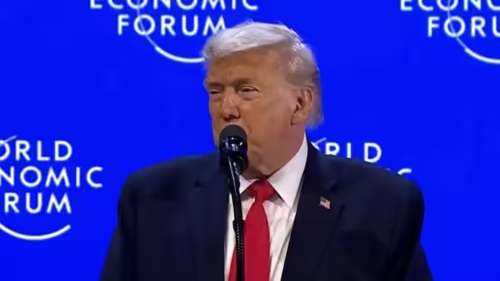
It was a moment that instantly went viral: standing at the podium in Davos, former President Donald Trump declared, “Until the last few days when I told them about Iceland, they loved me. They called me daddy.” The only problem? He was almost certainly talking about Greenland, not Iceland .
This wasn’t a one-off slip. During his speech at the World Economic Forum, Trump repeatedly conflated the two distinct North Atlantic nations, referring to Greenland as “Iceland” on multiple occasions . This latest episode has reignited a fierce debate about his understanding of global geography and the serious geopolitical ambitions that underpin his persistent interest in the Arctic.
Table of Contents
- The Davos Gaffe: What Trump Actually Said
- Greenland vs. Iceland: Why the Confusion Matters
- The Real Strategy Behind Trump’s Arctic Obsession
- NATO, Sovereignty, and the ‘Piece of Ice’ Comment
- Conclusion: A Slip of the Tongue or a Symptom of a Larger Issue?
- Sources
The Davos Gaffe: What Trump Actually Said
During his address, Trump was attempting to justify his renewed push to acquire Greenland, framing it as a necessary move for global peace. He claimed that his popularity among NATO allies had plummeted only after he raised the topic. “Europe, I’m helping NATO… until the last few days when I told them about Iceland, they loved me. They called me daddy,” he stated .
He doubled down on this narrative, repeating the reference to Iceland and the “daddy” comment, even as he described the territory he wanted as a “piece of ice, cold and poorly located, that can play a vital role in world peace” . The description perfectly fits Greenland, the world’s largest island, which is covered by a massive ice sheet. Iceland, by contrast, is a volcanic island nation with a temperate climate and a population of over 370,000.
This conflation happened not once, but multiple times throughout his speech, leading to widespread online mockery and genuine concern from foreign policy analysts .
Greenland vs. Iceland: Why the Confusion Matters
While both are North Atlantic islands with “land” in their names, Greenland and Iceland are fundamentally different entities with distinct political statuses, which makes Trump’s confusion particularly significant.
- Greenland is an autonomous territory within the Kingdom of Denmark. It is not an independent country. Its defense and foreign policy are managed by Copenhagen. Crucially, through its connection to Denmark, Greenland is part of NATO .
- Iceland is a fully independent, sovereign nation and a founding member of NATO in its own right . It has its own government, foreign policy, and international standing.
Confusing the two isn’t just a geographical error; it reveals a fundamental misunderstanding of the complex legal and political frameworks that govern the region. Mistaking a Danish territory for an independent ally could have serious diplomatic repercussions, especially when the subject is a potential U.S. land grab.
The Real Strategy Behind Trump’s Arctic Obsession
Beyond the gaffe, there is a clear and calculated strategy driving Trump’s fixation on Greenland. His interest is not whimsical but rooted in hard-nosed geopolitical realities of the 21st century.
The Arctic is rapidly becoming the world’s next strategic frontier. As sea ice melts, new shipping lanes are opening, and vast reserves of oil, natural gas, and rare earth minerals are becoming accessible. For a superpower like the United States, controlling or having a dominant influence over this region is paramount.
Greenland’s location is its greatest asset. It sits astride the GIUK gap (Greenland-Iceland-United Kingdom), a critical maritime chokepoint for naval movements between the Atlantic and the Arctic . The U.S. already operates the Thule Air Base in northern Greenland, a key site for missile warning and space surveillance. Full control would solidify America’s position as the dominant Arctic power and act as a bulwark against growing Russian and Chinese interests in the region .
NATO, Sovereignty, and the ‘Piece of Ice’ Comment
Trump’s description of Greenland as a mere “piece of ice” belies its immense strategic value, but it also serves a rhetorical purpose. By downplaying its worth, he attempts to frame his acquisition proposal as a simple, pragmatic real estate deal rather than a profound challenge to national sovereignty.
However, this ignores the fact that Greenland, as part of a NATO ally, is already under the alliance’s collective defense umbrella. An attack on Greenland would be considered an attack on all NATO members, including the U.S. . Therefore, the argument that the U.S. needs to own it for its own security is, from a military standpoint, redundant. The real goal appears to be direct access to its resources and an unchallenged strategic foothold, free from the constraints of alliance politics.
His promise at Davos that he “won’t use force” to take Greenland was a direct response to the backlash from his previous comments, but it doesn’t diminish the audacity of the request itself .
Conclusion: A Slip of the Tongue or a Symptom of a Larger Issue?
The Trump Iceland Greenland confusion is more than just a funny soundbite. It’s a window into a worldview where complex international relationships are reduced to transactional deals and personal loyalty (“they called me daddy”). While the underlying strategic rationale for wanting Greenland is sound from a realist perspective, the manner in which it’s being pursued—marked by geographical inaccuracies and a disregard for the sovereignty of allies—undermines its credibility and risks alienating the very partners the U.S. needs in the Arctic.
As the competition for the Arctic intensifies, the world will be watching to see if this is merely a rhetorical blunder or a sign of a deeper, more troubling approach to global statecraft.
Sources
- Times of India: ‘They called me daddy’: Did Trump confuse Greenland with Iceland?
- Various reports on Trump’s Davos speech [[1], [3], [5], [16], [19], [20]]
- Geopolitical analysis of Greenland and NATO [[7], [8], [10], [11], [14]]