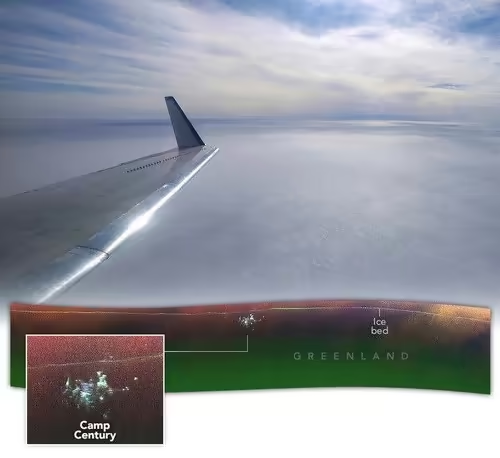
In a discovery that feels ripped straight from a spy thriller, a long-buried secret from the height of the Cold War has been thrust back into the spotlight. Deep beneath the seemingly pristine ice of Greenland, NASA’s powerful radar has captured the clearest images yet of Camp Century—a sprawling, abandoned US military base that was far more than just a scientific outpost. This wasn’t just a camp; it was the test site for a terrifying, top-secret plan that could have changed the course of history.
Table of Contents
- What is Camp Century? The Public Face vs. The Secret Reality
- Project Iceworm: The Terrifying Plan Behind the Base
- How NASA’s Radar Accidentally Unearthed a Cold War Relic
- The Modern Implications: A Ticking Time Bomb?
- Conclusion: A Stark Reminder from the Past
- Sources
What is Camp Century? The Public Face vs. The Secret Reality
Officially, Camp Century was sold to the public and Denmark (which has sovereignty over Greenland) as a cutting-edge scientific research station. Built in 1959, it was a marvel of engineering, carved directly into the ice sheet. It even boasted a nuclear reactor for power, a hospital, a chapel, and a movie theater—a so-called “city under the ice” designed to house over 200 soldiers and scientists .
However, this was a brilliant cover story. The true, classified purpose of Camp Century was far more sinister. It served as the primary testing ground for a clandestine US Army program with a chillingly apt name: Project Iceworm .
Project Iceworm: The Terrifying Plan Behind the Base
Project Iceworm was the brainchild of a Cold War strategy born out of fear and paranoia. The ambitious—and frankly, audacious—plan was to construct a vast, hidden network of tunnels beneath the Greenland ice cap. Inside these tunnels, the US military intended to deploy up to 600 nuclear-armed ballistic missiles, ready to be launched at the Soviet Union at a moment’s notice .
The concept was to use mobile launchers on a rail system, allowing the missiles to be moved between different hidden silos, making them nearly impossible for the enemy to target . Camp Century was built to prove this concept was feasible, with over 1,300 feet of tunnels excavated to test the structural integrity of the ice and the logistics of such an operation .
Ultimately, the project was abandoned by 1966. The engineers had fatally underestimated the dynamic nature of the ice sheet. The tunnels were deforming and collapsing much faster than anticipated, rendering the entire plan unworkable . The US military simply walked away, leaving behind a significant amount of infrastructure, waste, and, most concerningly, the base’s low-level radioactive coolant from its nuclear generator .
How NASA’s Radar Accidentally Unearthed a Cold War Relic
The recent rediscovery of Camp Century wasn’t the result of a dedicated archaeological mission. Instead, it was a byproduct of NASA’s ongoing climate science efforts. As part of its Operation IceBridge and other airborne campaigns, NASA has been using ultra-sensitive, ice-penetrating radar to map the thickness and structure of the Greenland ice sheet to understand the impacts of global warming .
During one of these routine scientific flights, the radar’s powerful signals pierced through hundreds of feet of ice and returned an astonishingly detailed image of the man-made structures below. The data revealed the clear layout of the camp’s main tunnel, known as “Main Street,” along with its various side tunnels and chambers, providing an unprecedented “map” of the buried city [[19], [23]].
This accidental discovery has given scientists their best look yet at the physical remains of the base, confirming its location and extent in a way that was previously impossible .
The Modern Implications: A Ticking Time Bomb?
The rediscovery of Camp Century isn’t just a fascinating historical footnote; it’s a potential environmental and political time bomb. When the base was abandoned, an estimated 200,000 liters of diesel fuel, unknown quantities of sewage, polychlorinated biphenyls (PCBs), and the radioactive coolant were left behind, encased in the ice .
For decades, this toxic cocktail was considered safely entombed. However, with the accelerating pace of climate change and the rapid melting of the Greenland ice sheet, that assumption is no longer safe. A 2016 study warned that the portion of the ice sheet covering Camp Century could begin to melt by the end of this century, potentially releasing these hazardous materials into the environment .
This raises a host of difficult questions: Who is responsible for the cleanup—the United States or Denmark? How can such a remote and deeply buried site even be remediated? And what are the potential ecological consequences for the fragile Arctic ecosystem? These are complex issues that will require international cooperation to resolve, all stemming from a secret project that was supposed to stay buried forever.
Conclusion: A Stark Reminder from the Past
The ghost of Camp Century serves as a powerful and sobering reminder of the extreme lengths nations went to during the Cold War. What was once a secret weapon of mass destruction is now a stark symbol of our own hubris and the long-lasting, unintended consequences of our actions. As the ice melts, not only is a physical base being uncovered, but also the legacy of a dangerous era. The story of Camp Century is a compelling blend of history, science, and a warning for our future, proving that some secrets are never truly buried.
Sources
- Times of India: A forgotten US Cold War base resurfaces under Greenland ice in NASA radar scan
- NASA Earth Observatory: New View of the “City Under the Ice”
- CIRES, University of Colorado Boulder: Greenland and the Legacy of Camp Century
- Smithsonian Magazine: When the Pentagon Dug Ice Tunnels in Greenland to Hide Nuclear Missiles