Table of Contents
- The Shock Takeover: How Daryl Mitchell Claimed the Top Spot
- What Happened to Virat Kohli and Rohit Sharma?
- How the ICC ODI Ranking System Works
- New Zealand’s Rise in Batting Depth
- Historical Context: Past No.1 ODI Batsmen
- What This Means for Team India
- Conclusion: A New Chapter in ODI Cricket
- Sources
The Shock Takeover: How Daryl Mitchell Claimed the Top Spot
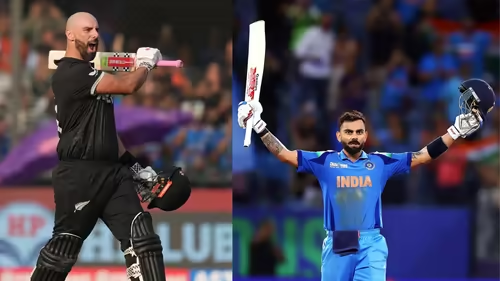
In a development that has sent ripples through the cricketing world, Daryl Mitchell has surged to the top of the ICC men’s ODI ranking, overtaking none other than Virat Kohli. The New Zealand all-rounder’s meteoric rise is the direct result of his masterful performances in the recent three-match ODI series against India—a series that New Zealand won 2–1 on Indian soil .
Mitchell scored consecutive centuries: 134* in the first ODI in Mumbai and 101 in the decisive third match in Pune. These weren’t just runs—they were match-defining innings under pressure, against one of the strongest bowling attacks in the world. His consistency, composure, and ability to anchor the innings while accelerating when needed earned him 845 rating points, enough to nudge past Kohli’s long-held dominance .
This achievement marks a historic moment for New Zealand cricket. Mitchell becomes only the second Kiwi batsman—after Ross Taylor—to reach the No.1 spot in the ICC ODI batting rankings.
What Happened to Virat Kohli and Rohit Sharma?
For years, Virat Kohli has been the face of ODI excellence. With 13,000+ runs and 50 centuries, his name was almost synonymous with the No.1 ODI ranking. But after a relatively quiet series—scoring 67, 16, and 39—he has now dropped to second place.
Even more concerning for Indian fans is the fall of captain Rohit Sharma. Once a dominant force at the top of the order, Rohit managed just 12, 1, and 23 in the series. That poor form has seen him slip from the top five all the way down to fourth place in the latest ICC update .
Here’s the updated top five in the ICC men’s ODI batting rankings as of January 2026:
- Daryl Mitchell (New Zealand) – 845 points
- Virat Kohli (India) – 838 points
- Ibrahim Zadran (Afghanistan) – 820 points
- Rohit Sharma (India) – 812 points
- Babar Azam (Pakistan) – 805 points
How the ICC ODI Ranking System Works
Many fans wonder: how does someone jump from outside the top three to No.1 in just one series? The answer lies in the ICC’s dynamic and performance-weighted ranking algorithm.
The system considers:
- Runs scored relative to the strength of the opposition.
- Match result—performances in wins carry more weight.
- Recency—recent matches are weighted more heavily than older ones.
- Quality of bowling attack faced during the innings.
This means that Mitchell’s two centuries didn’t just add points—they replaced older, lower-scoring performances in the calculation window, creating a significant net gain. For more on how ICC rankings work, visit the official [ICC website](https://www.icc-cricket.com/rankings/mens/player-rankings/odi). [INTERNAL_LINK:how-icc-rankings-work]
New Zealand’s Rise in Batting Depth
Mitchell’s ascent isn’t happening in isolation. It reflects a broader transformation in New Zealand’s ODI batting lineup. Alongside him, Glenn Phillips has also cracked the top 20, jumping to 20th place after consistent middle-order contributions .
This depth gives the Black Caps a formidable top six, capable of adapting to any condition or situation. From Finn Allen’s explosive starts to Kane Williamson’s stability, and now Mitchell’s anchoring brilliance, New Zealand looks poised for a strong run in the upcoming ICC Champions Trophy.
Historical Context: Past No.1 ODI Batsmen
The No.1 spot in the ODI ranking has been held by legends: Viv Richards, Sachin Tendulkar, Ricky Ponting, AB de Villiers, and most recently, Virat Kohli. Kohli held the top position for over 1,200 days across multiple stints—a testament to his extraordinary consistency.
Mitchell’s reign may be short-lived if he doesn’t maintain this level, but his achievement underscores a key truth in modern cricket: rankings are no longer monopolized by traditional powerhouses. Players from smaller nations can—and do—rise to the pinnacle through sheer performance.
What This Means for Team India
For India, this ranking shift is a wake-up call. The top order’s fragility in the series exposed a worrying trend. With the 2027 ODI World Cup on the horizon, the team must address:
- Lack of consistent opening partnerships.
- Over-reliance on middle-order rescues.
- Form slumps of senior batters like Rohit and Kohli.
While both remain world-class, their current dip highlights the need for India to integrate younger talent and build a more resilient batting core.
Conclusion: A New Chapter in ODI Cricket
Daryl Mitchell’s rise to No.1 in the ODI ranking isn’t just a personal triumph—it symbolizes the evolving landscape of international cricket. Excellence is no longer confined to a few stars; it’s emerging from unexpected corners, driven by fearless performances and tactical maturity.
As fans, we’re witnessing a thrilling transition. Kohli and Rohit aren’t done—but their throne is now contested. And in that contest lies the future of the game: competitive, unpredictable, and gloriously global.
Sources
- Times of India. “Daryl Mitchell dethrones Virat Kohli to claim No.1 ODI ranking as Rohit Sharma slips to fourth.” https://timesofindia.indiatimes.com/…
- International Cricket Council (ICC). “Official Men’s ODI Player Rankings.” https://www.icc-cricket.com/rankings/mens/player-rankings/odi