Table of Contents
- The Karnataka Standoff: What Happened?
- Constitutional Duties and Article 176: What Does the Law Say?
- A Growing National Trend: Governors vs. State Governments
- Political Implications for the Siddaramaiah Government
- Conclusion: What’s Next for the Karnataka Governor Dispute?
- Sources
The Karnataka Standoff: What Happened?
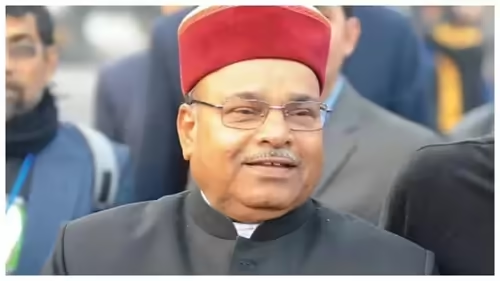
In a move that has sent shockwaves through the political corridors of Bengaluru, Karnataka Governor Thaawarchand Gehlot has refused to deliver his customary address to the joint session of the state legislature, which was scheduled to begin on January 22, 2026 . This unprecedented decision has plunged the state into a fresh constitutional controversy, pitting the Raj Bhavan against the elected government of Chief Minister Siddaramaiah.
While the Governor’s office has not officially disclosed the reason for this refusal, multiple government sources have indicated that the dispute centers around the content of the speech prepared by the state cabinet. It is widely believed that the draft contained references to the Central government that the Governor found objectionable . This sets a dangerous precedent, as the Governor’s address is meant to be a formal reading of the government’s agenda, not a platform for the appointee to insert personal or political opinions.
The Siddaramaiah government, caught off guard, is now planning to meet with the Governor to understand his specific objections and seek a resolution. This standoff is not just a procedural hiccup; it’s a direct challenge to the authority of a democratically elected state government.
Constitutional Duties and Article 176: What Does the Law Say?
At the heart of this conflict lies Article 176 of the Indian Constitution. This article clearly mandates that the Governor shall address both Houses of the State Legislature assembled together at the commencement of the first session after each general election and at the commencement of the first session of each year .
Crucially, the Constitution states that the Governor “may” address the legislature, but the convention and legal interpretation have long held that this is a binding duty, not a discretionary power. The speech itself is not the Governor’s own; it is a statement of the policies and programmes of the state government, drafted and approved by the Council of Ministers. The Governor’s role is purely ceremonial in this context—to act as a conduit for the government’s message to the legislature.
This principle is a cornerstone of India’s parliamentary democracy, where the real executive power lies with the Council of Ministers headed by the Chief Minister, who are collectively responsible to the legislative assembly. When a Karnataka Governor or any other governor attempts to edit or veto this speech, they are effectively stepping into the domain of the elected executive, which is a clear violation of the spirit of the Constitution .
A Growing National Trend: Governors vs. State Governments
The Karnataka crisis is not an isolated incident. It is part of a disturbing and growing national trend of conflicts between governors—often seen as appointees of the Central government—and state governments led by opposition parties.
Just days before the Karnataka standoff, a similar drama unfolded in Tamil Nadu. Governor R.N. Ravi walked out of the Legislative Assembly without delivering his address, after a prolonged face-off with the Speaker over his insistence on making changes to the government-approved speech . In his eventual address, he had even expressed “grave concern” over the Centre’s funding denial for Tamil Nadu projects, a clear political statement from a supposedly apolitical office .
Likewise, in Kerala, Governor Rajendra Vishwanath Arlekar was embroiled in a dispute with the Pinarayi Vijayan-led government over the same issue—the content of the Governor’s address . These repeated incidents across different states suggest a coordinated strategy or a systemic problem with the current appointment and functioning of governors, turning what should be a neutral constitutional post into a political battleground.
Political Implications for the Siddaramaiah Government
For the Siddaramaiah government, this conflict is a double-edged sword. On one hand, it provides a potent political narrative to rally its base against perceived interference from the Centre. The government can frame this as an attack on Karnataka’s autonomy and the mandate given by its people.
On the other hand, it creates a significant roadblock at the start of the legislative session. The Governor’s address is the formal launchpad for the government’s legislative agenda for the year. Without it, the session’s proceedings are thrown into disarray, potentially delaying crucial bills and policy announcements.
Key implications include:
- Legislative Logjam: The session’s business cannot proceed smoothly without the formal address, causing delays in passing important legislation.
- Public Perception: The government must carefully manage public perception to avoid appearing weak or in constant conflict with central authorities.
- Constitutional Precedent: How this standoff is resolved will set a critical precedent for future interactions between the Raj Bhavan and the state government in Karnataka and beyond.
Conclusion: What’s Next for the Karnataka Governor Dispute?
The refusal of the Karnataka Governor to address the joint session is more than a political spat; it’s a test of India’s federal structure and constitutional morality. The core issue is simple: should an appointee of the Centre have the power to dictate the terms of a speech that belongs to an elected state government?
The ball is now in the court of both parties. The Siddaramaiah government must stand firm on the principle that the Governor’s role is ceremonial in this matter, while also seeking a diplomatic off-ramp to avoid a prolonged crisis. For Governor Gehlot, the path forward requires him to respect the constitutional conventions that have governed this office for decades. The nation will be watching closely, as the outcome in Karnataka could define the relationship between states and the Centre for years to come. For more on the intricacies of Indian federalism, see our deep dive on [INTERNAL_LINK:indian-federalism-challenges].
Sources
- Times of India. “Karnataka Guv vs Sidda govt: Gehlot refuses to address joint session; what triggered row.” https://timesofindia.indiatimes.com/…
- Constitution of India, Article 176. “Special address by the Governor.”
- The Hindu. “Fresh Governor–government clashes erupt in poll-bound Tamil Nadu and Kerala.”
- PRS India. “Role Of Governors Under The Indian Constitution.” https://www.prsindia.org/