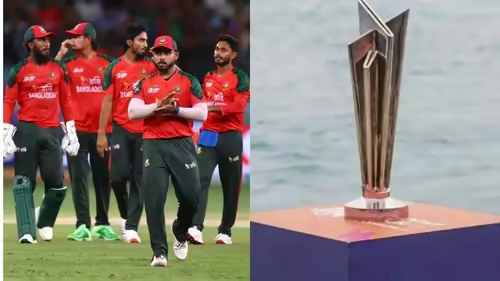
From Cricket Pitch to Political Minefield: The Bangladesh T20 World Cup Crisis
The beautiful game of cricket has once again been dragged into a messy geopolitical and administrative tussle. The International Cricket Council (ICC) has officially rejected Bangladesh’s request to shift its T20 World Cup matches out of India, setting the stage for a potential historic expulsion from the sport’s biggest global event .
This isn’t just about logistics; it’s a direct consequence of a bitter fallout between the Bangladesh Cricket Board (BCB) and the Indian Premier League (IPL) over star pacer Mustafizur Rahman. Now, with the ICC drawing a hard line and Scotland waiting in the wings, the entire integrity of the upcoming T20 World Cup hangs in the balance. Let’s unpack this complex and rapidly evolving situation.
Table of Contents
- The ICC’s Final Decision
- How Did We Get Here? The Mustafizur Rahman Saga
- Why India is a Red Line for Bangladesh
- Scotland on Standby: The Next Team in Line
- The Bigger Picture: What This Means for World Cricket
- Conclusion: A Looming Deadline
- Sources
The ICC’s Final Decision
In a move that leaves little room for negotiation, the ICC has formally denied the Bangladesh Cricket Board’s plea to relocate their group-stage fixtures from India to a neutral venue like Sri Lanka . The governing body cited a security assessment that deemed the risk level in India as “low to moderate,” effectively dismissing Bangladesh’s safety concerns .
Critically, the ICC didn’t just say ‘no.’ They attached a clear and severe consequence: if the Bangladesh team refuses to travel to India, they will be removed from the tournament and replaced by another nation . This transforms the dispute from a simple scheduling issue into an existential threat to Bangladesh’s participation in the T20 World Cup 2026.
How Did We Get Here? The Mustafizur Rahman Saga
The roots of this crisis lie in the high-octane world of the IPL. The BCB, in a controversial decision, instructed Mustafizur Rahman to withdraw from his IPL franchise, a move widely seen as retaliation for the IPL’s previous treatment of the player . In response, the BCB imposed a nationwide ban on the broadcast of the IPL within Bangladesh.
This tit-for-tat escalation created a toxic atmosphere. The BCB’s subsequent request to move its World Cup matches out of India appears to be a direct extension of this political and commercial rift. It’s a classic case of domestic league politics spilling over and poisoning the well of international sport. The ICC, however, is refusing to let a bilateral dispute dictate the terms of its global event.
Why India is a Red Line for Bangladesh
While the ICC’s security report downplays the risks, the BCB’s stance is likely influenced by more than just player safety. The intense political and public sentiment in Bangladesh following the IPL ban has created immense pressure on the board. Sending the national team to India under these circumstances could be seen as a betrayal of their own stance, potentially leading to a massive public backlash at home.
For the BCB, this is now a matter of national pride and internal political survival. Backing down could make them appear weak in front of their own fans and government. This puts them in an impossible position: defy the ICC and lose their World Cup spot, or defy their own public and travel to India.
Scotland on Standby: The Next Team in Line
If Bangladesh holds its ground, the ICC has a ready-made contingency plan. Reports strongly indicate that Scotland, who were among the final teams to miss out on qualification, are the prime candidates to step into the void .
This would be a seismic moment for Scottish cricket, offering them a rare chance to compete on the world’s biggest stage. However, it would also be a deeply controversial outcome, as a team that earned its place through qualification could be ousted due to a political dispute, while another that didn’t qualify gets a free pass. This scenario raises serious questions about the fairness and sporting integrity of the qualification process.
The Bigger Picture: What This Means for World Cricket
This crisis exposes a fundamental flaw in the modern cricket ecosystem. The immense power and financial clout of private leagues like the IPL are now directly interfering with the smooth running of international tournaments sanctioned by the ICC. The lines between club and country have become dangerously blurred.
Furthermore, the ICC’s handling of the situation is a test of its authority. If it caves to the demands of a single board, it sets a precedent that could lead to future chaos. But if it expels a major Test-playing nation, it risks damaging the tournament’s credibility and viewership. It’s a lose-lose situation that highlights the urgent need for clearer governance structures separating league and international cricket.
Conclusion: A Looming Deadline
The ball is now firmly in Bangladesh’s court. The ICC rejects Bangladesh venue shift decision is final, and the clock is ticking. The BCB must choose between its political stance and its place in the T20 World Cup. Whatever their decision, the repercussions will be felt across the cricketing world for years to come. One thing is certain: the drama off the pitch may overshadow the action on it.
Sources
- Times of India: Bangladesh face T20 WC exit: ICC rejects venue shift request; votes to replace team
- NDTV Sports: T20 World Cup Row Deadline Day Highlights: ICC Rejects Bangladesh’s Request
- ICC Official Statement (as reported by multiple sources): ICC Media Release on T20 World Cup 2026 Venues [[1], [2], [3], [5]]