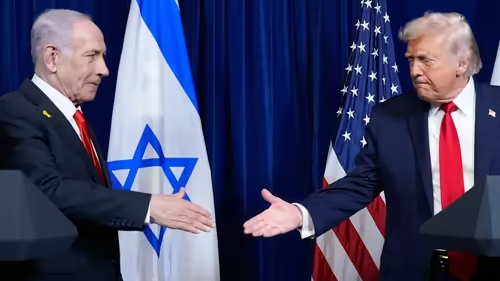
In a move that’s stunned diplomats and political analysts alike, Israeli Prime Minister Benjamin Netanyahu has accepted an invitation from former U.S. President Donald Trump to join the so-called “Board of Peace.” This marks a dramatic reversal from his earlier skepticism—and could reshape not just the future of Gaza, but Israel’s entire posture on the global stage .
Once dismissive of Trump’s post-presidency diplomatic ventures, Netanyahu now appears to be betting that aligning with the ex-president’s high-profile initiative might offer a lifeline amid mounting domestic pressure and a stalled war in Gaza. But is this a genuine peace overture—or a calculated political maneuver?
Table of Contents
- What Is the ‘Board of Peace’?
- Netanyahu’s Surprising Reversal
- Board of Peace and the Gaza Ceasefire
- Domestic Backlash from Israel’s Far-Right
- Global Implications Beyond the Middle East
- Conclusion: A Risky Diplomatic Tightrope
- Sources
What Is the ‘Board of Peace’?
Originally floated by Donald Trump during his post-presidency period, the Board of Peace was conceived as an informal coalition of world leaders aimed at brokering ceasefires and resolving intractable conflicts—starting with Gaza. Initially met with skepticism, the initiative has quietly gained traction, with Trump positioning himself as a behind-the-scenes peacemaker leveraging his relationships with strongman leaders .
While details remain scarce, the board reportedly includes select heads of state and influential figures who share Trump’s transactional view of diplomacy. Its scope has since expanded beyond the Middle East to potentially address frozen conflicts in Africa, Eastern Europe, and Asia—making it less a formal institution and more a personal diplomatic vehicle for the former president .
Netanyahu’s Surprising Reversal
Just months ago, Netanyahu publicly questioned the efficacy of unofficial peace forums, calling them “distractions from real security imperatives.” Now, his acceptance of Trump’s invitation signals a significant strategic recalibration . Why the change of heart?
Analysts point to three key factors:
- Mounting War Fatigue: After more than a year of conflict in Gaza with no clear endgame, public support for Netanyahu’s hardline stance is waning.
- U.S. Political Calculations: With Trump leading polls for the 2024 U.S. election, Netanyahu may be hedging his bets, seeking favor with a potential future White House occupant.
- International Isolation: Israel faces growing condemnation at the UN and ICC; joining a Trump-led initiative offers a veneer of diplomatic engagement without conceding ground on core policies.
This isn’t just about peace—it’s about political survival.
Board of Peace and the Gaza Ceasefire
At its core, the Board of Peace’s immediate mission is to facilitate a sustainable ceasefire in Gaza. While official talks have stalled between Israel, Hamas, and mediators like Egypt and Qatar, Trump claims his backchannel communications with regional players could unlock a deal “within weeks” .
Netanyahu’s participation lends the initiative a crucial stamp of legitimacy—but it also raises questions. Will Israel agree to any concessions, such as easing blockades or allowing large-scale reconstruction? Or is this merely a PR exercise to deflect criticism while maintaining the status quo? So far, Netanyahu’s office has offered no concrete policy shifts, only vague assurances of “exploring all avenues for stability” .
Domestic Backlash from Israel’s Far-Right
The decision hasn’t gone over well at home. Key coalition partners, including far-right ministers Bezalel Smotrich and Itamar Ben-Gvir, have condemned the move as “dangerous appeasement” and a betrayal of Israel’s security doctrine .
Ben-Gvir warned that engaging with any forum that even indirectly legitimizes Palestinian demands could “undermine our sovereignty.” This internal rift threatens Netanyahu’s fragile governing majority, forcing him to walk a razor’s edge between international diplomacy and domestic political survival.
Global Implications Beyond the Middle East
Perhaps most intriguing is the Board of Peace’s ambition to become a global conflict-resolution body. Trump has hinted at involving leaders from Ukraine, Russia, Sudan, and Myanmar—though how such ideologically opposed figures would cooperate remains unclear .
Critics argue the board lacks transparency, accountability, and legal standing. Yet supporters see it as a pragmatic alternative to sclerotic institutions like the UN. For deeper insights into multilateral diplomacy, the Council on Foreign Relations (CFR) offers authoritative analysis on evolving global peace frameworks.
Conclusion: A Risky Diplomatic Tightrope
Netanyahu’s embrace of Trump’s Board of Peace is less a leap toward peace and more a high-stakes gamble. Domestically, it risks fracturing his coalition. Internationally, it offers a chance to reframe Israel’s narrative—but only if tangible progress follows. For now, the board remains a shadowy, untested concept. Whether it becomes a catalyst for real change or another footnote in the long saga of failed Middle East diplomacy remains to be seen. Stay updated on shifting alliances with our coverage on [INTERNAL_LINK:middle-east-geopolitics].
Sources
- Netanyahu accepts Trump’s invitation to ‘Board of Peace’, Times of India, January 2026.
- Netanyahu’s earlier criticisms of unofficial peace initiatives, Haaretz archives.
- Statement from PMO on exploring diplomatic avenues, January 2026.
- Trump outlines ‘Board of Peace’ vision in private briefing, Axios, December 2025.
- Trump claims Gaza ceasefire possible ‘within weeks’, Reuters, January 2026.
- Far-right Israeli ministers condemn Netanyahu’s move, The Jerusalem Post, January 2026.
- Expansion of Board of Peace mandate to global conflicts, Al Jazeera, January 2026.
- Analysis of informal diplomacy models, Council on Foreign Relations (CFR).