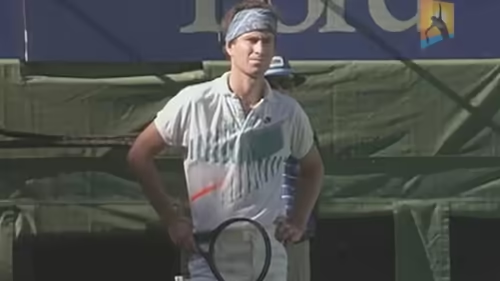
It was a sweltering Melbourne afternoon on January 21, 1990. The Australian Open was in full swing, and the Rod Laver Arena buzzed with anticipation for a classic fourth-round clash between the fiery American No. 4 seed, John McEnroe, and Sweden’s Mikael Pernfors. But what unfolded wasn’t just a tennis match—it was a seismic event that would forever change the sport’s disciplinary landscape. This was the day of the John McEnroe disqualification, a moment so explosive it remains etched in sporting infamy over three decades later .
For fans of a certain generation, McEnroe wasn’t just a tennis player; he was a force of nature. And for a young cricket prodigy in India named Sachin Tendulkar, he was nothing short of a hero. Tendulkar has openly shared how, in his formative years, he idolized McEnroe, pleading with his parents for the same headband and wristbands and even growing his hair long to emulate his idol [[8], [9]]. The irony is palpable: the man who inspired a generation of calm, focused champions like Tendulkar was himself ejected from the game’s biggest stage for losing his cool.
Table of Contents
- The Match That Broke the Rules
- Why John McEnroe Was Disqualified: The Code Violation Breakdown
- Sachin’s Idol: The Human Side of a Tennis Legend
- The Aftermath and Legacy of the 1990 Australian Open
- Conclusion: More Than Just a Tantrum
- Sources
The Match That Broke the Rules
McEnroe, a seven-time Grand Slam champion, was known for his genius on the court and his volcanic temper off it. By 1990, he was 31, past his prime but still a formidable competitor. The match against Pernfors was tight, with McEnroe leading 6-1, 4-6, 7-5, and Pernfors up 4-2 in the fourth set .
The tension was mounting. A disputed line call became the spark. McEnroe, convinced the ball was in, unleashed a torrent of abuse at the chair umpire. His frustration wasn’t new, but the tournament officials, led by supervisor Ken Farrar, were operating under a newly enforced, stricter code of conduct. The era of letting legends get away with verbal assaults was over.
Why John McEnroe Was Disqualified: The Code Violation Breakdown
The John McEnroe disqualification wasn’t a sudden decision. It was the culmination of a clear, escalating process of penalties under the Grand Slam code of conduct:
- First Violation (Warning): For unsportsmanlike conduct after an initial outburst.
- Second Violation (Point Penalty): For continued verbal abuse directed at the officials.
- Third Violation (Game Penalty / Default): After McEnroe called the tournament supervisor a “spastic” and an “idiot,” he was issued a third code violation, which mandated an automatic disqualification .
This made McEnroe the first player in the Open Era to be defaulted from a Grand Slam singles match for misconduct [[18], [22]]. The precedent was set, and the message was loud and clear: no player, not even a legend, was above the rules.
Sachin’s Idol: The Human Side of a Tennis Legend
While the world saw a petulant superstar being thrown off the court, a young Sachin Tendulkar in Mumbai saw his childhood hero falter. It’s a fascinating duality. Tendulkar, who would go on to become the epitome of grace under pressure in cricket, found his early inspiration in McEnroe’s raw, unfiltered passion for the game .
“I also played a lot of tennis—and I was pretty good too,” Tendulkar once recalled, highlighting his deep connection to the sport and its stars . This personal link makes the 1990 incident more than just a tennis footnote; it’s a cultural touchstone, connecting two of the greatest athletes from different worlds through a single, dramatic moment.
The Aftermath and Legacy of the 1990 Australian Open
The fallout was immediate and global. McEnroe was fined $6,500 and faced a wave of criticism. Yet, the incident had a profound positive impact on the sport. It forced a necessary conversation about player behavior and established a firm framework for enforcing discipline.
Since that day, several other players have been disqualified from Grand Slams, including Serena Williams at the 2009 US Open and Novak Djokovic at the 2020 US Open, proving that the precedent set in Melbourne holds true . The “McEnroe Rule” became a shorthand for the zero-tolerance policy that now governs the tour.
For McEnroe himself, the event became a defining, albeit negative, part of his complex legacy. He has since reflected on it with a mix of regret and his trademark wit, acknowledging that his temper cost him a real chance at a late-career Grand Slam title.
Conclusion: More Than Just a Tantrum
The John McEnroe disqualification at the 1990 Australian Open was far more than a celebrity meltdown. It was a pivotal moment that modernized tennis, ensuring that respect for the game and its officials became non-negotiable. It’s a stark reminder that even the most brilliant talents are subject to the same rules as everyone else. And for millions of fans, especially a young boy in India dreaming of sporting greatness, it was a powerful, if painful, lesson in the fine line between passion and professionalism.
Sources
- Times of India: Australian Open: When Sachin’s childhood idol became first to be disqualified from a Grand Slam
- UPI Archives: McEnroe disqualified from Australian Open
- International Tennis Hall of Fame: John McEnroe Player Profile
- ESPN: What happened during John McEnroe’s 1990 Australian Open disqualification?
- [INTERNAL_LINK:sachin-tendulkar-childhood-inspiration]
- [INTERNAL_LINK:history-of-tennis-grand-slam-controversies]