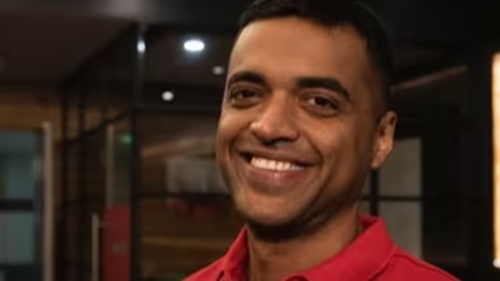
After more than 15 years at the helm, the man who turned food delivery into a national obsession is walking away from the driver’s seat. Deepinder Goyal, the visionary founder and CEO of Zomato, has announced his resignation from the top role at parent company Eternal Limited—subject to shareholder approval. In a candid statement, Goyal revealed he’s being “drawn to a set of new ideas” that demand his full attention, ideas too risky and experimental for a publicly listed company like Zomato. He’ll remain on the board as Vice Chairman, while industry veteran Albinder Dhindsa—co-founder of logistics unicorn Delhivery—steps in as the new CEO. This isn’t just a leadership shuffle; it’s a pivotal moment for India’s most iconic consumer tech brand.
Table of Contents
- The Deepinder Goyal Legacy: From Blog to Billion-Dollar Brand
- Why Now? The Real Reason Behind Goyal’s Exit
- Who Is Albinder Dhindsa? The New Captain of Zomato
- What’s Next for Zomato Under New Leadership?
- Is This Part of a Bigger Trend in Indian Startups?
- Conclusion: End of an Era, Dawn of a New Chapter
- Sources
The Deepinder Goyal Legacy: From Blog to Billion-Dollar Brand
It’s hard to overstate Deepinder Goyal’s impact on Indian consumer behavior. In 2008, frustrated by the lack of restaurant menus online, he launched “Foodiebay”—a simple blog listing Delhi eateries. That humble project evolved into Zomato, a platform that not only digitized restaurant discovery but revolutionized how millions eat, socialize, and even date.
Under Goyal’s leadership, Zomato survived brutal competition (including a near-fatal battle with Swiggy), expanded into hyperlocal grocery delivery, went public in a landmark 2021 IPO, and even dabbled in cloud kitchens and live events. His relentless focus on user experience and data-driven decisions made Zomato synonymous with foodtech in India. As one early investor put it, “Deepinder didn’t just build a company—he built a cultural habit.”
Why Now? The Real Reason Behind Goyal’s Exit
Goyal’s official reason—“drawn to new ideas”—is telling. Public companies operate under quarterly pressure, regulatory scrutiny, and shareholder expectations. For a founder wired for moonshot thinking, this environment can feel stifling.
Insiders suggest Goyal has been exploring ventures in AI-driven personalization, decentralized commerce, and even Web3 applications—areas where failure is likely but breakthroughs could be transformative. “He wants to tinker again,” said a former colleague. “But you can’t bet the farm on unproven concepts when you’re managing a $5 billion market cap company.”
This mirrors global trends: founders like Jack Dorsey (Twitter) and Evan Spiegel (Snap) have stepped back to pursue passion projects, trusting professional CEOs to steward their legacy businesses.
Who Is Albinder Dhindsa? The New Captain of Zomato
Albinder Dhindsa isn’t a random pick. As co-founder and former CEO of Delhivery—one of India’s largest logistics firms—he brings deep operational expertise in scaling complex, asset-heavy networks. Under his watch, Delhivery grew from a campus courier service to a nationwide logistics powerhouse handling e-commerce, retail, and enterprise deliveries.
His strengths align perfectly with Zomato’s current needs:
- Operational rigor: Streamlining delivery fleets and warehouse efficiency.
- Profitability focus: Delhivery achieved consistent EBITDA positivity—a skill Zomato needs post-IPO.
- B2B experience: Could unlock Zomato’s underutilized SaaS offerings for restaurants.
Dhindsa’s appointment signals a shift from “growth at all costs” to sustainable, disciplined expansion.
What’s Next for Zomato Under New Leadership?
With Dhindsa at the wheel, expect Zomato to double down on three pillars:
- Hyperlocal profitability: Optimizing unit economics in Tier 2/3 cities.
- Restaurant partnerships: Expanding Zomato Dining and white-label tech solutions.
- Adjacent services: Scaling Blinkit (quick commerce) without overextending.
Goyal’s continued presence as Vice Chairman ensures strategic continuity, but day-to-day innovation will now be filtered through Dhindsa’s execution-first lens. For deeper insights, see our analysis on [INTERNAL_LINK:indian-startup-leadership-transitions].
Is This Part of a Bigger Trend in Indian Startups?
Absolutely. As Indian unicorns mature, founders are increasingly stepping into advisory or board roles:
- Bhavish Aggarwal (Ola) remains CEO but delegated daily ops to executives.
- Vijay Shekhar Sharma (Paytm) shifted focus to fintech innovation while hiring COOs.
- Nandan Nilekani (Infosys) returned as non-executive chairman after a decade away.
The pattern is clear: build the vision, then bring in operators to scale it. According to a 2025 report by the National Stock Exchange, 68% of Indian tech IPOs now feature professional CEOs within five years of listing .
Conclusion: End of an Era, Dawn of a New Chapter
Deepinder Goyal’s departure as CEO marks the end of Zomato’s founding chapter—but not its story. By stepping back, he’s ensuring the company he built can evolve beyond his persona. And by choosing a leader like Albinder Dhindsa, he’s betting on stability over spectacle. For Zomato, the challenge is no longer about disruption—it’s about durability. And for Goyal? The world waits to see what audacious idea he cooks up next.
Sources
- Times of India: ‘Drawn to new ideas’: Deepinder Goyal resigns as CEO of Zomato parent company Eternal
- National Stock Exchange (NSE) Report: Leadership Transitions in Post-IPO Indian Tech Firms, 2025
- Economic Times: Zomato Founder Steps Down: What It Means for Indian Startups