Is Europe Finally Cutting the Cord? The Meaning Behind Von der Leyen’s ‘Nixon Shock’ Warning
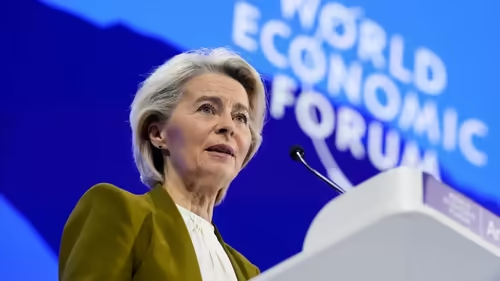
At the World Economic Forum in Davos, a phrase sent ripples through the global political and financial elite: “US-free Europe.” But it wasn’t a call for isolationism. Instead, European Commission President Ursula von der Leyen used a powerful historical parallel—the 1971 ‘Nixon shock’—to issue a clarion call for a new kind of European sovereignty. Her message was clear: the current era of geopolitical chaos isn’t just a threat; it’s an unprecedented opportunity for the EU to seize its own destiny.
Table of Contents
- What Was the 1971 Nixon Shock?
- Von der Leyen’s Davos Message: From History to a New Future
- Defining the ‘US-Free Europe’ Vision
- The Pillars of European Strategic Autonomy
- Conclusion: A New Bretton Woods Moment for Europe?
- Sources
What Was the 1971 Nixon Shock?
To understand von der Leyen’s warning, we must first travel back to August 15, 1971. In a stunning, unilateral move, U.S. President Richard Nixon announced a series of economic measures that instantly reshaped the global financial order. This event became known as the Nixon shock.
The core of his action was the cancellation of the direct international convertibility of the US dollar to gold, effectively ending the Bretton Woods system that had governed international finance since the end of World War II . This system had pegged global currencies to the dollar, which was itself backed by gold. Overnight, the world shifted to a system of floating exchange rates.
For America’s allies, particularly in Europe, this was a profound betrayal. Their economies were deeply intertwined with the US, and the sudden devaluation of the dollar and the imposition of a 10% import surcharge created immediate economic turmoil . The lesson was seared into European memory: over-reliance on a single, dominant power is a critical vulnerability.
Von der Leyen’s Davos Message: From History to a New Future
Standing in Davos in 2026, von der Leyen looked at a world facing its own set of cascading crises—supply chain fragility, energy insecurity, and great power competition—and saw a mirror of 1971. She argued that just as the Nixon shock forced a global economic reset, today’s disruptions are a catalyst for Europe to fundamentally restructure its dependencies .
Her speech wasn’t about severing ties with the United States out of animosity. Instead, it was a pragmatic and urgent plea for what she termed a new form of European strategic autonomy. “Europe has everything it takes,” she declared, urging the continent to mobilize its own resources and industrial capacity to become a more sovereign and resilient global actor .
Defining the ‘US-Free Europe’ Vision
So, what does a “US-free Europe” actually mean? It’s a provocative term, but its intent is strategic, not emotional. It doesn’t envision a Europe that is anti-American or isolated from the world. Rather, it describes a Europe that is no longer dependent on the US for its core strategic needs.
This vision is built on the principle that the EU must be able to act independently in key areas, ensuring its security, economic stability, and technological future are in its own hands. As one analysis puts it, strategic autonomy is about “the ability to act autonomously, to rely on one’s own resources in key strategic areas” while remaining open to global cooperation .
The Pillars of European Strategic Autonomy
Von der Leyen’s call for a ‘US-free Europe’ rests on several concrete pillars that are already being actively developed by the EU:
- Critical Minerals & Raw Materials: Reducing reliance on external suppliers (including the US and its allies) for the minerals essential for green tech and defense. The goal is to build a secure, internal European supply chain .
- Defense & Security: Accelerating the development of a credible European defense industry and command structure, so that Europe can protect its own interests without always waiting for a US-led NATO response .
- Financial Sovereignty: Promoting the use of the Euro in international trade and developing independent European payment systems to reduce exposure to the US-dominated SWIFT network and potential sanctions.
- Technology & Digital Infrastructure: Investing heavily in homegrown semiconductor production, AI, and cloud computing to avoid dependence on American (or Chinese) tech giants for critical digital infrastructure .
This comprehensive approach shows that the EU’s ambition is not a simple trade policy shift but a fundamental re-engineering of its place in the world order.
Conclusion: A New Bretton Woods Moment for Europe?
Ursula von der Leyen’s invocation of the Nixon shock is more than a historical footnote; it’s a strategic blueprint. By reminding the world of a moment when US unilateralism upended the global system, she is making a powerful case for why Europe must now build its own fortress of resilience. The path to a ‘US-free Europe’ is not about building walls, but about laying stronger, independent foundations. In a world where the old certainties are crumbling, von der Leyen is betting that Europe’s future lies not in dependence, but in its own sovereign strength. This is not just a political project; it’s an existential one for the European Union.
Sources
- World Economic Forum. “Special Address by the President von der Leyen: World Economic Forum Annual Meeting 2026.” [INTERNAL_LINK:davos-2026-key-takeaways]
- Office of the Historian, U.S. Department of State. “Nixon and the End of the Bretton Woods System, 1971–1973.” https://history.state.gov/milestones/1969-1976/nixon-shock
- European Trade Union Institute (ETUI). “Europe’s open strategic autonomy.” https://www.etui.org/
- Times of India. “US free Europe? EU chief Leyen invokes 1971 ‘Nixon shock’ in Davos; what it means.” https://timesofindia.indiatimes.com/world/europe/us-free-europe-eu-chief-leyen-invokes-1971-nixon-shock-in-davos-what-it-means/articleshow/126926281.cms