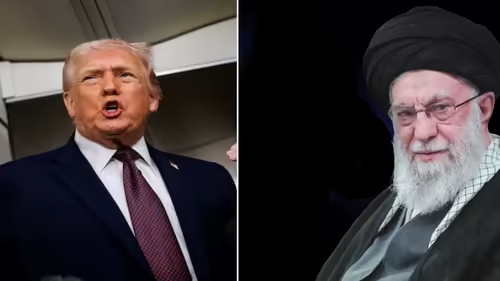
The war of words between Washington and Tehran has just entered a dangerous new phase. Former U.S. President Donald Trump has issued a stark, apocalyptic warning to Iran: if the Islamic Republic is involved in any plot to assassinate him, America will “wipe them out.” This explosive statement came just hours after Iran’s Supreme Leader, Ayatollah Ali Khamenei, delivered a chilling counter-threat: “We will cut that hand.”
This high-stakes exchange—part bluster, part brinkmanship—has reignited fears of a full-blown confrontation between two longtime adversaries. At the heart of this crisis is the volatile dynamic of Trump vs Khamenei, a clash not just of nations but of personalities, ideologies, and decades of mutual distrust.
Table of Contents
- The Trigger: Assassination Fears and Red Lines
- Trump vs Khamenei: A History of Hostility
- What Does “Wipe Them Out” Mean? Military Implications
- Khamenei’s Response: Symbolism and Strategy
- Global Reactions and Diplomatic Fallout
- Could This Lead to War? Assessing the Risk
- Conclusion: Rhetoric or Reality?
- Sources
The Trigger: Assassination Fears and Red Lines
According to multiple reports, Trump recently told aides and supporters that he has given explicit instructions to his inner circle: if intelligence confirms Iran’s involvement in any assassination attempt against him, the U.S. military should respond with overwhelming force—enough to effectively “obliterate” the Iranian regime .
This isn’t idle chatter. In 2024, U.S. intelligence agencies reportedly uncovered an Iranian-linked plot targeting Trump during his campaign rallies. While details remain classified, the incident appears to have deeply unsettled the former president, who now views Tehran as a direct personal threat—not just a geopolitical rival.
Iran, for its part, denies any such plot. But its leadership didn’t back down. Instead, Ayatollah Khamenei issued a rare public rebuke, stating: “If anyone dares to raise a hand against Iran’s dignity, we will cut that hand.” The message was clear: threats against Iran’s sovereignty—or its leaders—will be met with severe consequences.
Trump vs Khamenei: A History of Hostility
The animosity between Trump and Khamenei didn’t start yesterday. It dates back to Trump’s first term, when he unilaterally withdrew the U.S. from the 2015 Iran nuclear deal (JCPOA) in 2018—a move that Khamenei called a “betrayal.”
Things escalated dramatically in January 2020, when a U.S. drone strike killed Iranian General Qasem Soleimani near Baghdad Airport. Trump framed it as a preemptive act against terrorism; Khamenei called it “state-sponsored murder” and vowed revenge. Iran responded with missile strikes on U.S. bases in Iraq, bringing the two countries to the brink of war.
Now, with Trump potentially returning to the White House in 2026, these old wounds are being reopened—with even more personal stakes.
What Does “Wipe Them Out” Mean? Military Implications
When Trump says “wipe them out,” what does that actually entail? Experts warn it could signal a range of actions:
- Decapitation strikes targeting Iran’s leadership, including the Revolutionary Guard Corps (IRGC) and possibly even Khamenei himself.
- Massive cyberattacks
- Airstrikes on nuclear sites
- Naval blockade
Any of these actions would likely trigger a regional war, drawing in Israel, Saudi Arabia, Hezbollah, and possibly Russia. The economic fallout—especially on global oil prices—would be immediate and severe.
Khamenei’s Response: Symbolism and Strategy
Khamenei’s phrase—“We will cut that hand”—is steeped in Persian and Islamic symbolism. It echoes Quranic verses about justice and retribution, and it’s a common idiom in Iranian political discourse meaning to decisively neutralize a threat.
But beyond rhetoric, Iran has real capabilities:
- Its proxy network spans Lebanon (Hezbollah), Iraq, Yemen (Houthis), and Syria.
- It can disrupt shipping in the Persian Gulf using fast attack boats and mines.
- It possesses ballistic missiles capable of reaching U.S. bases across the Middle East.
Khamenei’s goal isn’t necessarily to start a war—but to deter one. By projecting strength and unpredictability, he hopes to convince Washington that the cost of aggression is too high.
Global Reactions and Diplomatic Fallout
The international community has reacted with alarm. The European Union called for “maximum restraint,” while China urged both sides to “avoid inflammatory language.” Even traditional U.S. allies like the UK and Germany expressed concern over the potential for miscalculation.
Notably, the current Biden administration has distanced itself from Trump’s comments, calling them “unhelpful” to ongoing diplomatic efforts. However, with Trump leading in several 2026 election polls, foreign capitals are already preparing for a possible return of his “maximum pressure” policy toward Iran.
Could This Lead to War? Assessing the Risk
While full-scale war remains unlikely, the risk of a limited conflict has increased significantly. Both leaders operate within domestic political contexts that reward toughness:
- Trump needs to project strength to his base ahead of the 2026 election.
- Khamenei faces internal pressure from hardliners to stand firm against U.S. “arrogance.”
History shows that personal animosity between leaders can accelerate crises. The danger lies in a single incident—an intercepted drone, a misread signal, a rogue actor—that spirals out of control before diplomats can intervene.
Conclusion: Rhetoric or Reality?
The Trump vs Khamenei showdown is a high-wire act of nuclear-age brinkmanship. While much of the language is performative—designed for domestic audiences and strategic signaling—the underlying threat is real. In a region already simmering with tension, words can become weapons. And in this volatile game, the world can only hope that cooler heads prevail before the next tweet or fatwa turns rhetoric into reality.
Sources
- Times of India: Trump vs Khamenei: US president’s ‘wipe them off’ warning to Tehran’s ‘will cut that hand’ threat
- BBC: Why the killing of Soleimani escalated US-Iran tensions
- Council on Foreign Relations: Timeline of U.S.-Iran Relations
- [INTERNAL_LINK:us-iran-nuclear-deal-explained]
- [INTERNAL_LINK:donald-trump-foreign-policy-legacy]