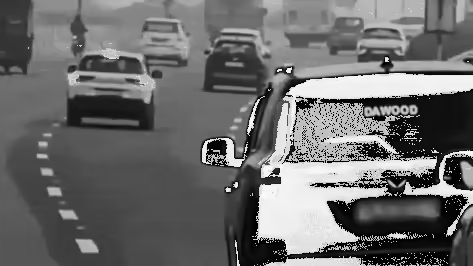
What started as a few seconds of online notoriety ended with handcuffs and a seized SUV. On January 18, 2026, a 21-year-old IGNOU student became the center of a major law enforcement operation after a video of his NH-48 reckless driving stunt went viral across social media platforms . The footage—showing him weaving erratically through dense highway traffic in a luxury SUV—didn’t just rack up views; it triggered immediate action from the Delhi Police, who tracked him down within days.
This incident isn’t just about one reckless driver. It’s a stark reminder of how social media fame can dangerously blur the line between thrill-seeking and criminal negligence—and why India’s new legal framework is stepping in to protect public safety on its roads.
Table of Contents
- The Viral Video That Sparked a Manhunt
- NH-48 Reckless Driving and the Legal Consequences
- Why National Highways Are No Place for Stunts
- How Social Media Fuels Dangerous Driving Trends
- What You Can Do to Promote Road Safety
- Conclusion: Accountability in the Age of Viral Content
- Sources
The Viral Video That Sparked a Manhunt
The now-infamous clip surfaced on January 18, showing a black SUV performing high-speed lane changes, cutting off trucks, and narrowly missing two-wheelers on NH-48—a critical artery connecting Delhi to Gurgaon and beyond. The driver, later identified as a 21-year-old male enrolled at Indira Gandhi National Open University (IGNOU), appeared to be filming the stunt himself, likely for social media clout .
Within hours, netizens flagged the video to authorities, citing extreme danger to other commuters. The Delhi Traffic Police acted swiftly, using vehicle registration details and digital forensics to locate the suspect. By January 20, he was in custody, and his SUV was impounded under Section 187 of the Motor Vehicles Act .
NH-48 Reckless Driving and the Legal Consequences
This case marks one of the first high-profile applications of the newly implemented Bharatiya Nyaya Sanhita (BNS), which replaced parts of the Indian Penal Code in 2024. Under Section 106 of the BNS, “endangering the personal safety of others” through rash or negligent driving can lead to imprisonment of up to three months, a fine of ₹1,000, or both .
Additionally, the accused faces charges under:
- Section 184 of the Motor Vehicles Act: Driving at a speed or in a manner dangerous to the public—punishable by up to six months in jail and/or a fine of ₹1,000–₹5,000 for first-time offenders.
- Section 187 of the MV Act: Refusing to provide vehicle documents—leading to vehicle seizure, as seen in this case.
Repeat offenders could face steeper penalties, including license suspension and mandatory community service. For more on evolving traffic laws, see our guide on [INTERNAL_LINK:india-new-traffic-laws-2026].
Why National Highways Are No Place for Stunts
NH-48 is not a racetrack—it’s a lifeline. Stretching over 2,800 kilometers from Delhi to Chennai, it carries thousands of vehicles daily, including heavy freight, school buses, and emergency services. Erratic maneuvers like those captured in the video don’t just risk the driver’s life; they create chain-reaction hazards that can lead to multi-vehicle pileups.
According to the Ministry of Road Transport and Highways, over 150,000 people died in road accidents in India in 2023 alone, with speeding and reckless driving cited as leading causes . National highways account for nearly 40% of all fatal crashes, despite making up only 2% of the country’s road network.
How Social Media Fuels Dangerous Driving Trends
The rise of short-form video platforms has created a disturbing subculture of “stunt driving” content. From drifting on empty streets to weaving through traffic at high speeds, young drivers often post these clips seeking likes, shares, and followers—without considering the real-world consequences.
Platforms like Instagram Reels and YouTube Shorts have algorithms that reward sensational content, inadvertently encouraging risky behavior. In several recent cases—including one in Bengaluru where a teen died attempting a TikTok challenge—online virality has preceded tragedy .
Experts warn that without stronger platform accountability and digital literacy education, such incidents will continue to rise. Parents and educators must engage with young drivers about the difference between online performance and real-life responsibility.
What You Can Do to Promote Road Safety
Road safety is a shared responsibility. Here’s how you can help:
- Report Reckless Driving: If you see dangerous behavior, note the vehicle number and report it to local traffic police or via the NTCP (National Traffic Control Portal).
- Don’t Share Stunt Videos: Refrain from liking or sharing videos that glorify risky driving—it reduces their algorithmic reach.
- Educate Young Drivers: Talk to teens and young adults about defensive driving and the legal consequences of negligence.
- Use Dashcams Responsibly: While dashcams can provide evidence, never use them to stage or encourage dangerous scenarios.
For authoritative guidance on safe driving practices, refer to the official resources from the Ministry of Road Transport and Highways.
Conclusion: Accountability in the Age of Viral Content
The arrest of the IGNOU student over his NH-48 reckless driving video sends a clear message: thrill-seeking at the expense of public safety will not be tolerated. With the Bharatiya Nyaya Sanhita now in force, authorities have stronger tools to hold offenders accountable—not just for the damage they cause, but for the fear they instill in everyday commuters.
As citizens, we must also take responsibility. By refusing to normalize dangerous behavior online and supporting stricter enforcement, we can turn our roads from zones of risk into corridors of safety. One viral video shouldn’t cost lives—or freedom.
Sources
- Times of India: Delhi Police arrests youth over viral NH-48 driving video
- PRS India: Bharatiya Nyaya Sanhita, 2023 – Key Provisions
- Ministry of Road Transport and Highways: Road Safety Annual Report 2023
- NDTV: Social Media Challenges Turn Deadly for Indian Teens