Table of Contents
- Cricket Star in the Electoral Spotlight
- What is an ‘Unmapped Voter’ and Why is it a Big Deal?
- Md Shami Voter Hearing: A Public Affirmation of Citizenship
- The Special Intensive Revision (SIR) Process Explained
- Shami’s Stellar Career: A Quick Recap
- Broader Implications for West Bengal Voters
- Conclusion: More Than Just a Cricket Story
- Sources
Cricket Star in the Electoral Spotlight
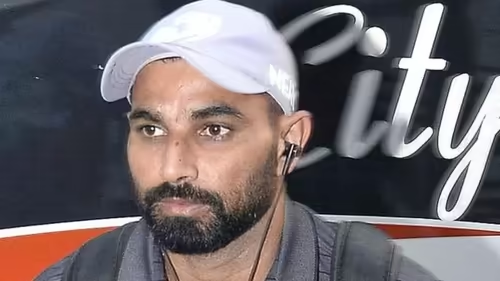
When you think of Md Shami, you picture a lethal yorker, a match-winning spell, or his incredible tally of 462 wickets for India across all formats. You don’t typically imagine him sitting in a civic office in Kolkata, presenting his passport to prove he belongs. Yet, that’s exactly what happened recently, thrusting the cricket star into the heart of a complex electoral verification process known as the Special Intensive Revision (SIR).
This story is not just about a famous athlete; it’s a window into a bureaucratic process affecting millions of ordinary citizens in West Bengal. Shami’s case has become a powerful symbol of the challenges many face in proving their most fundamental right: their citizenship and their vote.
What is an ‘Unmapped Voter’ and Why is it a Big Deal?
The term ‘unmapped voter‘ sounds technical, but its implications are deeply personal. According to the Election Commission of India, this category refers to voters whose names, or the names of their parents, could not be successfully linked or “mapped” to the digitized version of the 2002 electoral rolls—the baseline document for current voter lists .
This can happen for a variety of innocent reasons: a spelling discrepancy in a parent’s name, a change in address over two decades, or even a simple data entry error during the massive digitization effort. However, being flagged as ‘unmapped’ puts your current voter registration at risk, requiring you to go through a formal verification hearing to retain your voting rights.
The scale of this issue is enormous. In West Bengal alone, over 11,000 such hearings were scheduled, impacting a significant portion of the electorate . This has naturally led to political controversy and public concern, with the process being temporarily paused due to reported technical issues with the 2002 rolls .
Md Shami Voter Hearing: A Public Affirmation of Citizenship
Shami, a registered voter in Kolkata Municipal Corporation’s Ward No. 93, was summoned for one of these SIR hearings alongside his brother, Mohammed Kaif [[1], [7]]. The reason? Discrepancies in his voter enumeration form that left him categorized as ‘unmapped’ [[3], [5]].
On January 20, 2026, the Indian pacer appeared before the officials at Swarnamoyee Vidyalaya in Kolkata [[8], [9]]. He didn’t come empty-handed. To validate his identity and his deep roots in the community, Shami brought along his passport and other official documents .
His message was clear and resolute. “I am a proud Indian and Bengal citizen. If called 10 times I will come and prove my citizenship on every single occasion,” he declared to the media, turning a bureaucratic procedure into a powerful public statement of his belonging . This wasn’t just about clearing a formality; it was about defending his identity and his right to participate in the world’s largest democracy.
The Special Intensive Revision (SIR) Process Explained
The SIR is a critical, albeit often contentious, part of the Election Commission’s mandate to maintain a clean and accurate electoral roll. It’s a special door-to-door enumeration drive aimed at identifying new eligible voters, updating records for those who have moved, and verifying the status of existing voters—especially those in the ‘unmapped’ category.
Here’s a quick breakdown of how it works for someone like Shami:
- Flagging: A voter’s record is flagged due to a mismatch with the 2002 baseline data.
- Notice: The individual receives an official notice from the Booth Level Officer (BLO) to appear for a hearing.
- Hearing: The voter must present themselves at a designated location with valid proof of identity, address, and relationship (like a birth certificate or passport).
- Verification & Inclusion: If the documents are satisfactory, the voter’s name is confirmed for inclusion in the final electoral roll.
While the goal is accuracy, the process has been criticized for potentially disenfranchising legitimate voters due to historical data inconsistencies.
Shami’s Stellar Career: A Quick Recap
Before this electoral chapter, Shami had already cemented his legacy on the cricket field. His career stats are a testament to his skill and consistency:
- Test Cricket: 229 wickets at an average of 27.71 .
- ODI Cricket: 206 wickets at an impressive average of 24.05 .
- World Cup Heroics: He holds the record for the most wickets by an Indian bowler in a single World Cup edition (24 in 2023) [[11], [15]].
His 462 international wickets make him one of India’s most successful fast bowlers ever. His dedication to his sport is now mirrored in his dedication to his civic duty, showing a different kind of strength and resolve.
Broader Implications for West Bengal Voters
Shami’s high-profile case has shone a national spotlight on the SIR process in West Bengal. While he had the resources and platform to navigate the system publicly, countless ordinary citizens may find the process daunting and confusing.
The controversy has sparked a wider debate about the reliability of using a 24-year-old document as the sole arbiter of current citizenship. The Election Commission has acknowledged the challenges, even halting hearings temporarily to address technical glitches . For many, this situation underscores the delicate balance between ensuring electoral integrity and protecting the fundamental democratic right to vote for every eligible citizen.
Conclusion: More Than Just a Cricket Story
The story of the Md Shami voter hearing transcends sports. It’s a human story about identity, belonging, and the sometimes-frustrating intersection of bureaucracy and personal rights. Shami’s willingness to stand up and prove his citizenship, not once but as many times as needed, is a powerful reminder of the value we should all place on our democratic participation. His case serves as both a cautionary tale about systemic data issues and an inspiring example of civic responsibility. For more on civic engagement in India, see our guide on [INTERNAL_LINK:voter-registration-process-india].
Sources
- Times of India: “Md Shami, with 462 wickets for India, falls in line for SIR”
- Election Commission of India announcements on SIR process.
- Various news reports from January 2026 on Shami’s hearing [[1], [3], [5], [6], [7], [8], [9]].
- ICC and ESPN Cricinfo for career statistics [[11], [13], [15], [16]].
- Reports on the ‘unmapped voter’ definition and SIR scale in West Bengal [[20], [21], [25]].