Table of Contents
- Unprecedented Move in Kerala Assembly
- What Was Omitted from the Kerala CM Policy Speech?
- The Constitutional Standoff Explained
- Political Fallout and Public Reaction
- Conclusion: A Deepening Constitutional Crisis?
- Sources
Unprecedented Move in Kerala Assembly
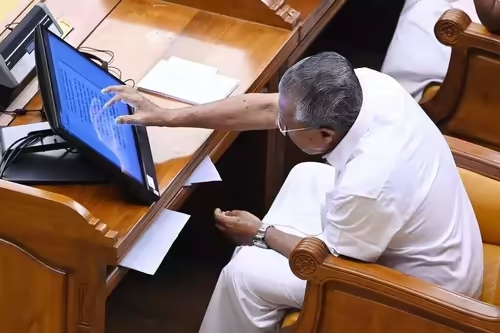
In a dramatic and highly unusual scene at the Kerala Legislative Assembly, Chief Minister Pinarayi Vijayan took to the floor to personally read out portions of the state government’s official Kerala CM policy speech that had been left out by Governor Rajendra Arlekar. This direct intervention by the head of the elected government underscores a deepening rift between the state executive and the gubernatorial office, raising serious questions about constitutional propriety and the autonomy of a democratically elected administration .
The incident occurred immediately after the Governor concluded his customary address to the first session of the new year. The CM’s action was not just a procedural correction but a powerful political statement, highlighting what the state government perceives as a deliberate attempt to silence its critique of the Union government.
What Was Omitted from the Kerala CM Policy Speech?
The omitted sections were far from trivial. According to the Chief Minister, the Governor skipped critical parts of the cabinet-approved, 112-minute-long speech that contained pointed criticisms of the BJP-led central government. These omissions were not random; they specifically targeted content that was politically sensitive .
The key missing portions included:
- Criticism of Central Government’s Fiscal Policy: A section that detailed how the financial policies of the Union government have placed “severe fiscal stress” on Kerala, despite the state’s strong social and institutional achievements [[19], [21]].
- Delay in Bill Approvals: A crucial part of paragraph 15, which stated that bills passed by the Kerala state legislature “have remained pending for prolonged periods” with the central government, awaiting the President’s assent [[7], [10]].
- Specific Grievances: The beginning of paragraph 12 and the end of paragraph 15 were entirely left out, which the CM’s office confirmed contained the most direct critiques .
This selective editing by the Governor effectively sanitized the government’s official stance, presenting a version of the Kerala CM policy speech that was more palatable to the Centre but fundamentally at odds with the cabinet’s approved message .
The Constitutional Standoff Explained
At the heart of this controversy is a long-standing constitutional debate. The Governor’s address to the state assembly is, by convention, a verbatim reading of the speech prepared and approved by the state cabinet. The Governor, as the ceremonial head of state, is expected to act on the aid and advice of the council of ministers. Any deviation from the approved text is seen as a breach of this constitutional norm and an overreach of gubernatorial power .
The Kerala government argues that the Governor’s unilateral modifications constitute a direct interference in the executive functions of the elected government. This is not an isolated incident; it reflects a broader pattern of tension between several non-BJP state governments and their Governors, who are appointed by the Union government. For more on the role of Governors in India’s federal structure, see this analysis from The Hindu.
The opposition leader, V.D. Satheesan, also supported the CM’s stance, stating that the Governor’s actions were inappropriate and undermined the democratic process . This rare show of unity across party lines in Kerala highlights the gravity of the situation.
Political Fallout and Public Reaction
The fallout from this event has been swift and significant. The ruling LDF has accused the Governor of acting as a political agent of the Centre rather than an impartial constitutional authority. They have framed the omissions as an attempt to suppress the state’s legitimate grievances on a national platform.
On the other hand, the Raj Bhavan (Governor’s office) has defended its actions, though specific justifications for the omissions have been vague. In past instances, Governors have cited reasons like “half-truths” or “inappropriate content,” but these claims are often disputed by the state government .
This incident has ignited a fierce public debate on social media and in the press, with citizens questioning the independence of the Governor’s office. The controversy over the Kerala CM policy speech has become a flashpoint in the larger national conversation about federalism and states’ rights. It also serves as a critical case study for anyone interested in [INTERNAL_LINK:indian-politics] or [INTERNAL_LINK:federalism-in-india].
Conclusion: A Deepening Constitutional Crisis?
The events in the Kerala Assembly are more than just a political spat; they represent a fundamental challenge to the principles of cooperative federalism. By omitting key criticisms from the cabinet-approved Kerala CM policy speech, the Governor has forced a confrontation that tests the boundaries of his constitutional role. Chief Minister Pinarayi Vijayan’s decision to read the omitted sections aloud was a bold assertion of his government’s mandate and a defense of its right to communicate its agenda without censorship. As this standoff continues, it will be closely watched by other states facing similar tensions, potentially setting a precedent for how such conflicts are managed in India’s complex democratic framework.