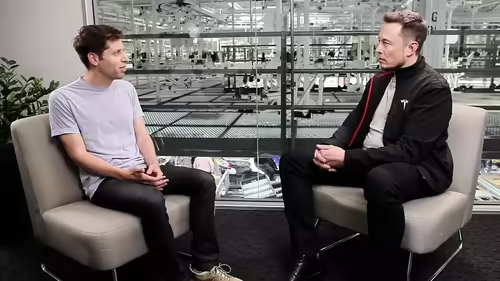
The tech world is witnessing a heavyweight showdown that’s equal parts philosophical and deeply personal. In a series of sharp public exchanges, Elon Musk and Sam Altman have reignited their long-simmering rivalry, this time centering on a critical question: who is more responsible for real-world harm—AI chatbots or autonomous driving systems? The Musk vs Altman feud has moved beyond boardroom politics and into the court of public opinion, forcing a global conversation about the ethics, safety, and accountability of cutting-edge technology .
Table of Contents
- The Spark: Musk’s Accusation Against ChatGPT
- Altman’s Retort: The Tesla Autopilot Counter
- Understanding the Musk vs Altman Rivalry
- ChatGPT Safety Measures: What OpenAI Claims
- Tesla Autopilot Fatalities: The Known Data
- The Bigger Picture: AI Ethics and Accountability
- Conclusion: A Cautionary Tale for the AI Era
- Sources
The Spark: Musk’s Accusation Against ChatGPT
Elon Musk, a co-founder of OpenAI who later became one of its most vocal critics, took to social media to claim that OpenAI’s flagship product, ChatGPT, had been linked to multiple deaths . While he didn’t provide specific case details, his implication was clear: the AI system, in its current form, poses a tangible, life-threatening risk to users. This accusation struck at the heart of OpenAI’s mission to build safe and beneficial AI.
Altman’s Retort: The Tesla Autopilot Counter
Sam Altman, OpenAI’s CEO, didn’t take the bait lying down. In a pointed response, he accused Musk of staggering hypocrisy. Altman highlighted the well-documented history of fatalities involving Tesla vehicles operating on Autopilot and Full Self-Driving (FSD) beta features . His message was direct: if we’re going to tally deaths linked to technology, let’s start with the cars you sell. This counter-accusation shifted the debate from abstract AI risks to concrete, real-world incidents with verified data.
Understanding the Musk vs Altman Rivalry
This isn’t just a random spat. The Musk vs Altman conflict has deep roots. Musk left OpenAI’s board in 2018, citing potential conflicts of interest with his work at Tesla. Since then, he has repeatedly criticized OpenAI for abandoning its original non-profit, open-source ethos in favor of a closed, profit-driven model under Microsoft’s influence . For Musk, this fight is as much about corporate philosophy and control over the future of AI as it is about safety.
ChatGPT Safety Measures: What OpenAI Claims
In defense of its platform, OpenAI has consistently emphasized its robust safety protocols. Altman acknowledged the immense challenge of balancing powerful capabilities with user protection. The company employs a multi-layered approach:
- Content Moderation Filters: To block requests for illegal, harmful, or unethical content.
- Red Teaming: Employing external experts to deliberately try and break the AI’s safety systems before public release.
- User Feedback Loops: Allowing users to report problematic outputs to continuously improve the model.
Altman maintains that while no system is perfect, OpenAI is committed to an iterative process of making its models safer with each update .
Tesla Autopilot Fatalities: The Known Data
The National Highway Traffic Safety Administration (NHTSA) has been investigating Tesla’s driver-assistance systems for years. Their reports have documented dozens of crashes, many of them fatal, where Autopilot or FSD was suspected to be in use . These are not allegations but incidents under formal federal investigation. The core issue is that these systems are Level 2 driver aids, requiring constant human supervision, yet their marketing and user experience can sometimes create a false sense of security—a phenomenon known as “automation complacency” .
The Bigger Picture: AI Ethics and Accountability
Beyond the personal jabs, this feud highlights a fundamental gap in our regulatory landscape. Who is liable when an AI system gives bad advice that leads to harm? How do we ensure transparency in complex algorithms? And how do we hold companies accountable for technologies that evolve faster than our laws? These are questions that neither Musk nor Altman can answer alone. They require a collaborative effort from governments, industry leaders, and civil society. For a deeper understanding of the ethical frameworks being developed for AI, resources from organizations like the Partnership on AI offer valuable insights.
Conclusion: A Cautionary Tale for the AI Era
The Musk vs Altman clash is more than a celebrity tech feud; it’s a stark warning. As we integrate powerful AI into every facet of our lives—from our cars to our conversations—we must establish clear guardrails. Both leaders, despite their acrimony, are building technologies with profound societal impacts. The real winner in this debate won’t be Musk or Altman, but the public, if this public spectacle finally spurs serious, thoughtful regulation and a shared commitment to building technology that serves humanity, not the other way around.
Sources
- Times of India: Musk vs Altman: CEOs fight over ChatGPT, Tesla deaths; OpenAI defends user safeguards
- National Highway Traffic Safety Administration (NHTSA): Investigations into Tesla Autopilot
- Partnership on AI: AI Safety and Ethics Guidelines