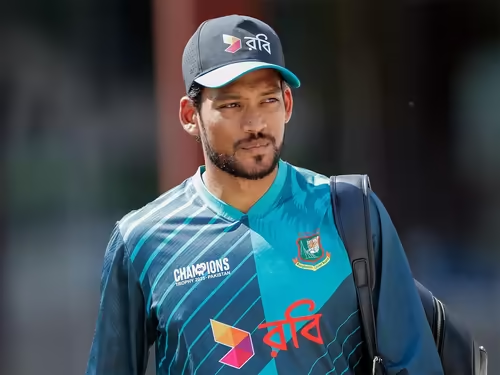
“We want to play.”
These four simple words—spoken by Bangladesh’s captain and star batter Najmul Hossain Shanto—carry the weight of a nation’s sporting dreams and the frustration of athletes caught in a geopolitical crossfire. As the T20 World Cup Bangladesh participation hangs in the balance, the players’ heartfelt plea stands in stark contrast to the hardline stance of their own board.
The Bangladesh Cricket Board (BCB) has publicly refused to send its team to India for the upcoming ICC Men’s T20 World Cup 2026, citing unresolved diplomatic and security concerns. But behind closed doors, the players are reportedly devastated. For them, this isn’t about politics—it’s about passion, pride, and the rare chance to compete on cricket’s biggest T20 stage.
Table of Contents
- The Players’ Emotional Plea: Caught Between Duty and Desire
- Why the BCB Is Refusing to Play in India
- The ICC’s Tightrope Walk: What Happens Next?
- Historical Context: Bangladesh-India Cricket Relations
- Fan Outrage and Public Opinion in Bangladesh
- Conclusion: Can Cricket Rise Above Politics?
The Players’ Emotional Plea: Caught Between Duty and Desire
In a rare public intervention, Najmul Hossain Shanto broke his silence to express the collective sentiment of the squad. “Every cricketer dreams of playing in a World Cup,” he said in a recent interview. “We’ve trained hard, we’re ready, and we want to represent Bangladesh. We hope a solution is found.”
This statement is significant. Captains rarely speak out when official boards are engaged in sensitive negotiations. Shanto’s words suggest mounting pressure from within the dressing room—and perhaps a fear that their careers could be defined by a tournament they never got to play.
For many in the current squad—including young stars like Towhid Hridoy and Tanzid Hasan—this might be their only shot at a T20 World Cup. With aging legends like Shakib Al Hasan possibly nearing the end of their international careers, the stakes couldn’t be higher.
Why the BCB Is Refusing to Play in India
The BCB’s position stems from broader bilateral tensions between Dhaka and New Delhi. While no official reason has been detailed publicly, sources indicate concerns over:
- Lack of direct government-to-government clearance for the tour
- Unresolved issues from past bilateral series (including visa delays and security protocols)
- Domestic political pressure in Bangladesh to take a firm stance on India-related engagements
Notably, the BCB has not ruled out participation entirely. Instead, it insists that any decision must come with “full assurance” from both the ICC and the Indian government—a condition that complicates the ICC’s efforts to finalize logistics .
The ICC’s Tightrope Walk: What Happens Next?
The International Cricket Council (ICC) is now in a race against time. The T20 World Cup 2026 is scheduled to begin in early June, and group allocations, broadcast schedules, and ticket sales hinge on confirmed participants.
If Bangladesh officially withdraws, the ICC would likely replace them with the next highest-ranked non-qualified team—possibly Scotland or the Netherlands. But such a move would trigger financial penalties for the BCB and damage Bangladesh’s standing in global cricket governance.
According to ICC regulations, member boards are contractually obligated to participate in World Cups unless granted exceptional exemption. A unilateral withdrawal could even lead to suspension—a scenario neither side wants, but one that remains on the table .
For authoritative updates on global cricket governance, the ICC’s official website remains the primary source.
Historical Context: Bangladesh-India Cricket Relations
Cricket between India and Bangladesh has long been more than just sport. From Bangladesh’s historic 2007 World Cup win over India to their tense 2015 and 2019 encounters, matches carry immense emotional and nationalistic weight.
Yet, bilateral series have often been disrupted by politics. In 2023, a proposed white-ball tour was postponed due to scheduling conflicts—but insiders cited “unofficial hesitations” from both sides. Now, with the World Cup hosted entirely in India, the issue has escalated from logistical to existential for Bangladeshi players [INTERNAL_LINK:bangladesh-india-cricket-rivalry-history].
Fan Outrage and Public Opinion in Bangladesh
Back home, public opinion is overwhelmingly in favor of participation. Social media in Bangladesh is flooded with hashtags like #LetUsPlay and #ShantoVoiceOfPlayers, with fans accusing the BCB of “sacrificing players’ careers for politics.”
Former cricketers have also weighed in. Ex-captain Mashrafe Mortaza urged the board to “separate sport from statecraft,” while coach Chandika Hathurusingha emphasized that “the team is mentally and physically prepared.”
Conclusion: Can Cricket Rise Above Politics?
The T20 World Cup Bangladesh dilemma is a microcosm of a larger global challenge: can sport remain a unifying force in an increasingly fragmented world? The players’ plea—“We want to play”—is a reminder that behind every jersey is a human being whose life’s work is on hold.
As the ICC prepares to make its final decision in the coming days, all eyes are on Dhaka and Dubai. One hopes that cooler heads prevail—not for diplomacy’s sake, but for the sake of the game, and the dreams of those who’ve dedicated their lives to it.
Sources
- Times of India – “We want to play”: Star Bangladesh batter voices players’ plea: https://timesofindia.indiatimes.com/sports/cricket/icc-mens-t20-world-cup/we-want-to-play-star-bangladesh-batter-voices-players-plea-as-t20-world-cup-standoff-deepens/articleshow/126945024.cms
- International Cricket Council (ICC) – Official Regulations and Statements: https://www.icc-cricket.com/
- Bangladesh Cricket Board (BCB) Press Releases (January 2026)
- ESPNcricinfo – Analysis of Bangladesh-India Cricket Relations