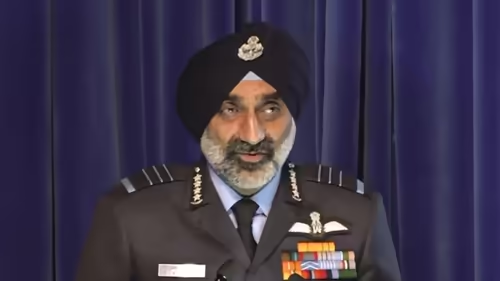
“Air power did the trick.”
These five words, spoken by Air Chief Marshal A.P. Singh—the head of the Indian Air Force (IAF)—carry immense strategic weight. In a recent address that has sent ripples through defense and geopolitical circles, the IAF chief didn’t just praise aerial warfare; he confirmed its decisive role in one of India’s most sensitive military operations: striking multiple targets inside Pakistan within mere hours.
This isn’t just rhetoric. It’s a clear signal about India’s evolving doctrine of rapid retaliation and the central role the IAF chief on air power envisions for the skies in 21st-century conflict. As tensions simmer in South Asia, understanding this shift is critical—not just for defense analysts, but for every citizen invested in national security.
Table of Contents
- The IAF Chief’s Bold Claim: Speed, Precision, and Deterrence
- What Exactly Is ‘Air Power’—And Why Does It Matter?
- Historical Context: From Balakot to Today
- How the IAF Built This Capability
- Strategic Implications for India-Pakistan Relations
- Conclusion: The Future of Warfare is in the Skies
The IAF Chief’s Bold Claim: Speed, Precision, and Deterrence
Speaking at a high-level defense seminar, Air Chief Marshal A.P. Singh emphasized that modern warfare no longer hinges on weeks of mobilization. “We can hit multiple targets across the border within hours,” he stated, underscoring the IAF’s readiness and operational tempo .
His comments weren’t limited to offensive strikes. He also highlighted air power’s versatility—its use in humanitarian evacuations (like Operation Ganga during the Ukraine crisis), disaster relief, and surveillance. But the core message was unambiguous: when it comes to deterrence and retaliation, air dominance is non-negotiable.
This statement aligns with India’s broader shift toward a “proactive” or “Cold Start”-adjacent doctrine—where rapid, calibrated responses replace slow, large-scale mobilizations that risk escalation .
What Exactly Is ‘Air Power’—And Why Does It Matter?
Air power isn’t just about fighter jets. It’s a complex ecosystem that includes:
- Strike aircraft (e.g., Rafale, Mirage 2000, Su-30MKI)
- Intelligence, Surveillance, and Reconnaissance (ISR) platforms like Netra AEW&C and Heron drones
- Aerial refueling tankers that extend mission range
- Electronic warfare systems to jam enemy radars
- Command and control networks for real-time coordination
Together, these assets allow a force like the IAF to detect, decide, and destroy with unprecedented speed. As the IAF chief noted, this integrated approach is what enables “swift, decisive outcomes”—the hallmark of modern military success.
Historical Context: From Balakot to Today
The most public demonstration of this doctrine came in February 2019, when the IAF conducted airstrikes on a Jaish-e-Mohammed camp in Balakot, Pakistan, in retaliation for the Pulwama terror attack. That operation—codenamed Operation Bandar—was the first time since 1971 that Indian jets crossed the Line of Control to strike deep inside Pakistani territory .
While details remain classified, reports suggest the mission was planned and executed in under 12 hours. The IAF chief’s latest remarks confirm that such capabilities have only improved since then. With the induction of Rafale jets, upgraded Mirage 2000s, and indigenous systems like the Astra missile, the IAF’s reach, accuracy, and survivability have dramatically increased [INTERNAL_LINK:indian-air-force-rafale-impact].
How the IAF Built This Capability
Over the past decade, the IAF has quietly transformed from a legacy force into a networked, multi-domain operator. Key milestones include:
- Rafale Acquisition (2020–2022): These 4.5-gen fighters brought standoff strike, nuclear delivery, and advanced electronic warfare to the IAF.
- Network-Centric Warfare: Integration of AWACS, ground radars, and fighter data-links enables real-time battlefield awareness.
- Indigenous Missiles: The Astra BVRAAM (Beyond Visual Range Air-to-Air Missile) reduces reliance on foreign arms.
- Drone Expansion: Plans for armed MQ-9B SeaGuardians and indigenous combat UAVs are accelerating.
According to a 2025 report by the Stockholm International Peace Research Institute (SIPRI), India is now the world’s third-largest military spender—much of it directed toward air and space capabilities .
Strategic Implications for India-Pakistan Relations
The IAF chief’s statement isn’t just about capability—it’s about messaging. By publicly confirming the ability to strike “within hours,” India is reinforcing its deterrence posture. The goal? To convince adversaries that any provocation will be met with immediate, disproportionate, and precise retaliation.
For Pakistan, this raises the stakes. Its own air force, while capable, faces challenges in early warning, electronic defense, and fleet modernization. The asymmetry in ISR and precision-guided munitions gives India a significant edge—a reality Islamabad cannot ignore.
However, experts caution that over-reliance on air power carries risks. Escalation control, civilian safety, and international perception remain critical constraints .
Conclusion: The Future of Warfare is in the Skies
Air Chief Marshal A.P. Singh’s declaration that “air power did the trick” is more than a soundbite—it’s a strategic manifesto. The IAF chief on air power has laid bare India’s commitment to maintaining a credible, rapid-response aerial deterrent.
As global conflicts increasingly hinge on speed, precision, and information dominance, the IAF’s evolution offers a blueprint for modern defense. For India, the sky isn’t the limit—it’s the frontline.
Sources
- Times of India – “It was air power that did the trick”: https://timesofindia.indiatimes.com/defence/it-was-air-power-that-did-the-trick-iaf-chief-says-attacked-pakistan-within-hours-hails-operational-capability/articleshow/126949265.cms
- Stockholm International Peace Research Institute (SIPRI) – Military Expenditure Database: https://www.sipri.org/
- Ministry of Defence, India – Annual Reports and Press Releases
- International Institute for Strategic Studies (IISS) – The Military Balance 2025