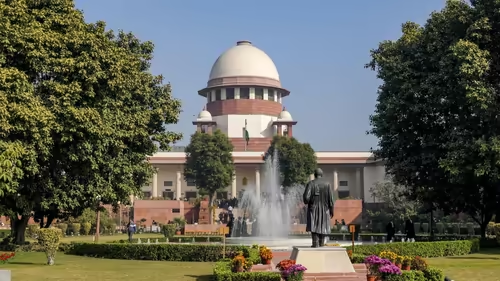
Supreme Court’s Strong Stand for the Punjab Kesari Press
In a decisive ruling that underscores the critical importance of a free press in a democracy, the Supreme Court of India has stepped in to protect the Punjab Kesari press from being shut down by the state government. The order, issued as an interim relief, is a powerful reminder that the business of journalism must not be held hostage over minor or disputed infractions.
The case has ignited a national conversation about the balance between regulatory compliance and the fundamental right to information. At the heart of the matter is a printing press in Ludhiana that was ordered closed by the Punjab Pollution Control Board (PPCB), a move that threatened to silence one of the region’s most prominent newspapers.
Table of Contents
- The Allegations and the Shutdown
- The Supreme Court’s Decisive Intervention
- Why the Press is Different: A Matter of Public Interest
- Broader Implications for Press Freedom in India
- What Happens Next?
- Conclusion
- Sources
The Allegations and the Shutdown
The trouble began when the Punjab Pollution Control Board moved to shut down a key Punjab Kesari press in Ludhiana. The official justification cited environmental violations. However, during the proceedings, it emerged that the discovery of a few liquor bottles on the premises was also part of the state’s rationale for the harsh action .
The newspaper’s legal team, led by senior advocate Mukul Rohatgi, argued that the presence of two bottles was a trivial matter and could not possibly warrant the closure of an entire newspaper operation that serves a vast readership. As Rohatgi pointedly asked the court, “Two bottles were found, and because of that you will close the paper?” .
This move was widely seen by media watchdogs and opposition parties as a politically motivated attempt to muzzle a critical voice, especially as the newspaper had recently published content unfavorable to the ruling Aam Aadmi Party (AAP) government in Punjab .
The Supreme Court’s Decisive Intervention
The Supreme Court, recognizing the gravity of the situation, acted swiftly. In a clear and unambiguous directive, the Chief Justice of India himself stated, “Don’t close the newspaper part,” effectively drawing a line between the newspaper’s journalistic function and any other ancillary businesses the group might run, such as a hotel, which the court deemed less critical .
The court granted interim relief to the publication, ordering the Bhagwant Mann-led Punjab government to allow the Punjab Kesari press to “continue to function uninterruptedly” . This order halts any coercive action by the state authorities until the matter can be heard in full by the Punjab and Haryana High Court, where a related petition is pending .
Why the Press is Different: A Matter of Public Interest
The Supreme Court’s reasoning highlights a foundational principle of democratic societies: the press is not just another business. It is a public utility, a fourth pillar of democracy tasked with informing citizens and holding power to account.
Shutting down a newspaper’s printing press has a direct and immediate impact on the public’s right to know. Unlike closing a factory or a hotel, which affects a limited set of stakeholders, silencing a newspaper deprives an entire community of its primary source of news and information.
The court’s distinction between the newspaper and the group’s other commercial ventures is a crucial legal precedent. It establishes that the core journalistic function must be shielded from actions that, while perhaps procedurally valid against a business, would have a chilling effect on free speech if applied to a news organization.
Broader Implications for Press Freedom in India
This case is more than just a win for one newspaper; it’s a significant victory for press freedom in India. It sends a strong message to state governments across the country that they cannot use regulatory bodies as a backdoor to target and intimidate media houses that are critical of their policies.
According to the Reporters Without Borders World Press Freedom Index, India’s ranking has been a subject of concern in recent years. The Supreme Court’s firm stance in the Punjab Kesari press case is a welcome counter-narrative, demonstrating that the highest judiciary remains a staunch defender of constitutional rights.
This ruling could set a powerful precedent for other media organizations facing similar pressures. It reinforces the idea that any action against a press entity must be proportionate, justified, and never used as a tool for political retribution.
What Happens Next?
While the immediate threat to the Punjab Kesari press has been averted, the legal battle is far from over. The underlying case regarding the alleged environmental violations and the presence of liquor bottles will now proceed in the Punjab and Haryana High Court.
Key questions that remain include:
- Will the High Court uphold the Supreme Court’s view on the sanctity of the press?
- What evidence will the PPCB present to justify its initial shutdown order?
- Could this case lead to new guidelines for how regulatory agencies interact with media organizations?
For now, the newspaper can continue its operations without fear of a sudden blackout, ensuring that its readers in Punjab and beyond remain informed.
Conclusion
The Supreme Court’s intervention to protect the Punjab Kesari press is a timely and necessary affirmation of press freedom. By prioritizing the public’s right to information over a disputed administrative penalty, the court has upheld a cornerstone of Indian democracy. This case serves as a stark reminder that a free and functioning press is non-negotiable, and any attempt to stifle it—under any pretext—will be met with the full force of judicial scrutiny. For anyone concerned about the health of our democracy, this ruling is a beacon of hope. To stay updated on other critical developments in Indian politics and governance, see our coverage on [INTERNAL_LINK:indian-politics].