Table of Contents
- The Standoff: Bangladesh’s Security Concerns
- Pakistan Steps In: A Strategic Alliance
- The ICC’s Firm Stance and Upcoming Crucial Meet
- Broader Implications for the T20 World Cup 2026
- Conclusion: A Tournament at a Crossroads
- Sources
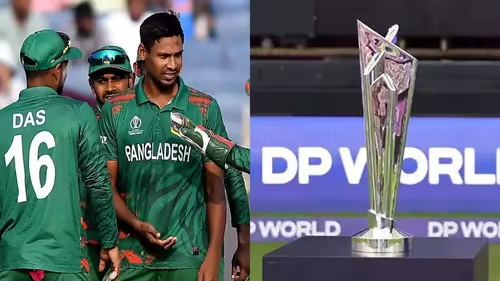
The stage is set for a high-stakes drama that could redefine the T20 World Cup 2026 before a single ball is bowled. In a move that blends sport with geopolitics, the Pakistan Cricket Board (PCB) has thrown its full weight behind Bangladesh’s controversial decision to avoid playing its matches in India, citing serious security concerns . This unprecedented alliance has put the International Cricket Council (ICC) in a tight spot just weeks before a crucial meeting to decide the fate of the tournament.
The Standoff: Bangladesh’s Security Concerns
The core of this crisis lies in Bangladesh’s firm refusal to send its national team to India for the upcoming T20 World Cup 2026. The Bangladesh Cricket Board (BCB) has officially communicated its position to the ICC, requesting that all its scheduled fixtures be relocated from Indian soil to Sri Lanka, the tournament’s co-host . Their primary justification is a deep-seated apprehension about the safety and security of their players and officials .
However, the ICC has pushed back hard against these claims. According to official sources, the ICC has shared a comprehensive security assessment with the BCB which explicitly states there is “no specific or heightened threat” to the Bangladesh team in India . The council has even gone so far as to label some of Bangladesh’s assertions as a “complete lie,” firmly rejecting any notion that they have validated the security concerns . Despite this, Bangladesh remains resolute, creating a significant logistical and political headache for the global governing body .
Pakistan Steps In: A Strategic Alliance
This is where Pakistan enters the fray. In a show of solidarity that has surprised many in the cricketing world, the PCB has not only expressed support for Bangladesh’s stance but has also taken concrete action. The board has formally written to the ICC, backing the BCB’s request and offering a potential solution: Pakistan is willing to host Bangladesh’s matches if the need arises .
This offer is particularly significant given the complex history between the two nations and their own bilateral cricketing relations with India. The PCB’s move can be seen as both a strategic gesture of regional camaraderie and a pragmatic attempt to ensure the tournament’s integrity by keeping all qualified teams in the competition. Reports suggest Pakistan has assured the BCB of its “full support” and is ready to step in as an alternative venue should Sri Lanka’s three allocated grounds prove insufficient . This bold proposition adds another layer of complexity to the ICC’s already difficult decision-making process.
The ICC’s Firm Stance and Upcoming Crucial Meet
For now, the ICC is holding its ground. The official line remains that the T20 World Cup 2026 schedule will not be altered. The tournament is officially set to run from February 7 to March 8, 2026, across eight venues—five in India and three in Sri Lanka—with the final slated for the Narendra Modi Stadium in Ahmedabad [[21], [22]].
Yet, the pressure is mounting. With two of its top member boards in open defiance, the ICC cannot afford to ignore the situation. A crucial meeting is on the horizon, where the council will have to navigate a minefield of diplomatic sensitivities, contractual obligations, and the fundamental principle of player safety. The outcome of this meeting will be pivotal. Will the ICC stand firm on its original plan, risking the withdrawal of a participating nation? Or will it be forced to make unprecedented concessions, potentially redrawing the entire tournament map ?
Broader Implications for the T20 World Cup 2026
The ripple effects of this standoff are far-reaching:
- Logistical Nightmare: Rescheduling matches, especially at this late stage, would be a monumental task involving broadcasters, sponsors, ticket holders, and local organizers across multiple countries.
- Precedent Setting: If the ICC yields to Bangladesh’s demands, it could set a dangerous precedent for future tournaments, where political or security concerns from any nation could lead to venue changes.
- Geopolitical Tensions: The situation has once again highlighted how deeply intertwined cricket is with the politics of the South Asian subcontinent. The PCB’s support for the BCB is a clear signal of shifting regional dynamics in the sport.
- Fan Experience: Millions of fans in India are looking forward to hosting these matches. Any change would be a massive disappointment for the local cricket community and could impact the vibrant atmosphere that makes an Indian World Cup so special.
For fans eager to understand the historical context of such disputes, our deep dive into past [INTERNAL_LINK:cricket-politics-history] offers valuable insights.
Conclusion: A Tournament at a Crossroads
The T20 World Cup 2026 stands at a critical juncture. What was meant to be a celebration of the sport’s fastest format has become a test of the ICC’s authority and its ability to manage the complex interplay between sport and state. Pakistan’s backing of Bangladesh has escalated the situation from a bilateral issue into a wider regional challenge. As the clock ticks down to the ICC’s crucial meeting, the entire cricketing world watches with bated breath. The decision made in that room will not only determine the venues for a few matches but could also shape the future governance of international cricket for years to come. One thing is certain: the road to the final in Ahmedabad just got a lot more complicated.