Table of Contents
- The AIBE Timing Crisis: What Was the Problem?
- Supreme Court Intervention: The Game-Changing Ruling
- New AIBE Rules Explained: What You Need to Know
- Real Impact on Law Students: From Lost Years to Launch Pads
- Conclusion: A New Era for Legal Education in India
- Sources
The AIBE Timing Crisis: What Was the Problem?
For years, a frustrating bottleneck plagued India’s legal education system. Law graduates would complete their final semester, only to face a grueling wait. Why? Because the All India Bar Examination (AIBE) was traditionally held just once a year. This meant that if you missed the registration window or your results were delayed, you could lose an entire year before even being eligible to practice law.
This wasn’t just an inconvenience; it was a career-derailing hurdle. Many bright minds were forced into a holding pattern, unable to start their professional journey while their peers in other fields were already gaining experience. The system was broken, and everyone knew it.
Supreme Court Intervention: The Game-Changing Ruling
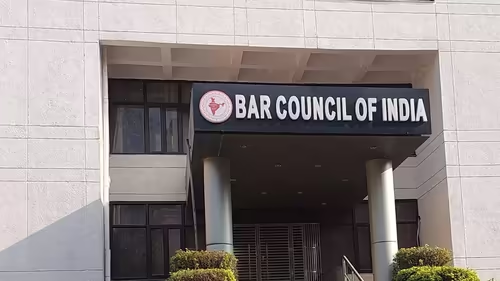
The judiciary has finally stepped in to fix this mess. In a significant development, the Bar Council of India (BCI) informed the Supreme Court that it has framed new rules to address this critical issue . The cornerstone of this reform is a simple yet powerful change: the AIBE will now be conducted twice a year .
But that’s not all. The most impactful part of this ruling is the new eligibility criteria. Now, final-semester LLB students are allowed to sit for the AIBE . This is a monumental shift from the previous requirement that mandated candidates to have already passed their final exams and be enrolled with a State Bar Council before they could even apply.
The Supreme Court’s directive, issued in September 2024, recognized the absurdity of the old system and pushed the BCI to modernize its approach .
AIBE Twice a Year: The New Rules Explained
Let’s break down exactly what these new rules mean for aspiring lawyers.
Eligibility Criteria: Who Can Apply Now?
The updated eligibility is a breath of fresh air:
- Final-year students of both 3-year and 5-year LLB programs are eligible to apply, provided they have no backlogs .
- Candidates must be citizens of India .
- There is no minimum percentage requirement in their qualifying exam .
- There is no age restriction for the AIBE .
Crucially, there’s a condition: students who appear for the AIBE in their final semester must successfully clear their university’s final examinations to have their AIBE result validated and to proceed with their legal practice . This ensures the integrity of the qualification while providing much-needed flexibility.
Exam Frequency: A Welcome Change
The move to hold the AIBE twice a year is perhaps the most practical improvement. Historically, the exam was an annual event, creating a single, high-pressure point of entry into the profession . By doubling the opportunities, the BCI is aligning itself with global standards and acknowledging the diverse academic calendars across India’s numerous law universities. This change drastically reduces the risk of a student losing an entire year due to a minor delay or a missed deadline.
Real Impact on Law Students: From Lost Years to Launch Pads
This isn’t just a procedural update; it’s a life-changing policy shift. Imagine this scenario:
A student completes their final semester in May. Under the old system, if the AIBE was scheduled for November, they’d have to wait six months just to take the exam, and then several more months for the results. Their career start would be pushed to the next year.
Now, with the AIBE twice a year and the ability to appear as a final-year student, that same individual could potentially take the exam in, say, June or July, receive their results by August or September, and be ready to practice by the end of the year they graduate. This seamless transition is invaluable.
It also levels the playing field for students from universities with later result declarations. They are no longer penalized for administrative delays beyond their control. This reform empowers them to take charge of their own timelines.
For those looking to build their profile, this opens up immediate opportunities for internships, clerkships, and junior associate roles without the dreaded “waiting for AIBE” gap on their resume. It’s a direct boost to their employability and professional confidence.
Conclusion: A New Era for Legal Education in India
The Supreme Court’s push for the BCI to implement these changes marks a pivotal moment in Indian legal education. By allowing final-year students to appear for the AIBE and mandating the exam be held twice a year, the system has finally become more responsive, efficient, and student-centric.
This move demonstrates a growing understanding that regulatory bodies must adapt to the real-world challenges faced by young professionals. It’s a victory for common sense and a huge relief for thousands of law students across the country who can now plan their futures with greater certainty. The path from law school to the courtroom just got a lot smoother.
Sources
- Times of India: AIBE twice a year, final-year students allowed: The Supreme Court just fixed a timing mess
- Bar Council of India Official Website: https://www.barcouncilofindia.org/
- Supreme Court of India: https://main.sci.gov.in/