Table of Contents
- A Series Loss That Sparked a Storm
- What Went Wrong in the Middle Overs?
- Ashwin’s Scathing Assessment of Gill’s Captaincy
- Rohit and Dhoni: The Gold Standard?
- Is Gill Ready for the Top Job?
- Conclusion: Leadership Is Earned, Not Given
- Sources
A Series Loss That Sparked a Storm
India’s 1-2 defeat to New Zealand in the recent ODI series wasn’t just another loss—it ignited a fierce national debate about the future of Indian cricket leadership. With regular skipper Rohit Sharma rested, the reins were handed to young Shubman Gill, a move many saw as a natural progression for the team’s next-gen leader. But instead of a smooth transition, the series exposed glaring gaps in tactical execution, prompting former star all-rounder R Ashwin to openly question Gill’s readiness for the role .
The core issue? A perceived lack of strategic clarity—especially during the crucial middle overs—and an over-cautious approach that failed to apply pressure when it mattered most. For a nation that prides itself on producing world-class captains like MS Dhoni and Rohit Sharma, this performance raised uncomfortable questions.
What Went Wrong in the Middle Overs?
In modern ODI cricket, the 10th to 40th overs—the so-called “middle phase”—often decide the match. It’s where teams either build momentum or strangle the opposition with disciplined bowling and smart field placements.
According to Ashwin, India’s biggest failure in the IND vs NZ series was its inability to control this phase. “We didn’t bowl with intent,” he remarked on his YouTube channel. “There was no plan to create pressure. The bowlers were just going through the motions.”
A telling example was the underutilization of Kuldeep Yadav, India’s premier wrist-spinner and one of the few bowlers capable of breaking partnerships on flat pitches. In the decisive third ODI, Kuldeep bowled just **six overs**—despite being among the most economical and wicket-taking options in the squad .
This wasn’t an isolated incident. Across the series, India’s bowling changes lacked urgency, and field settings often appeared passive, allowing Kiwi batters like Rachin Ravindra and Daryl Mitchell to settle without real disruption.
Ashwin’s Scathing Assessment of Gill’s Captaincy
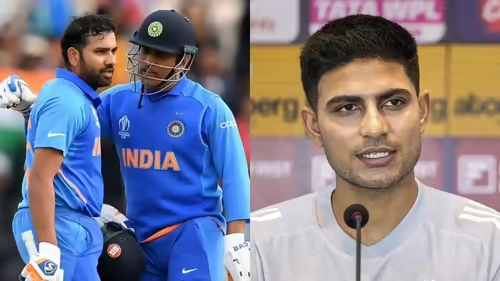
R Ashwin didn’t mince words. In a candid analysis, he directly compared Gill’s leadership to that of Rohit Sharma and MS Dhoni—two of India’s most successful captains—and found it wanting.
“Why do we praise Rohit and Dhoni?” Ashwin asked rhetorically. “Because they knew how to apply pressure at the right time. They had backup plans. They read the game.”
He went on to suggest that Gill, while technically gifted as a batter, appeared “hesitant” and “reactive” rather than proactive. There was no clear Plan B when the initial strategy failed, and the captain seemed reluctant to take bold calls—like attacking with spin early or using part-timers aggressively to break rhythms.
Crucially, Ashwin emphasized that captaincy isn’t just about wearing the armband—it’s about **decision-making under pressure**, something Gill has yet to consistently demonstrate at the international level.
Rohit and Dhoni: The Gold Standard?
Comparing any new captain to legends like MS Dhoni and Rohit Sharma is always risky—but in this case, it’s instructive. Both leaders transformed Indian cricket through calm authority and tactical innovation:
- MS Dhoni revolutionized death bowling with his trust in specialists like Jasprit Bumrah and Bhuvneshwar Kumar, and his uncanny ability to back unheralded players in high-stakes games.
- Rohit Sharma brought aggressive field placements and flexible batting orders, often promoting himself to No. 3 to dominate the powerplay.
What set them apart wasn’t just success—it was **clarity of thought**. They knew what they wanted from each over, each player, and each phase of the game. In contrast, Gill’s captaincy during the NZ series often felt ad hoc, lacking that signature decisiveness.
Is Gill Ready for the Top Job?
Let’s be fair: Shubman Gill is still early in his captaincy journey. Leading a full-strength Indian side in a bilateral series is vastly different from captaining domestic or U-19 teams. Mistakes are expected.
However, the stakes are high. With the 2027 ODI World Cup on the horizon and Rohit Sharma nearing the twilight of his career, the BCCI is actively grooming successors. Gill is a prime candidate—but this series showed he may need more time and mentorship before taking on permanent leadership.
Experts suggest three areas for immediate improvement:
- Bowling management: Learn to maximize impact bowlers like Kuldeep and Siraj in high-leverage overs.
- Proactive field settings: Move beyond default fields; use data and intuition to disrupt batter comfort zones.
- Crisis response: Develop contingency plans for when the game slips away—because it will.
[INTERNAL_LINK:future-captains-of-indian-cricket] The good news? Gill has the temperament, the respect of teammates, and the backing of the board. What he needs now is experience—and perhaps a stint as vice-captain under Rohit to absorb the nuances of top-level leadership.
Conclusion: Leadership Is Earned, Not Given
The criticism of Shubman Gill’s captaincy isn’t personal—it’s a reflection of India’s sky-high expectations for its cricket leaders. While the loss to New Zealand stings, it could be a valuable learning moment. Great captains aren’t born; they’re forged in adversity. If Gill takes this feedback seriously, studies the masters, and refines his tactical instincts, he could still emerge as the leader India needs. But for now, the armband feels a little heavy for his shoulders.