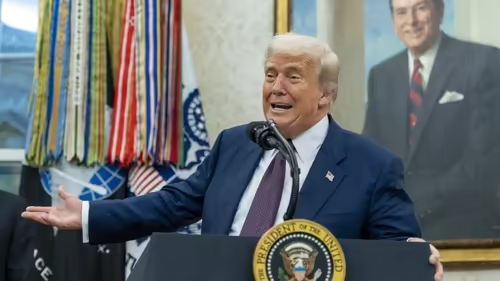
Donald Trump has done it again—rewriting history in real time. At a recent rally, the former U.S. president declared with characteristic bravado: “If I didn’t come along, there would be no NATO.” This extraordinary claim, which dismisses over 75 years of post-war diplomacy and collective defense, comes amid a fresh firestorm in transatlantic relations. While Trump takes credit for an alliance that predates him by decades, European leaders are bracing for what they call a “downward spiral” in U.S.-EU ties—triggered by his renewed threats to impose punishing tariffs unless Europe hands over Greenland .
The juxtaposition is jarring: on one hand, Trump portrays himself as NATO’s savior; on the other, his actions threaten to fracture the very unity the alliance was built to protect. As Brussels and Washington drift further apart, experts warn that the transatlantic partnership—the bedrock of global security since 1949—is facing its most serious test in a generation.
Table of Contents
- Trump Claims He Saved NATO: A Historical Reality Check
- The Greenland Gamble: Tariffs and Territorial Ambitions
- Europe Responds with Unflinching Defiance
- Why NATO Is More Than a Spending Dispute
- The Broader Impact on Global Security
- Conclusion: A Transatlantic Tipping Point
- Sources
Trump Claims He Saved NATO: A Historical Reality Check
The assertion that Trump claims he saved NATO is not just hyperbolic—it’s factually inaccurate. The North Atlantic Treaty Organization was founded in 1949 by 12 founding members, including the United States, Canada, and several Western European nations, as a collective defense pact against Soviet expansion. By the time Trump entered office in 2017, NATO had already endured the Cold War, the Balkan conflicts, and the global war on terror.
What Trump *did* do was pressure allies—often publicly and abrasively—to meet the agreed-upon defense spending target of 2% of GDP. While some allies did increase their budgets during his tenure, historians and defense analysts agree that NATO was never in imminent danger of dissolution. His framing of the alliance as a “charity” or a “rip-off” fundamentally misunderstands its strategic purpose: mutual security, not transactional profit .
The Greenland Gamble: Tariffs and Territorial Ambitions
Trump’s latest provocation centers on Greenland—a semi-autonomous territory of Denmark rich in rare earth minerals and strategically positioned in the Arctic. During his first term, he floated the idea of buying Greenland, a proposal so outlandish that it drew ridicule even from close allies. Now, in early 2026, he’s escalated his rhetoric, threatening to impose 25% tariffs on all EU goods unless the bloc “facilitates American control” over the island—a demand that is both legally impossible and diplomatically toxic .
This isn’t just about land; it’s about power projection. As the Arctic ice melts, new shipping lanes and resource reserves are emerging, making Greenland a geopolitical prize. But Trump’s approach—economic blackmail instead of diplomatic negotiation—has backfired spectacularly.
Europe Responds with Unflinching Defiance
European leaders have not remained silent. In a rare show of unity, senior EU officials issued a joint statement vowing an “unflinching” response to any coercive measures. “The sovereignty of Denmark and the self-determination of the Greenlandic people are non-negotiable,” read the statement. “We will not allow our transatlantic partnership to be held hostage by ultimatums” .
The message is clear: Europe is no longer willing to tolerate what it sees as American bullying. This stance is particularly significant given the EU’s recent move to suspend a major trade deal with the U.S.—a direct consequence of Trump’s tariff threats . The two crises are now feeding into each other, creating a perfect storm in transatlantic relations.
Why NATO Is More Than a Spending Dispute
To reduce NATO to a billing dispute is to miss its essence. The alliance is a political-military covenant based on shared democratic values, intelligence sharing, joint exercises, and rapid-response capabilities. While defense spending matters, the true strength of NATO lies in its cohesion.
Trump’s transactional view—“you pay, I protect”—ignores critical contributions from allies like Germany (hosting key U.S. bases), the UK (nuclear deterrence), and the Baltic states (frontline defense against Russian aggression). Moreover, U.S. bases in Europe provide America with strategic depth it cannot replicate elsewhere. It’s a symbiotic relationship, not a vendor-client arrangement .
The Broader Impact on Global Security
A fractured NATO and a hostile EU-U.S. relationship play directly into the hands of adversaries like Russia and China. Moscow has long sought to drive a wedge between Washington and its European partners, and Beijing benefits from a distracted West.
If trust erodes further, joint operations—from Arctic surveillance to cyber defense—could stall. Intelligence sharing might slow. And in a crisis, hesitation could be catastrophic. As one former NATO commander warned, “Alliances aren’t maintained by tweets or tariffs. They’re built on trust—and trust is fragile” .
Conclusion: A Transatlantic Tipping Point
When Trump claims he saved NATO, he’s not just distorting history—he’s undermining the very foundation of the alliance he purports to champion. Combined with his aggressive stance on Greenland, his rhetoric is accelerating a rift that could take years to heal. Europe’s firm response shows it’s ready to defend its sovereignty and its vision of a rules-based order. The question now is whether the United States will choose partnership over provocation before it’s too late.
Sources
- Times of India: ‘If I didn’t come along, there would be no … ‘: Trump takes credit for Nato’s existence
- NATO Official History: NATO’s Founding Treaty and Evolution
- [INTERNAL_LINK:eu-us-trade-deal-suspension-details]
- [INTERNAL_LINK:history-of-nato-defense-spending]