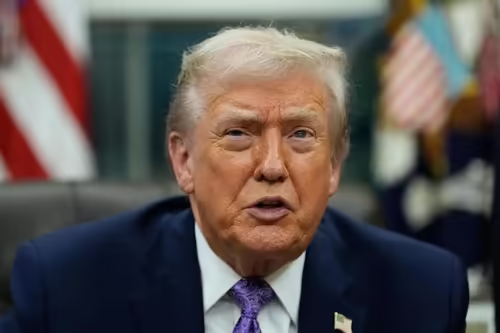
Trump’s Unrelenting Quest for Greenland
Donald Trump is not known for backing down, and his latest geopolitical maneuver proves it. On his way to the World Economic Forum in Davos, the former president has doubled down on his long-standing ambition to acquire Greenland, bluntly stating there is “no going back” on the “Greenland grab” . This isn’t just a throwaway comment; it’s a calculated power play that has sent shockwaves through Europe and reignited a fierce debate over Arctic sovereignty and American influence.
Table of Contents
- Why Does Trump Want Greenland So Badly?
- Europe and Denmark’s Fierce Rejection
- The Real Prize: Thule Air Base and the Arctic
- Beyond the Military: Economic and Geopolitical Stakes
- A History of American Interest in Greenland
- Conclusion: A Dangerous Game of High-Stakes Diplomacy
- Sources
Why Does Trump Want Greenland So Badly?
For Trump, the idea of purchasing Greenland is more than a real estate deal; it’s a symbol of American power and strategic foresight. He has repeatedly framed the acquisition as “crucial for the US,” viewing the vast, resource-rich island as an essential asset for national security and future economic dominance . His comments at Davos suggest he sees this as a non-negotiable objective, a legacy-defining move that would cement his reputation as a dealmaker on the world stage. The fact that he chose the global elite gathering at Davos to reiterate this stance is a deliberate provocation, aimed squarely at his European critics.
Europe and Denmark’s Fierce Rejection
Trump’s aggressive rhetoric has been met with a united front from Europe. Danish Prime Minister Mette Frederiksen has been unequivocal, warning Trump to “stop the threats” over acquiring the autonomous territory . She has firmly stated that the United States has no right to annex Greenland, a position that has been strongly backed by her European allies . This solidarity is a clear message to Washington: such a brazen attempt to redraw the map will not be tolerated. European leaders are actively working to “avoid escalation” but are prepared to defend their sovereignty and that of their partners . The situation has become a major point of contention in transatlantic relations, with some even suggesting it could lead to new trade barriers.
The Real Prize: Thule Air Base and the Arctic
Beneath the political bluster lies a core strategic reality. The United States already maintains a significant military presence in Greenland, most notably at the Thule Air Base (now Pituffik Space Base). This base, established during the Cold War, remains a critical asset due to its unique geographical location in the Arctic . It serves as a vital hub for missile defense, space surveillance, and satellite communications, providing the US Air Force with an unparalleled vantage point over the northern hemisphere . A 1951 treaty grants the US a major role in Greenland’s defense, but full ownership would give Washington complete and unchallenged control over this strategic outpost . In an era of renewed great-power competition, particularly with Russia and China expanding their own Arctic ambitions, controlling Greenland is seen by many in the US defense establishment as a key to maintaining dominance in the region .
Beyond the Military: Economic and Geopolitical Stakes
The allure of Greenland extends far beyond its military value. The island is believed to be sitting on a treasure trove of untapped natural resources, including rare earth minerals that are essential for modern technology and green energy infrastructure. As the Arctic ice melts, new shipping lanes are opening, making Greenland a potential linchpin in future global trade routes. For Trump, securing these resources and controlling this emerging economic corridor would be a massive win for his “America First” agenda. However, this ambition has also drawn criticism from the scientific community, with over 200 scientists signing a letter to “vehemently oppose” the US effort to acquire the island, citing environmental and ethical concerns .
A History of American Interest in Greenland
Trump’s obsession with Greenland is not entirely new. The United States has had a deep and complex relationship with the island for decades. During the Cold War, the construction of the sprawling Thule Air Base was a top-secret project that transformed Greenland into a frontline of the conflict . While Denmark holds sovereignty, the US has effectively been the island’s primary military power for much of the last century . Trump’s proposal to buy Greenland is simply the most overt and aggressive expression of this long-standing American interest. When pressed on how far he would go to secure the deal, Trump cryptically told reporters, “you’ll find out,” leaving the world to wonder what his next move might be .
Conclusion: A Dangerous Game of High-Stakes Diplomacy
Trump’s renewed push for Trump Greenland is more than just a headline-grabbing stunt. It’s a high-stakes gamble that tests the limits of international law, alliance politics, and diplomatic norms. While the strategic and economic logic behind the desire for Greenland is clear, the method—openly threatening to seize a sovereign territory—is a dangerous path that risks alienating key allies and destabilizing the fragile Arctic region. The world is now watching to see if this is a masterstroke of realpolitik or a colossal geopolitical blunder that could have far-reaching consequences. One thing is certain: the battle for the Arctic has just entered a new and more volatile phase.
Sources
- Times of India. (n.d.). No going back on Greenland grab: Trump torches Europe on way to Davos. Retrieved from https://timesofindia.indiatimes.com/world/us/no-going-back-on-greenland-grab-trump-torches-europe-on-way-to-davos/articleshow/126832513.cms
- Web Search Results: [1], [2], [3], [4], [5], [6], [7], [8], [9], [10], [11], [12], [13], [14], [15], [16], [17].