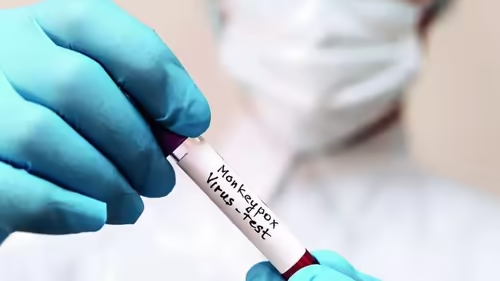
Is a New Mpox Threat Looming Over India?
The tranquil backwaters of Kerala have become the unexpected epicenter of a potential public health crisis. A first-of-its-kind genetic study has revealed that the recent Mpox cases in the state are not just isolated incidents but are tied to a far more aggressive and transmissible global threat: the Mpox Clade Ib variant. This discovery, linking the infections directly to international travel, is a stark warning bell for the entire nation.
Table of Contents
- What is Mpox Clade Ib and Why Is It So Dangerous?
- The Kerala Cases: A Direct Line to Foreign Travel
- How Does This Aggressive Variant Spread?
- Is India’s Surveillance System Ready for Clade Ib?
- What You Need to Know to Protect Yourself
- Conclusion: Vigilance, Not Panic
- Sources
What is Mpox Clade Ib and Why Is It So Dangerous?
For years, Mpox (formerly known as monkeypox) was considered a rare zoonotic disease with limited human-to-human transmission. However, the emergence of new clades has changed the game entirely. The Mpox Clade Ib variant, which has been driving a significant outbreak in parts of Africa since 2023, is proving to be a formidable adversary.
Unlike its predecessors, Clade Ib appears to be evolving rapidly, with distinct mutations that suggest it is adapting to its human host. This adaptation translates to a key concern: faster and more efficient human-to-human transmission. Early symptoms can also be subtle or atypical, making early detection and containment incredibly difficult .
While the global outbreak that began in 2022 was primarily driven by Clade IIb, Clade Ib represents a new and potentially more concerning chapter. The World Health Organization (WHO) has been closely monitoring its spread, with thousands of cases and dozens of deaths reported across multiple countries in 2025 alone .
The Kerala Cases: A Direct Line to Foreign Travel
The genetic sequencing conducted in Kerala provides a clear and alarming link. The virus samples from the infected individuals were an exact match to the Mpox Clade Ib circulating internationally. This isn’t a case of a local, endemic strain flaring up; it’s an imported threat that has now taken root on Indian soil .
Reports confirm that the initial cases had a direct history of international travel, specifically to regions where the Clade Ib variant is known to be active . This underscores a critical vulnerability in our globalized world: a single traveler can inadvertently introduce a dangerous pathogen into a new population. The fact that this variant is adept at human-to-human spread means that the risk of local transmission chains is now very real.
This situation is reminiscent of the early days of other global health crises, where a localized event quickly became a national concern. [INTERNAL_LINK:global-pandemic-preparedness] For India, with its dense population and extensive travel networks, the stakes are particularly high.
How Does This Aggressive Variant Spread?
Understanding the transmission dynamics of Mpox Clade Ib is crucial for prevention. The primary modes of spread include:
- Direct contact with infectious rash, scabs, or body fluids. This is the most common route.
- Respiratory secretions during prolonged, face-to-face contact. While not as airborne as measles, close contact can still pose a risk.
- Intimate physical contact, including sexual contact. Many of the global Clade Ib cases have been linked to sexual networks .
- Touching items that have been in contact with an infected person’s rash or body fluids, such as clothing or bedding.
The virus’s ability to spread through close household and community contact makes it a significant challenge for public health officials trying to contain an outbreak .
Is India’s Surveillance System Ready for Clade Ib?
The identification of the Clade Ib variant in Kerala is a testament to the capabilities of India’s scientific and medical community. However, detection is only the first step. The real test lies in the country’s surveillance and response infrastructure.
The National Centre for Disease Control (NCDC) has established protocols for Mpox surveillance, including a network of Viral Research and Diagnostic Laboratories (VRDLs) and a case alert system . Following the initial cases, the NCDC held expert meetings to assess the national risk and strategize a response .
Yet, the true effectiveness of these systems will be proven in their ability to rapidly identify new cases, trace contacts, and prevent further spread. The subtle early symptoms of Clade Ib make this task even harder. Community health workers will be on the front lines, needing to be trained to recognize potential cases and report them swiftly . The current system must be agile and robust enough to handle a potential surge.
What You Need to Know to Protect Yourself
While the situation warrants serious attention, it does not call for panic. Public awareness and personal responsibility are powerful tools. Here’s what you can do:
- Be aware of the symptoms: Look out for fever, headache, muscle aches, swollen lymph nodes, and a distinctive rash that often starts on the face and spreads.
- Avoid close contact: If you or someone you know is showing symptoms, avoid skin-to-skin contact until they have been evaluated by a healthcare professional.
- Practice good hygiene: Wash your hands frequently with soap and water or use an alcohol-based hand sanitizer.
- Stay informed: Follow official updates from the Ministry of Health and Family Welfare and the NCDC.
For those planning international travel, it’s wise to check the latest health advisories for your destination. [INTERNAL_LINK:international-travel-health-tips]
Conclusion: Vigilance, Not Panic
The discovery of the Mpox Clade Ib variant in Kerala is a significant development that demands a coordinated and swift national response. It highlights the constant threat of emerging infectious diseases in our interconnected world. While the link to foreign travel is clear, the potential for local, human-to-human transmission is the real challenge ahead. India’s public health system now faces a critical test of its surveillance, diagnostic, and containment capabilities. For the public, staying informed, practicing good hygiene, and being vigilant about symptoms are the best defenses. The goal is not to incite fear, but to foster a state of preparedness that can protect the health of the nation.
Sources
- Pan, W., et al. (2025). The first reported case of monkeypox virus clade Ⅰb.
- World Health Organization (WHO). (2025, August 29). WHO global mpox update.
- Times of India. (n.d.). Monkey pox strain links Kerala cases to foreign travel: Study. Retrieved from https://timesofindia.indiatimes.com/india/monkey-pox-strain-links-kerala-cases-to-foreign-travel-study/articleshow/126869621.cms
- National Centre for Disease Control (NCDC). (2024). CD Alert – MPox.
- Singh, T. (2025). Mpox in India: Current Insights and Strategic Recommendations.