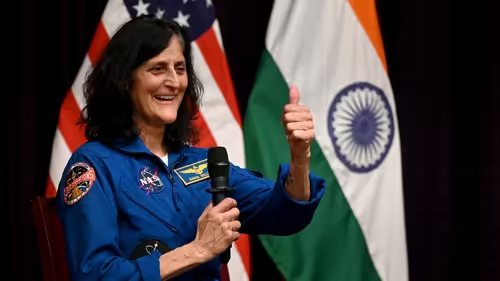
Sunita Williams Missed Historic Meeting with Indian Astronaut Shukla on ISS: ‘He Arrived Just After I Left’
In a moment that could have been a landmark in Indo-American space history, veteran astronaut Sunita Williams
“The first thing I did after reaching space was to locate the countries of my father and mother,” Williams said, her voice filled with emotion. Then came the bittersweet twist: “I missed meeting Group Captain Shukla on the ISS—he reached just after I left.” This near-miss has since become a symbol of timing, ambition, and the accelerating pace of India’s journey into human spaceflight .
Table of Contents
- Sunita Williams’ Inspiring Talk in Delhi
- The Near-Miss with Group Captain Shukla: What Happened?
- India’s Human Spaceflight Program and the Road to Gaganyaan
- Why International Cooperation in Space Matters More Than Ever
- Williams’ Message to Indian Students: ‘Reach for the Stars’
- Conclusion: A Missed Handshake, But a Shared Future
- Sources
Sunita Williams’ Inspiring Talk in Delhi
During her recent visit to India, Williams engaged with students, scientists, and diplomats at the American Center, sharing candid insights from her record-breaking career—including holding the record for the longest cumulative spacewalk time by a woman (50 hours and 40 minutes across seven EVAs) .
She spoke about the challenges of her most recent extended mission, which included technical issues with the Boeing Starliner spacecraft that forced an unplanned extension of her stay in orbit. Despite these hurdles, Williams emphasized the resilience, teamwork, and global spirit that define life on the ISS—a floating laboratory representing 15 nations working together .
Sunita Williams missed meeting Shukla on ISS: What Happened?
While official details about Group Captain Shukla’s mission remain limited—likely because he is part of India’s classified astronaut training program under ISRO’s Gaganyaan project—Williams’ comment confirms that Indian astronauts are now on the cusp of joining the elite ranks of those who have lived and worked in space.
The timing mismatch—Williams departing just before Shukla’s arrival—highlights the intricate choreography required for crew rotations on the ISS. With missions planned years in advance and subject to launch delays, weather, and vehicle readiness, such near-misses, while disappointing, are not uncommon. Yet, the symbolic weight of two astronauts—one of Indian heritage, one from India itself—almost crossing paths in orbit resonates deeply in a nation eager to claim its place among spacefaring powers.
India’s Human Spaceflight Program and the Road to Gaganyaan
India’s Gaganyaan mission, led by the Indian Space Research Organisation (ISRO), aims to send three Indian astronauts to low Earth orbit by 2025–2026 . The four selected candidates—including Group Captain Shukla—have undergone rigorous training in Russia and India, preparing for this historic leap.
Williams’ acknowledgment of Shukla not only validates India’s progress but also underscores a shift in global space dynamics. No longer is space exploration the domain of just a few nations. With commercial players like SpaceX, Blue Origin, and soon, potentially Indian private firms, the final frontier is becoming more accessible—and collaborative.
Why International Cooperation in Space Matters More Than Ever
Williams stressed that the ISS exists because of unprecedented international cooperation. “In space, there are no borders,” she remarked. “You see Earth as one planet—and that changes everything.”
This philosophy aligns with India’s growing role in global space initiatives. From joint satellite missions with NASA (like NISAR) to data-sharing agreements and potential future collaborations on lunar or Mars missions, the foundation for deeper Indo-U.S. space ties is being laid .
[INTERNAL_LINK:isro-nasa-collaboration] could be a key driver in accelerating India’s human spaceflight capabilities, providing access to advanced life-support systems, docking protocols, and astronaut training modules.
Williams’ Message to Indian Students: ‘Reach for the Stars’
Perhaps the most impactful part of her talk was directed at young Indians. “Don’t wait for permission to dream,” Williams urged. “Study science, ask questions, fail fast, and keep going.” She highlighted that diversity in space—not just in nationality but in thought and background—is essential for solving the complex challenges of deep space exploration.
She also encouraged girls to pursue STEM fields without hesitation: “When I was your age, I didn’t know an astronaut could look like me. Now you do.”
Conclusion: A Missed Handshake, But a Shared Future
While Sunita Williams and Group Captain Shukla didn’t meet in orbit this time, their stories are now intertwined in the narrative of India’s space ascent. Williams’ near-miss is not an end—it’s a prologue. It signals that Indian astronauts are no longer aspirational figures but imminent reality.
As India prepares for Gaganyaan and eyes lunar bases and Mars missions, the spirit of collaboration that Williams champions will be crucial. The next time an Indian astronaut boards the ISS—or a joint India-U.S. station orbits Earth—that handshake in space won’t be missed. It will be celebrated by billions below.
Sources
- Times of India: Missed meeting Shukla on ISS, he reached just after I left: Sunita Williams
- NASA Biography: Sunita L. Williams – NASA Astronaut
- ISRO: Gaganyaan Mission Overview
- International Space Station Facts: NASA ISS Program