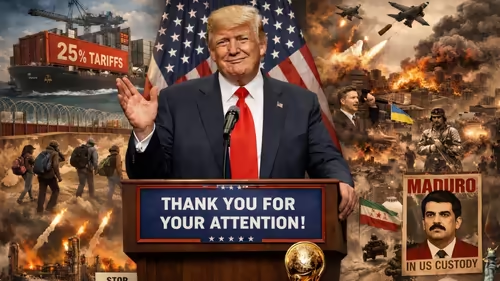
Just weeks into his second presidential term, Donald Trump has made one thing crystal clear: Trump 2.0 isn’t a sequel—it’s a full-scale reboot with higher stakes, sharper edges, and a global audience holding its breath. From imposing sweeping new tariffs within his first 100 days to authorizing precision airstrikes and floating audacious proposals like U.S. ownership of Gaza, the 47th president is executing a vision so bold it’s already redrawing the map of international relations .
Table of Contents
- What Is Trump 2.0?
- The Economic Shockwave: Tariffs and Trade Wars
- Military Muscle: Airstrikes and Territorial Ambitions
- Fortress America: Immigration and Border Policy
- Global Reactions: Allies Alarmed, Adversaries Uncertain
- Conclusion: The World in the Age of Trump 2.0
- Sources
What Is Trump 2.0?
If his first term was defined by disruption, Trump 2.0 appears engineered for transformation—on his terms. Freed from electoral constraints and emboldened by a loyal base, President Trump has doubled down on his “America First” doctrine with unprecedented speed and scale. This new chapter is marked by a fusion of economic nationalism, assertive military posture, and a transactional view of diplomacy that treats alliances as leverage rather than legacy .
The Economic Shockwave: Tariffs and Trade Wars
Within weeks of his inauguration on January 20, 2025, the Trump administration rolled out a sweeping new tariff regime targeting key trading partners, including China, the European Union, and Mexico. These aren’t symbolic gestures—they’re structural weapons aimed at reshoring manufacturing and punishing what the White House calls “unfair trade practices.”
Key elements of Trump’s 2026 trade strategy include:
- A proposed 60% tariff on all Chinese imports, far exceeding the levels seen during his first term .
- New auto tariffs on German and Japanese vehicles, citing national security concerns under Section 232 of the Trade Expansion Act.
- A push to renegotiate USMCA (the updated NAFTA) with stricter labor and content rules favoring American workers.
Economists warn this could trigger retaliatory measures and global supply chain chaos, but the administration argues it’s necessary to protect U.S. industrial sovereignty—a core pillar of Trump 2.0.
Military Muscle: Airstrikes and Territorial Ambitions
Diplomacy in the Trump 2.0 era is backed by immediate, visible force. In early January 2026, the U.S. launched precision airstrikes against Houthi targets in Yemen following attacks on commercial shipping in the Red Sea—a move framed as protecting American economic interests and freedom of navigation .
But it’s Trump’s unconventional geopolitical ideas that have stunned the world. During a high-profile interview, he floated the idea that the United States should “take over” the Gaza Strip after the Israel-Hamas war, relocate its Palestinian population, and turn the area into “the Riviera of the Middle East” . While quickly dismissed by regional leaders and U.S. allies as impractical, the proposal underscores a hallmark of Trump 2.0: a willingness to challenge decades-old diplomatic orthodoxies with brash, headline-grabbing alternatives.
Fortress America: Immigration and Border Policy
True to his campaign promises, Trump has moved swiftly to seal the southern border. His executive orders have reinstated and expanded policies like Title 42, revived construction of the border wall using redirected military funds, and mandated expedited deportations for undocumented immigrants—even those with longstanding ties to U.S. communities .
The administration has also revived the “Remain in Mexico” policy (officially MPP—Migrant Protection Protocols), forcing asylum seekers to wait south of the border while their cases are processed. Human rights groups have condemned these moves, but they remain wildly popular with his political base and are central to his vision of national sovereignty.
Global Reactions: Allies Alarmed, Adversaries Uncertain
The world is scrambling to adapt. European leaders, already wary of U.S. unpredictability, are accelerating efforts toward strategic autonomy. NATO members are quietly debating contingency plans in case U.S. security guarantees waver . Meanwhile, China has responded to the tariff threats with a mix of state-backed economic countermeasures and rhetorical defiance.
Ironically, some authoritarian regimes see opportunity in the chaos. A more transactional, less values-driven U.S. foreign policy could create openings for nations like Russia and Iran to expand their influence in contested regions—though Trump’s own aggressive stance toward both suggests this may be short-lived.
Conclusion: The World in the Age of Trump 2.0
Love him or loathe him, Donald Trump’s second term is proving to be a defining moment in 21st-century geopolitics. Trump 2.0 is not merely a continuation—it’s an acceleration of a worldview that prioritizes American power above multilateral consensus, economic self-sufficiency over global integration, and decisive action over diplomatic patience. Whether this leads to renewed American dominance or global fragmentation remains the trillion-dollar question. One thing is certain: in the age of Trump 2.0, there will never be a dull moment. For deeper analysis on U.S. foreign policy shifts, see our feature on [INTERNAL_LINK:future-of-american-diplomacy].
Sources
- Times of India: “Never a dull moment in Trump 2.0: Tariffs, airstrikes & year that kept world on edge”
- The White House Official Statements (January 2025–January 2026)
- Reuters: “Trump proposes 60% tariff on Chinese goods in second-term plan”
- Associated Press: “U.S. launches airstrikes on Houthi targets in Yemen”
- CNN: “Trump suggests U.S. take over Gaza Strip in explosive interview”
- Department of Homeland Security: Executive Orders on Border Security (Jan 2025)
- Financial Times: “European allies brace for second Trump term”
- Brookings Institution: Analysis of U.S. trade and foreign policy under Trump 2.0