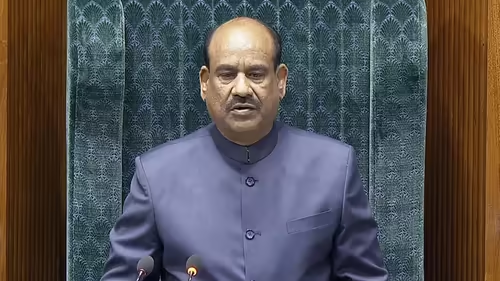
Starting with the upcoming Budget Session of Parliament in 2026, a quiet but significant shift is coming to the Lok Sabha: Members of Parliament will no longer be able to mark their attendance from just anywhere inside the House. Instead, they must do so **only from their assigned seats**—a rule change that Speaker Om Birla says is designed to ensure that attendance reflects real engagement, not just a token appearance .
This Lok Sabha attendance rule change may seem like a minor technical adjustment, but it carries profound implications for parliamentary discipline, legislative productivity, and public trust in India’s democratic institutions. At a time when political theatrics often overshadow substantive debate, this move signals a renewed push for accountability from within the system itself.
Table of Contents
- What the New Rule Actually Says
- Why This Lok Sabha Attendance Rule Change Matters
- The Role of Technology in Enforcing Compliance
- Reactions from MPs and Political Parties
- Historical Context: How Attendance Has Been Tracked
- What This Means for Democracy and Accountability
- Conclusion: A Small Step Toward a More Effective Parliament?
- Sources
What the New Rule Actually Says
Announced by Lok Sabha Speaker Om Birla in January 2026, the revised attendance protocol is clear and strict: during functioning hours of the House, an MP can register their presence **only by using the biometric or electronic device installed at their designated seat** .
Previously, MPs could mark attendance from any terminal within the Lok Sabha chamber—meaning someone could swipe in while standing near the entrance or even on their way out. This loophole allowed for “proxy presence” without actual participation in debates, voting, or committee work.
The new system, set to roll out during the crucial Budget Session, aligns attendance with physical location—ensuring that if your name is on the record as “present,” you’re actually sitting in your seat and (theoretically) ready to contribute.
Why This Lok Sabha Attendance Rule Change Matters
At its core, the Lok Sabha attendance rule change tackles a long-standing credibility gap. For years, critics have pointed out the disconnect between high attendance figures and low legislative output. In the 17th Lok Sabha (2019–2024), average attendance hovered around 85%, yet the number of bills passed per sitting day declined compared to previous decades .
By tying attendance to seat-based verification, the Speaker’s office is sending a clear message: **being in the room isn’t enough—you must be at your post**. This reform supports broader goals of enhancing parliamentary efficiency, reducing absenteeism during key votes, and restoring public faith in lawmakers’ commitment.
The Role of Technology in Enforcing Compliance
The success of this rule hinges on seamless tech integration. Each MP’s seat in the Lok Sabha is already equipped with a touchscreen console linked to the Parliament’s digital infrastructure. The updated system will now require MPs to authenticate their presence via fingerprint or PIN **at their specific console**, which is geo-tagged to their seat number.
This eliminates the possibility of one MP marking attendance for another—a practice that, while officially prohibited, has been rumored for years. The move also complements other digital upgrades under the Central Vista redevelopment project, including real-time voting and AI-assisted transcription services .
Reactions from MPs and Political Parties
Initial responses have been mixed but largely supportive:
- Bharatiya Janata Party (BJP): Backbenchers welcomed the move as a “step toward serious governance.” Senior leaders called it a natural extension of PM Modi’s emphasis on “minimum government, maximum governance.”
- Indian National Congress: While not opposing the rule, some leaders questioned its timing, suggesting it could be used to penalize opposition members during contentious debates.
- Independent Analysts: Many praised the intent but cautioned that true reform requires cultural change—not just procedural tweaks. As political scientist Dr. Pratap Bhanu Mehta noted, “Attendance is a proxy for engagement. The real test is whether MPs speak, question, and deliberate—not just sit.”
Historical Context: How Attendance Has Been Tracked
Since India’s first Lok Sabha in 1952, attendance has been a formal requirement. Initially recorded manually, the process went digital in the early 2000s. However, the system remained flexible—allowing MPs to log in from multiple kiosks inside the chamber.
Over time, this flexibility became a vulnerability. High-profile absences during critical votes—like the 2023 Delimitation Bill or the 2021 Farm Laws repeal—sparked public outrage, even when overall attendance stats looked healthy. The new rule directly addresses this perception gap.
What This Means for Democracy and Accountability
Beyond procedure, this reform touches on a deeper democratic principle: **representation requires presence**. When voters elect an MP, they expect them to be in the House—debating, scrutinizing, and shaping laws.
While the rule won’t force MPs to speak or vote a certain way, it creates a baseline standard of physical accountability. Over time, consistent data from seat-based attendance could be used to:
- Identify chronic absenteeism and trigger internal party reviews.
- Inform voter decisions during elections through transparency portals like [INTERNAL_LINK:mp-performance-tracker].
- Strengthen parliamentary committees by ensuring members are available for scheduled meetings.
For more on global best practices, see the Inter-Parliamentary Union’s guidelines on legislative effectiveness.
Conclusion: A Small Step Toward a More Effective Parliament?
The Lok Sabha attendance rule change is not a magic fix for all of Parliament’s challenges—but it’s a meaningful step in the right direction. By demanding that presence equals position, Speaker Om Birla is reinforcing the idea that democracy thrives not on optics, but on active, accountable participation. Whether this translates into more productive sittings and better laws remains to be seen. But for now, every MP will have to earn their “present” stamp—one seat at a time.
Sources
- Times of India: “Rule change: Lok Sabha MPs can mark attendance only from their seats,” January 21, 2026.
- PRS Legislative Research: “Lok Sabha Productivity and Attendance Data (2019–2024).”
- Lok Sabha Secretariat: “Digital Infrastructure Upgrades under Central Vista Project.”
- Expert commentary from Dr. Pratap Bhanu Mehta, Centre for Policy Research.
- Inter-Parliamentary Union (IPU) – Global standards for parliamentary conduct.