Table of Contents
- A Shocking Question from the Captain
- The Context Behind Litton Das’ Statement
- Bangladesh T20 World Cup Uncertainty Deepens
- The Slow Pitch Problem and BPL Performance
- ICC, India, and the Unresolved Venue Dispute
- What the BCB Hasn’t Said
- Implications for the Tournament
- Conclusion
- Sources
A Shocking Question from the Captain
“Are you sure we are going to play in the World Cup?”
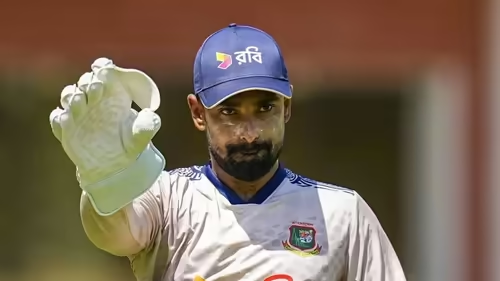
These are not the words you expect to hear from a national cricket captain just weeks before a major global tournament. Yet, that’s exactly what Bangladesh T20 World Cup skipper Litton Das asked during a press interaction following his Rangpur Riders’ exit from the Bangladesh Premier League (BPL) .
The comment sent shockwaves through the cricketing world, raising immediate questions about Bangladesh’s commitment and readiness for the ICC Men’s T20 World Cup, which is scheduled to begin on February 7, 2026 .
The Context Behind Litton Das’ Statement
Litton’s frustration wasn’t born in a vacuum. It came on the heels of a disappointing BPL campaign and was heavily influenced by the ongoing, and seemingly unresolved, political and logistical standoff between the Bangladesh Cricket Board (BCB) and the International Cricket Council (ICC) regarding the hosting of matches in India .
Reports indicate that Bangladesh has formally rejected certain ICC conditions tied to playing in India, primarily linked to security protocols and diplomatic sensitivities . With no alternative venue confirmed and time running out, the situation has created a cloud of uncertainty over the team’s participation.
Bangladesh T20 World Cup Uncertainty Deepens
The core of the issue lies in this unresolved venue dispute. While the ICC has designated India as a co-host for the tournament, Bangladesh’s government and its cricket board have been hesitant to commit their team to travel there without ironclad assurances .
This political impasse has trickled down to the players. In his statement, Litton Das confirmed a startling fact: the BCB has not held any formal discussions with him, the team captain, about the status of their World Cup participation or the ongoing negotiations with the ICC . This lack of communication from the board to its leader on such a critical matter only fuels the anxiety within the camp.
The Slow Pitch Problem and BPL Performance
Adding fuel to the fire is Litton’s sharp criticism of the pitch conditions in the BPL. He lamented that the slow, low surfaces used in the domestic league are doing a disservice to the national team’s preparation for the high-octane, power-hitting format of T20 internationals .
He argued that these conditions don’t replicate the faster, bouncier pitches they are likely to encounter in the World Cup, leaving the players under-prepared. His team’s early exit from the BPL, he suggested, is a direct consequence of this misalignment in preparation strategy. This critique highlights a deeper systemic issue within Bangladesh’s domestic cricket structure that could hamper their global performance.
ICC, India, and the Unresolved Venue Dispute
The geopolitical backdrop is impossible to ignore. The relationship between India and Bangladesh, while generally cooperative in cricket, has seen its share of diplomatic friction. The ICC, as the global governing body, finds itself in a difficult position, trying to balance tournament logistics with the sovereign concerns of its member nations .
For more on how geopolitics impacts international sports, see our analysis on [INTERNAL_LINK:geopolitics-in-cricket]. The ICC’s official stance has been to remain neutral and encourage dialogue, but with the February 7 start date looming, a resolution is urgently needed. Failure to do so could lead to a scenario where a full-strength Test-playing nation is absent from the sport’s biggest T20 stage—a nightmare for fans and the ICC alike.
What the BCB Hasn’t Said
Perhaps the most concerning aspect for fans is the silence from the BCB. Despite the captain’s public expression of doubt, the board has yet to issue a clear, authoritative statement confirming Bangladesh’s participation or outlining a concrete plan to resolve the impasse with the ICC .
This communication vacuum is damaging team morale and creating confusion among supporters. In high-stakes international sport, clarity and strong leadership from the administration are non-negotiable.
Implications for the Tournament
If Bangladesh were to withdraw, it would trigger a cascade of logistical and competitive issues:
- Group Stage Chaos: Their group would need to be restructured, potentially giving other teams an unfair advantage or disadvantage.
- Financial Losses: Broadcasters and sponsors have invested heavily based on a full 20-team tournament.
- Reputational Damage: The credibility of the ICC and the T20 World Cup brand would take a significant hit.
Conclusion
Litton Das’s candid “Are you sure?” is more than just a frustrated outburst; it’s a stark warning signal. The combination of an unresolved political dispute with the ICC over venues in India, a complete lack of communication from the BCB, and inadequate domestic preparation due to poor pitch conditions has created a perfect storm of uncertainty around the Bangladesh T20 World Cup campaign. With the clock ticking towards February 7, all eyes are on the BCB and the ICC to provide a definitive answer—because right now, even the captain isn’t sure if his team will be playing.
Sources
- Times of India: ‘Are you sure?’ – Bangladesh captain makes shocking admission
- Various web search results on Bangladesh-ICC T20 World Cup dispute [[5], [8], [12]]
- International Cricket Council (ICC) Official Website