Table of Contents
- A Horrific Workplace Murder Disguised as an Accident
- Who Was Kalyani Nambi?
- The Suspect and His Motive: 40 Pending Death Claims
- How the Truth Emerged: From ‘Accident’ to Confession
- LIC Internal Controls Under Scrutiny
- Broader Implications for Workplace Safety in India
- Legal Proceedings and Public Outrage
- Conclusion
- Sources
A Horrific Workplace Murder Disguised as an Accident
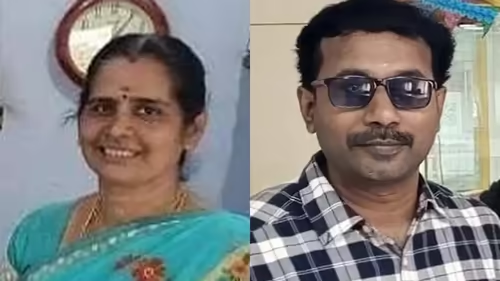
What began as a routine Tuesday at the Life Insurance Corporation (LIC) zonal office in Madurai ended in unspeakable horror. Kalyani Nambi, a respected Development Officer, was found engulfed in flames inside her office cabin. Initial reports suggested a tragic accident—perhaps a gas leak or electrical short circuit. But within hours, investigators uncovered a far more sinister truth: this was no accident. It was a cold-blooded, pre-planned murder .
The perpetrator? Her own colleague, Assistant Administrative Officer (AAO) D Ram. According to police, Ram doused Nambi with petrol and set her alight before attempting to flee the scene. The brutality of the act—and its location within a government insurance office—has sent shockwaves across Tamil Nadu and the nation.
Who Was Kalyani Nambi?
Kalyani Nambi, in her early 40s, was known as a diligent and principled officer with over 15 years of service at LIC. Colleagues described her as meticulous, especially when it came to verifying claims—a trait that may have ultimately cost her life. She was married and had two children, leaving behind a family shattered by grief and disbelief .
Her role involved scrutinizing life insurance death claims, ensuring they met all policy conditions before approval. This gatekeeping function, while essential for preventing fraud, often placed her at odds with agents or officials eager to fast-track payouts—sometimes for questionable reasons.
The Suspect and His Motive: 40 Pending Death Claims
D Ram, the accused AAO, reportedly harbored a deep grudge against Nambi. Police revealed that he had been “questioned over 40 pending death claims” that Nambi had flagged for further verification due to irregularities . These delays allegedly blocked commissions, bonuses, or even potential kickbacks linked to those claims.
In a shocking confession, Ram admitted to meticulously planning the murder. He brought petrol to the office, waited for a moment when the corridor was empty, entered Nambi’s cabin, and committed the act in broad daylight. He then tried to stage the scene to look like an accidental fire—pulling down files, overturning furniture—but forensic evidence quickly exposed the ruse.
How the Truth Emerged: From ‘Accident’ to Confession
Several red flags tipped off investigators:
- No ignition source: No gas cylinders, electrical faults, or flammable materials were found near the victim.
- Petrol residue: Forensic teams detected traces of petrol on Nambi’s clothing and the floor.
- Witness accounts: Security footage showed Ram entering the cabin minutes before the fire, carrying a small container.
- Behavioral cues: Ram’s nervous demeanor during initial questioning raised suspicion.
Within 24 hours of the incident, Ram was taken into custody. Faced with mounting evidence, he broke down and confessed to the crime, citing “professional enmity” as the sole motive.
LIC Internal Controls Under Scrutiny
This tragedy has cast a harsh spotlight on internal oversight at LIC, India’s largest insurer. How could such a volatile conflict fester unchecked? Questions are being raised about:
- The lack of a formal grievance redressal mechanism for inter-departmental disputes.
- Inadequate workplace safety protocols in high-stress environments.
- Potential systemic pressure to clear claims quickly, creating ethical dilemmas for officers like Nambi.
LIC has announced an internal review, but critics argue that without whistleblower protections and mental health support, such tragedies may recur. For more on corporate accountability in public sector units, see our analysis on [INTERNAL_LINK:public-sector-workplace-safety].
Broader Implications for Workplace Safety in India
The LIC officer set on fire case is not just an isolated crime—it’s a symptom of deeper issues in Indian workplaces. According to the National Crime Records Bureau (NCRB), incidents of workplace violence have risen by 18% over the past five years, with financial and bureaucratic sectors seeing a notable uptick .
Many organizations still treat conflict resolution as a “soft skill” rather than a critical risk management function. This case underscores the urgent need for mandatory de-escalation training, anonymous reporting channels, and zero-tolerance policies for threats or harassment.
Legal Proceedings and Public Outrage
D Ram has been charged under Section 302 (murder) and Section 201 (destruction of evidence) of the Indian Penal Code. Given the premeditated nature of the crime and its occurrence in a government office, prosecutors are likely to seek the maximum penalty.
Public outrage has been intense. Candlelight vigils have been held in Madurai and Chennai, with citizens demanding justice for Nambi and stronger protections for civil servants who uphold integrity. Women’s rights groups have also highlighted the gendered dimension of the attack, noting that female officers who enforce rules often face disproportionate hostility.
Conclusion
The murder of Kalyani Nambi is a devastating reminder that integrity can come at a terrible cost. The LIC officer set on fire in her own workplace was not just a victim of personal vendetta—she was a casualty of a system that failed to protect those who protect it. As investigations continue, her legacy must inspire real reform: safer workplaces, stronger ethics, and unwavering support for those who refuse to compromise on principle.
Sources
[1] Times of India. “‘Questioned over 40 pending death claims’: Colleague sets woman on fire in LIC building; AAO arrested”.
[2] National Crime Records Bureau (NCRB). “Crime in India 2025 – Workplace Violence Statistics”. https://ncrb.gov.in/
[3] Life Insurance Corporation of India. “Code of Conduct and Ethical Guidelines for Employees”.