Table of Contents
- A Diplomatic Earthquake from Ottawa
- What Is the ‘Rules-Based Order’—And Why Call It a Fiction?
- Carney’s Scathing Indictment of Western Hypocrisy
- The Trump Factor: Rising Tensions with the U.S.
- Historical Context: How the West Enabled U.S. Hegemony
- Global Reactions and Geopolitical Implications
- Canada at a Crossroads: Sovereignty vs. Alliance
- Conclusion
- Sources
A Diplomatic Earthquake from Ottawa
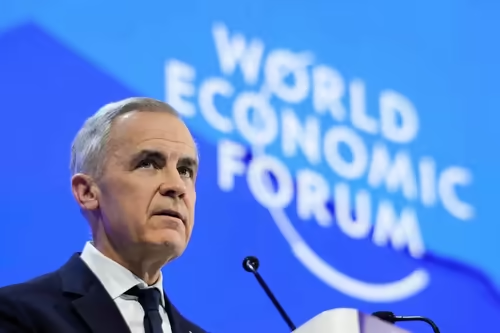
In a speech that has sent shockwaves through diplomatic corridors from Washington to Brussels, Canadian Prime Minister Mark Carney delivered a blistering critique of the foundational myth of Western foreign policy: the “rules-based international order.” Calling it nothing more than a “fiction,” Carney accused allied nations—including his own—of willfully ignoring the glaring contradictions between their lofty rhetoric and geopolitical reality .
His core argument? For decades, the West tolerated—and even celebrated—American hegemony because it served their interests. But now, as U.S. leadership grows more erratic and transactional, that convenient silence has become untenable. This is not just criticism; it’s a profound confession from within the heart of the liberal democratic alliance.
What Is the ‘Rules-Based Order’—And Why Call It a Fiction?
The term “rules-based international order” has been a cornerstone of Western diplomacy since the end of World War II. It refers to a system where global affairs are governed by agreed-upon norms, treaties, and institutions like the United Nations, WTO, and International Court of Justice—rather than raw power or unilateral action.
But Carney argues this system was always selective. “We avoided calling out the gaps between rhetoric and reality,” he said, pointing to instances where the U.S. bypassed the UN Security Council (e.g., Iraq 2003), imposed extraterritorial sanctions, or withdrew from climate and arms control agreements—all while demanding others abide by the “rules.”
By labeling it a rules-based order fiction, Carney isn’t rejecting multilateralism—he’s exposing its weaponization. The rules, he implies, were never universal; they were applied when convenient and ignored when they constrained U.S. power.
Carney’s Scathing Indictment of Western Hypocrisy
Carney’s most damning line cut deep: “You cannot live within the lie of mutual benefit through integration when integration becomes the source of your subordination.”
This statement captures the growing frustration among U.S. allies who feel economically and strategically dependent yet politically disrespected. Canada, in particular, has faced repeated threats from Donald Trump—from tariffs on steel and aluminum to demands to renegotiate NAFTA (now USMCA) and even suggestions of annexation .
Carney stopped short of naming Trump directly, but the context was unmistakable. His speech signals a shift from polite deference to principled dissent—a rare move for a leader whose country shares the world’s longest undefended border with the U.S.
The Trump Factor: Rising Tensions with the U.S.
While Carney’s critique is rooted in long-term structural issues, the timing is undeniably tied to the resurgence of Donald Trump in American politics. Even before officially assuming office again (as of January 2026), Trump has already made hostile remarks toward Canada, including renewed threats to impose 25% tariffs on Canadian exports and questioning the country’s sovereignty .
For Canadians, this isn’t abstract geopolitics—it’s an existential economic threat. Over 75% of Canada’s exports go to the U.S. . Living under the shadow of a neighbor who views your economy as a “rip-off” creates a form of “subordination through integration,” exactly as Carney described.
Historical Context: How the West Enabled U.S. Hegemony
Carney’s remarks reflect a broader reckoning happening across Europe and North America. For years, Western leaders justified U.S. exceptionalism by arguing that American power provided essential “public goods”—security via NATO, dollar liquidity, and global stability.
But that bargain assumed responsible stewardship. As the U.S. retreats into nationalism, allies are reevaluating the cost of complicity. Key examples include:
- 2003 Iraq War: Many allies privately opposed it but offered muted criticism.
- Extraterritorial Sanctions: European firms fined billions under U.S. laws like CAATSA.
- Climate Withdrawal: The Paris Agreement exit left global efforts in disarray.
As Carney put it, the West “excused” these actions because the benefits outweighed the moral cost—until they didn’t.
Global Reactions and Geopolitical Implications
Carney’s speech has been met with cautious applause from Global South nations long critical of Western double standards. Meanwhile, in Washington, reactions range from outrage to concern. Some see it as a betrayal; others as a necessary wake-up call.
Strategically, this could accelerate efforts to build alternative frameworks—like deeper EU-Canada trade ties or expanded BRICS+ engagement. It also underscores a key truth: the unipolar moment is over, and even loyal allies are no longer willing to be junior partners in a system they didn’t design.
Canada at a Crossroads: Sovereignty vs. Alliance
For Canada, this is more than rhetoric—it’s a strategic pivot. Carney’s government is already diversifying trade (e.g., CETA with Europe, Indo-Pacific Strategy) and boosting defense autonomy. The message is clear: Canada values its partnership with the U.S., but not at the cost of its sovereignty or principles. Learn more about Canada’s evolving foreign policy in our analysis on [INTERNAL_LINK:canada-global-strategy-2026].
Conclusion
Mark Carney’s declaration that the rules-based order fiction must end is a watershed moment in post-Cold War diplomacy. It’s not an attack on cooperation—it’s a demand for honesty. By acknowledging that the West excused U.S. hegemony for too long, Carney has opened the door to a more equitable, transparent, and truly rules-based future. Whether other leaders follow suit will determine if this is a lone voice—or the start of a new global consensus.
Sources
[1] Times of India. “‘Rules-based order a fiction’: Canadian PM says West excused US hegemony”.
[2] BBC News. “Trump’s history of controversial remarks about Canada”.
[3] Government of Canada. “Trade and Investment by Country – United States”. https://www.tradecommissioner.gc.ca/