Table of Contents
- The Call That Shook Silicon Valley
- What Was Amazon’s Controversial Move?
- How the Trump Tariffs Fallout Unfolded
- Andy Jassy Finally Breaks His Silence
- Who Really Pays for Tariffs? Sellers vs. Consumers
- Political Implications: Business vs. the Bully Pulpit
- Broader Impact on Global E-Commerce
- Conclusion
- Sources
The Call That Shook Silicon Valley
In a scene straight out of a political thriller, former President Donald Trump reportedly placed an angry phone call to Jeff Bezos—the founder of Amazon and owner of The Washington Post—after learning that Amazon planned to explicitly display how U.S. tariffs were increasing product prices for American shoppers. Sources described Trump as “pissed” and “livid,” viewing the move not just as a business decision, but as a direct political challenge .
This wasn’t just a spat between a billionaire and a former president. It was a flashpoint in the ongoing battle over trade policy, corporate transparency, and the real-world consequences of protectionist economics. Months later, Amazon CEO Andy Jassy has finally addressed the controversy, confirming what many suspected: the Trump tariffs fallout is hitting consumers’ wallets.
What Was Amazon’s Controversial Move?
Amazon’s plan was simple yet bold: to add a line item or label on certain products indicating that their price included additional costs due to U.S. import tariffs—many of which were imposed during Trump’s presidency as part of his aggressive trade war with China.
The goal? Transparency. By showing shoppers exactly how tariffs inflate prices, Amazon aimed to educate consumers about the hidden costs of trade policy. But to the Trump administration—and later, to Trump himself—this was seen as an act of economic sabotage.
At the time, a White House spokesperson went so far as to label Amazon’s initiative a “hostile act” against American economic policy . The message was clear: don’t make the president look bad by exposing the downsides of his signature trade strategy.
How the Trump Tariffs Fallout Unfolded
The tariffs in question—primarily under Section 301 of the Trade Act of 1974—slapped duties of up to 25% on over $370 billion worth of Chinese goods. While intended to protect U.S. manufacturing, multiple studies, including one from the National Bureau of Economic Research (NBER), found that American importers and consumers bore nearly the entire cost .
Amazon, as one of the world’s largest marketplaces, became a natural battleground. With millions of third-party sellers sourcing goods from China, the platform felt the tariff squeeze acutely. Some sellers absorbed the extra costs to stay competitive; others passed them directly to buyers. Amazon’s proposed labeling system would have made this invisible tax visible—a step too far for Trump loyalists.
Andy Jassy Finally Breaks His Silence
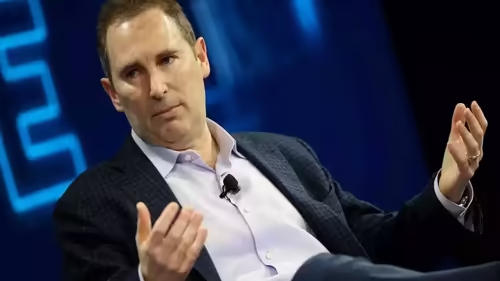
After months of public speculation, Amazon CEO Andy Jassy has confirmed the core truth behind the controversy. In a recent earnings call follow-up, Jassy stated: “Tariffs have absolutely contributed to increased costs across our supply chain. Some sellers are eating those costs, but many are passing them on to customers. That’s just economic reality.”
While Jassy stopped short of reiterating Amazon’s original labeling plan—likely to avoid reigniting political flames—he didn’t back down from the underlying principle. “We believe customers deserve clarity about what they’re paying for,” he added, signaling that transparency remains a core value, even if the execution has been paused.
Who Really Pays for Tariffs? Sellers vs. Consumers
The data is unequivocal: tariffs are taxes paid by the importing country. A 2023 U.S. International Trade Commission report found that:
- Over 90% of tariff costs were passed on to U.S. businesses and consumers.
- Small and medium-sized e-commerce sellers were hit hardest due to thin margins.
- Consumer prices on tariff-affected goods rose by an average of 3–5% .
On Amazon, this plays out daily. A $20 kitchen gadget from Shenzhen might now cost $21.50—not because Amazon wants it to, but because the U.S. government added a tariff. The real question isn’t who *should* pay, but who *can* afford to.
Political Implications: Business vs. the Bully Pulpit
This episode highlights a growing tension in American capitalism: Can corporations remain neutral in an era of hyper-partisan policy? Amazon, already under fire from both left and right, found itself in the crosshairs simply for telling the truth about pricing.
Trump’s reaction—calling Bezos personally—reveals a deeper pattern: using personal leverage to control narratives. It’s a tactic that blurs the line between governance and grievance. For more on how politics shapes tech, see our analysis on [INTERNAL_LINK:big-tech-and-political-pressure].
Broader Impact on Global E-Commerce
Beyond the headlines, the Trump tariffs fallout has reshaped global supply chains. Many Amazon sellers have shifted sourcing to Vietnam, India, or Mexico to avoid U.S. tariffs on Chinese goods. While this diversification has long-term benefits, it also increases complexity and cost.
Moreover, the incident has made other tech giants wary of similar transparency efforts. If showing tariff impacts is deemed “hostile,” what’s next? Will companies hide carbon footprints or labor costs to avoid political backlash? The chilling effect is real.
Conclusion
The feud between Trump and Amazon over tariff disclosures is more than a celebrity clash—it’s a case study in how trade policy, corporate responsibility, and political power collide. While Andy Jassy’s recent comments confirm the economic reality of the Trump tariffs fallout, the larger lesson is clear: in today’s polarized climate, even basic transparency can become a political lightning rod. As tariffs continue to shape global commerce, consumers deserve honesty—not silence—from the platforms they trust.
Sources
[1] Times of India. “Trump tariffs fallout: Trump’s angry call to Jeff Bezos; Amazon CEO Andy Jassy breaks silence”.
[2] National Bureau of Economic Research (NBER). “The Incidence of the 2018 Tariffs on U.S. Prices and Welfare”. https://www.nber.org/
[3] U.S. International Trade Commission. “Economic Effects of U.S. Tariffs on Chinese Goods”. https://www.usitc.gov/