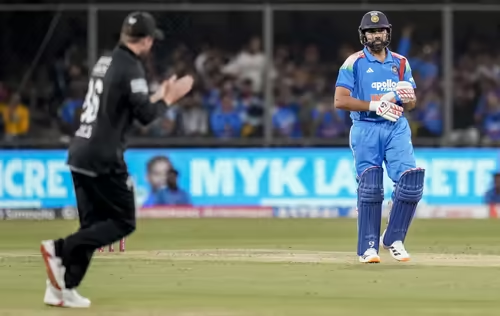
It was supposed to be a triumphant return to the ODI captaincy. Instead, Rohit Sharma’s latest outing has sparked a serious debate about his current form, motivation, and future in international cricket. His dismissal for just 11 runs in the decisive third ODI against New Zealand on Sunday wasn’t just another failure—it was the final straw that led veteran commentator Simon Doull to publicly question the Indian skipper’s “real hunger” for the game .
This latest stumble is part of a worrying trend for the 38-year-old opener, who now plays only limited-overs cricket. His struggles throughout the series have raised legitimate concerns among fans and pundits alike: is the lure of the 2027 ODI World Cup too distant to drive a player of his stature? This article dives deep into the controversy surrounding Rohit Sharma form, the expert critiques, and what it means for India’s future plans.
Table of Contents
- The Deepening Rohit Sharma Form Crisis
- Simon Doull’s Scathing Assessment: ‘No Matter Who You Are’
- Is the 2027 World Cup Too Far Away to Motivate?
- Kohli Shines as Rohit Falters: A Tale of Two Legends
- What’s Next for India’s ODI Opening Slot?
- Conclusion
- Sources
The Deepening Rohit Sharma Form Crisis
The numbers don’t lie. In the recently concluded three-match ODI series against New Zealand, Rohit Sharma managed a paltry total of just 45 runs across three innings—an average of 15.00. His highest score was a mere 23, and his final knock of 11 in the series decider at the Wankhede Stadium left the home crowd stunned and silent .
This isn’t an isolated incident. Over the past year, Rohit Sharma form in ODIs has been inconsistent at best. While he remains a destructive force on his day, those days are becoming increasingly rare. The problem is amplified by the fact that he’s no longer playing Test or T20I cricket, meaning his entire international focus is on the 50-over format—a format where consistency from the top order is non-negotiable.
Simon Doull’s Scathing Assessment: ‘No Matter Who You Are’
Former New Zealand fast bowler and respected commentator Simon Doull didn’t mince words during the broadcast. Pointing to Rohit’s recurring dismissals—often caught in the deep while attempting big shots early in his innings—Doull suggested a lack of intent and preparation.
“It doesn’t matter who you are. If you’re not performing, questions will be asked. And right now, you have to wonder where his real hunger is,” Doull stated bluntly .
Doull went on to argue that with so few ODIs scheduled between now and the 2027 World Cup, players like Rohit might struggle to stay match-fit and mentally engaged. The scarcity of games removes the constant pressure to perform, potentially dulling the competitive edge that once defined the “Hitman.”
Is the 2027 World Cup Too Far Away to Motivate?
This is the crux of the issue. At 38, Rohit is acutely aware that the 2027 ODI World Cup in South Africa could be his last chance at global glory in this format. But with over a year until the next major bilateral ODI series, and only a handful of matches scheduled before the tournament, maintaining peak intensity is a genuine challenge.
Compare this to the build-up to the 2023 World Cup, where India played a packed calendar of ODIs. That constant exposure kept players sharp. Now, the ICC’s congested schedule—prioritizing T20 leagues and World Test Championship cycles—has starved the ODI format of relevance, leaving veterans like Rohit in a limbo.
Kohli Shines as Rohit Falters: A Tale of Two Legends
While Rohit struggled, his long-time teammate Virat Kohli delivered when it mattered most. Kohli topped the series run charts with a commanding 240 runs, including a brilliant century in the second ODI . His ability to anchor the innings and accelerate at will was a masterclass in modern ODI batting.
The contrast was stark. Kohli, also in the twilight of his career, appears driven by a relentless desire to prove himself, while Rohit’s body language and shot selection have suggested a player searching for answers. This divergence has only fueled the narrative that Rohit’s fire may be dimming.
What’s Next for India’s ODI Opening Slot?
With the 2027 World Cup on the horizon, the BCCI and selectors face a tough call. Do they continue to back a proven champion in decline, or do they blood younger talent?
Several promising options are emerging:
- Yashasvi Jaiswal: The explosive left-hander has already shown his class in Tests and could be a natural fit at the top in ODIs.
- Ruturaj Gaikwad: The current T20I captain has a solid ODI record and thrives under pressure.
- Shubman Gill: Already a mainstay in the middle order, a move back to the top could rejuvenate his game.
Experimentation is key. As [INTERNAL_LINK:india-odi-opening-combinations] shows, finding the right opening pair is critical for World Cup success. Sticking with a struggling Rohit might cost India valuable time in their preparations.
Conclusion
The scrutiny on Rohit Sharma form is not born out of malice but from a place of deep concern for Indian cricket’s future. He is a legend of the game, a five-time World Cup winner, and a leader who has carried the team through thick and thin. But sport is brutally meritocratic. As Simon Doull rightly pointed out, “no matter who you are,” performance is the ultimate currency. With the 2027 World Cup still distant and ODI opportunities scarce, the onus is on Rohit to rediscover his spark—or make way for the next generation. The clock is ticking.
Sources
- Times of India: ‘No matter who you are’: Rohit’s ‘real hunger’ questioned after poor series
- ESPNcricinfo: India vs New Zealand, 3rd ODI Match Report
- ICC Official Website: ICC Future Tours Programme Overview