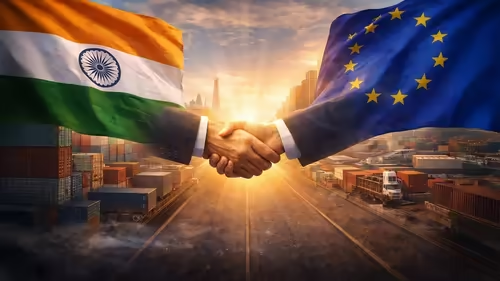
Geopolitical chaos often creates unexpected winners. And right now, India might be one of them. As former U.S. President Donald Trump reignites tensions with Europe over his controversial bid to exert influence on Greenland—backed by threats of 100% tariffs—the transatlantic alliance is showing cracks. In this vacuum of trust, the European Union is turning its gaze eastward. Experts now believe the long-stalled India EU Free Trade Agreement could see unprecedented momentum, with Brussels eager to lock in a strategic partnership with Asia’s fastest-growing major economy. For Indian exporters, manufacturers, and policymakers, this geopolitical realignment couldn’t come at a better time.
Table of Contents
- US-EU Tensions Over Greenland: A Brief Breakdown
- Where Does the India EU Free Trade Agreement Stand?
- How Trump’s Aggression Benefits India
- Key Indian Sectors Poised to Gain
- Challenges That Still Loom Large
- A Strategic Window for India’s Global Trade Ambitions
- Conclusion: Turning Geopolitical Shifts into Economic Wins
- Sources
US-EU Tensions Over Greenland: A Brief Breakdown
Donald Trump’s renewed fixation on Greenland—this time tied to threats of massive tariffs on European goods—has rattled Brussels. The EU views such coercion as a violation of sovereignty and trade norms. European Commission President Ursula von der Leyen’s firm rebuttal (“A deal is a deal”) underscores growing frustration with Washington’s transactional diplomacy. With the U.S. potentially destabilizing the Western economic order, the EU is actively seeking reliable, non-aligned partners to hedge against future American unpredictability. Enter India—a democratic, market-driven economy with a $4 trillion GDP and a rapidly expanding consumer base.
Where Does the India EU Free Trade Agreement Stand?
Negotiations for the India EU Free Trade Agreement (officially the EU-India Trade and Investment Agreement) began in 2007 but stalled in 2013 over disagreements on tariffs, data security, and labor standards. Talks resumed in 2022 with renewed vigor, and by late 2025, both sides had completed 18 rounds of negotiations. Key sticking points remain—particularly the EU’s demands on geographical indications (GIs) like Champagne or Parmesan, and India’s concerns about visa access for IT professionals. However, political will is now stronger than ever. EU Trade Commissioner Valdis Dombrovskis recently called India “a cornerstone of our de-risking strategy,” signaling a strategic pivot away from overreliance on any single power—including the U.S.
How Trump’s Aggression Benefits India
Trump’s Greenland gambit acts as a catalyst in three critical ways:
- Economic Diversification Urgency: If the U.S. imposes punitive tariffs, the EU needs alternative markets fast. India’s 1.4 billion consumers offer a compelling safety net.
- Strategic Alignment: Both India and the EU share concerns about China’s influence and support a rules-based global order—making them natural allies in turbulent times.
- Political Leverage: Finalizing an FTA with India sends a message to Washington: Europe has options. This isn’t just trade—it’s diplomacy through commerce.
According to a recent report by the European Centre for International Political Economy (ECIPE), concluding the deal could increase EU-India bilateral trade by up to 25% within five years .
Key Indian Sectors Poised to Gain
A ratified India EU Free Trade Agreement would be transformative for several Indian industries:
- Pharmaceuticals: India supplies 40% of the EU’s generic drugs. Lower tariffs could expand market access dramatically.
- Textiles & Apparel: Duty-free access would help Indian exporters compete with Bangladesh and Vietnam in the European market.
- IT & Digital Services: Easier visa regimes for professionals could boost India’s $250 billion tech services sector.
- Automobiles & Auto Components: While EU cars face high duties in India, component exports could surge under streamlined rules.
Challenges That Still Loom Large
Despite the momentum, hurdles persist. The EU insists on stronger protections for its GIs—meaning Indian producers may no longer be able to label local products as “basmati-style” or “feta-type.” India, meanwhile, wants greater mobility for its skilled workers, a sensitive issue in EU labor markets. Additionally, domestic opposition in both regions—farmers in the EU fearing cheap agri-imports, and Indian MSMEs worried about European competition—could slow ratification. Yet, with geopolitical winds shifting, compromise seems more likely than ever before.
A Strategic Window for India’s Global Trade Ambitions
This moment aligns perfectly with India’s broader trade strategy. Under Prime Minister Modi, India has signed FTAs with the UAE, Australia, and the UK, and is negotiating deals with Canada and the EU. A successful agreement with the EU would not only boost exports but also enhance India’s credibility as a stable, rules-abiding trade partner—critical as it seeks entry into global supply chains being reconfigured away from China. Moreover, it positions India as a key node in the “friend-shoring” trend reshaping 21st-century commerce.
Conclusion: Turning Geopolitical Shifts into Economic Wins
While Trump’s Greenland theatrics dominate headlines, the real story may be unfolding quietly in Brussels and New Delhi. The India EU Free Trade Agreement—once seen as a distant dream—is now on the cusp of reality, accelerated by transatlantic discord. For India, this isn’t just about lower tariffs; it’s about securing a seat at the high table of global economic governance. If handled wisely, this deal could become the cornerstone of India’s next decade of export-led growth. Stay ahead of the curve with our [INTERNAL_LINK:india-global-trade-strategy-2026] deep dive.