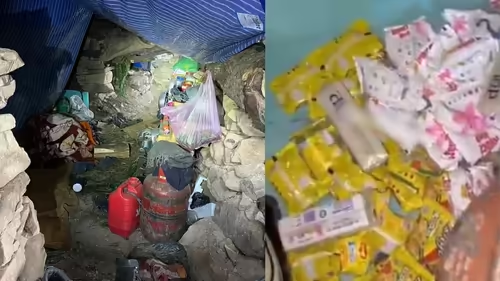
Deep in the snow-laden peaks of Kishtwar, at an altitude where oxygen thins and temperatures plummet below minus 10°C, Indian Army commandos stumbled upon a discovery that sent chills down spines far beyond the battlefield: a fully equipped terrorist bunker belonging to the Pakistan-based Jaish-e-Mohammad (JeM).
But this wasn’t just any hideout. Inside, neatly stacked like provisions for a long expedition, were 50 packets of Maggi noodles, 20 kilograms of rice, dried vegetables, cooking oil, tea leaves—and not one, but multiple LPG cylinders. This wasn’t a temporary shelter; it was a winter fortress designed to sustain militants for months without resupply.
The find came during a grueling counter-terrorism operation that culminated in a fierce gunfight, resulting in the supreme sacrifice of one elite commando and injuries to several others. Yet, the discovery of this JeM winter bunker has revealed a disturbing new tactic: terrorists are no longer just infiltrating—they’re settling in, preparing for prolonged stays in India’s most remote terrains.
Table of Contents
- The Kishtwar Encounter: A High-Altitude Showdown
- Inside the Bunker: What Security Forces Found
- Why Winter Bunkers Are a Growing Threat
- Jaish-e-Mohammad’s Tactical Shift
- Indian Army’s Response and Challenges
- Geopolitical Implications: Pakistan’s Denials
- Honoring the Fallen Commando
- Conclusion: Vigilance in the Hardest Terrain
- Sources
The Kishtwar Encounter: A High-Altitude Showdown
Acting on precise intelligence about foreign militant movement in the Warwan Valley—a notoriously difficult-to-access region flanked by glaciers and dense forests—units from the Rashtriya Rifles and Special Operations Group (SOG) launched a pre-dawn cordon on January 16, 2026.
What followed was a 36-hour standoff at over 12,000 feet. The terrorists, armed with AK-47s and grenades, used the rugged terrain to their advantage. Despite heavy snowfall and sub-zero conditions, security forces pressed on.
Tragically, Sepoy Rajesh Kumar, 28, from Bihar, was fatally wounded during the final assault. Three other personnel sustained serious injuries but are now stable.
Inside the Bunker: What Security Forces Found
Beyond weapons and ammunition, the cache inside the JeM hideout painted a picture of long-term occupation:
- Food Supplies: 50 Maggi packets, 20kg rice, lentils, dried potatoes, onions, and tea.
- Cooking Equipment: Two LPG cylinders, portable stoves, utensils, and fuel cans.
- Survival Gear: Thermal blankets, sleeping bags, solar chargers, and satellite phones.
- Propaganda Material: JeM pamphlets, digital storage devices with extremist content.
“This wasn’t a transit point,” said a senior officer. “They were planning to stay through the winter, possibly until spring infiltration routes reopened.”
Why Winter Bunkers Are a Growing Threat
Historically, terrorist activity in J&K drops during winter due to harsh weather and closed passes. But recent years show a shift:
- Climate Adaptation: Militants now use modern gear to survive extreme cold.
- Local Support Networks: Some hideouts receive covert supply drops via drones or sympathizers.
- Strategic Patience: Staying hidden allows them to avoid summer offensives and strike when least expected.
A 2025 report by the Institute for Defence Studies and Analyses (IDSA) warned that “winter entrenchment” is becoming a hallmark of Pakistan-backed groups like JeM and Lashkar-e-Taiba .
Jaish-e-Mohammad’s Tactical Shift
Once known for high-profile suicide attacks (like Pulwama 2019), JeM is now adopting guerrilla-style endurance tactics. Intelligence suggests they’re training recruits in high-altitude survival in Pakistan-administered Gilgit-Baltistan before infiltration.
The Maggi and rice aren’t just sustenance—they’re psychological tools. Familiar food helps maintain morale during isolation, a tactic borrowed from insurgent manuals worldwide.
Indian Army’s Response and Challenges
In response, the Army has intensified “Winter Dominance Drives”—specialized patrols using thermal drones, avalanche-resistant shelters, and AI-powered surveillance.
Yet, challenges remain:
- Vast, unguarded stretches along the Line of Control (LoC),
- Limited road access in regions like Kishtwar,
- Risk of avalanches hampering search operations.
Still, the swift neutralization of this cell shows improved coordination between intelligence and ground units.
Geopolitical Implications: Pakistan’s Denials
As expected, Pakistan denied any involvement, calling the bunker “fabricated.” But forensic analysis of recovered SIM cards and equipment points to procurement from Pakistani markets.
India is expected to raise the issue at the upcoming FATF review, seeking renewed scrutiny of Pakistan’s terror financing networks.
Honoring the Fallen Commando
Sepoy Rajesh Kumar, a decorated soldier with two prior gallantry commendations, was posthumously awarded the Sena Medal. His body was flown to Patna with full military honors.
“He died protecting our peace,” said his commanding officer. “We will not let his sacrifice be in vain.”
Conclusion: Vigilance in the Hardest Terrain
The unearthing of the JeM winter bunker is more than a tactical win—it’s a wake-up call. Terrorism is evolving, adapting to seasons, technology, and terrain. But so is India’s resolve. As soldiers brave blizzards to secure every ridge, the message is clear: no cave, no bunker, no mountain is beyond the reach of justice.
Sources
- Times of India: Maggi packets, 20kg rice, cylinders: JeM’s winter bunker unearthed
- Indian Army Press Release, Northern Command, January 17, 2026
- Ministry of Home Affairs: Annual Report on Left-Wing & Cross-Border Extremism, 2025
- Institute for Defence Studies and Analyses (IDSA): “Terror Tactics in High-Altitude Zones,” December 2025
- National Investigation Agency (NIA): Forensic Analysis Dossier #JEM-KISHTWAR/2026