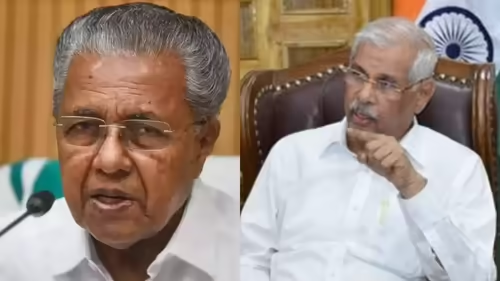
In a dramatic escalation of tensions between the elected government and the Raj Bhavan, Kerala’s legislative assembly witnessed a rare constitutional standoff this week. Governor Rajendra Vishwanath Arlekar delivered a governor’s address that significantly diverged from the version meticulously drafted and approved by the state cabinet—prompting Chief Minister Pinarayi Vijayan to take an unprecedented step: urging the Speaker to strike the governor’s spoken words from the official record and recognize only the cabinet-approved text as legitimate.
This incident isn’t isolated. It mirrors a growing pattern of friction between state governments and centrally appointed governors across India, most recently seen in Tamil Nadu, where the governor walked out of the assembly rather than read the prepared speech. But in Kerala, the stakes are even higher—touching on core democratic principles of ministerial responsibility and the limits of gubernatorial power.
Table of Contents
- What Is the Governor’s Address?
- What Happened in Kerala Assembly?
- Pinarayi Vijayan’s Strong Response
- Constitutional Protocol: Who Has the Final Say?
- The Tamil Nadu Precedent
- Why This Matters for Indian Federalism
- Conclusion: A Test for Democratic Norms
- Sources
What Is the Governor’s Address?
At the start of each new legislative session, the Governor of a state delivers a formal speech outlining the government’s agenda and policy priorities. Crucially, under Article 176(2) of the Indian Constitution, this address is not the governor’s personal statement—it is prepared by the Council of Ministers and reflects the elected government’s mandate.
The governor acts as a ceremonial head; their role is to read the speech, not rewrite it. This principle ensures that the executive remains accountable to the legislature and the people—not to the appointee of the Union government.
What Happened in Kerala Assembly?
According to sources from the Kerala Secretariat, the state cabinet finalized its draft of the governor’s address days before the assembly session and formally sent it to Raj Bhavan for delivery. However, during the session, Governor Arlekar omitted several paragraphs—particularly those highlighting welfare schemes, infrastructure projects, and critiques of central policies—and inserted new lines that aligned more closely with the BJP’s national narrative .
Notably, he skipped references to the state’s achievements in public health and education and avoided mentioning ongoing disputes with the Centre over fund allocations. Instead, he emphasized “national unity” and “constitutional morality” in ways that many legislators interpreted as politically loaded.
Pinarayi Vijayan’s Strong Response
CM Pinarayi Vijayan did not mince words. In a strongly worded statement, he declared: “The Governor has no authority to alter the cabinet-approved address. This is not just a breach of protocol—it’s an assault on the sovereignty of the elected government.”
He immediately wrote to Assembly Speaker A.N. Shamseer, requesting that the official Hansard (the verbatim record of proceedings) reflect only the original cabinet version. “The people of Kerala have a right to know what their government intends to do—not what an unelected representative chooses to say,” Vijayan asserted.
Constitutional Protocol: Who Has the Final Say?
Legal experts are clear: the Constitution places the responsibility for the content of the governor’s address squarely on the Council of Ministers. The Supreme Court, in multiple judgments—including the landmark Nabam Rebia case (2016)—has ruled that governors must act on the aid and advice of the cabinet in all matters except those explicitly reserved for discretionary powers.
Altering the speech without consent falls outside those discretionary powers. As constitutional scholar Dr. Menaka Guruswamy notes, “When a governor rewrites the address, they’re effectively substituting their political judgment for that of the democratically elected government—a dangerous precedent.”
The Tamil Nadu Precedent
Kerala’s crisis echoes events in Tamil Nadu in 2023, when Governor R.N. Ravi refused to read the DMK government’s prepared address and walked out of the assembly mid-session. That standoff lasted weeks and required intervention from the President’s office.
Eventually, the Union Ministry of Home Affairs issued an advisory reminding governors that they “shall not deviate from the text approved by the state cabinet.” Yet, enforcement remains weak, and political appointments often lead to partisan interpretations of the role.
Why This Matters for Indian Federalism
These recurring clashes aren’t just about speeches—they’re symptoms of a deeper erosion of federal balance. When governors, appointed by the Centre, routinely undermine state governments led by opposition parties, it weakens India’s pluralistic democracy.
Citizens suffer when policy announcements are censored or distorted. Investors lose clarity on state priorities. And trust in institutions frays. As Kerala’s Finance Minister K.N. Balagopal warned, “If every governor becomes a political auditor of state governments, cooperative federalism is dead.”
Conclusion: A Test for Democratic Norms
The controversy over the governor’s address in Kerala is more than a procedural dispute—it’s a litmus test for India’s commitment to constitutional morality and federal integrity. Will unelected appointees be allowed to override the will of elected representatives? Or will democratic norms prevail?
Pinarayi Vijayan’s demand for an accurate official record is not just about correcting a transcript; it’s about defending the very foundation of representative government. As similar battles brew in West Bengal, Punjab, and Delhi, the nation watches closely. For more on India’s federal challenges, explore our [INTERNAL_LINK:indian-federalism-crisis] series.
Sources
- Times of India: Kerala: Row over governor’s address in assembly — what happened
- Constitution of India, Article 176: Official Government Portal
- Supreme Court Judgments: Nabam Rebia vs Deputy Speaker (2016)
- The Hindu: Kerala CM protests changes in Governor’s address