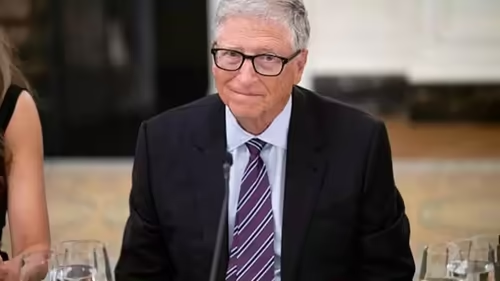
Bill Gates has long positioned himself as a global leader in the fight against climate change—funding clean energy startups, advocating for green innovation, and even publishing a book titled *How to Avoid a Climate Disaster*.
Yet a bombshell investigation has uncovered a stark contradiction: the **Gates Foundation Trust**—the financial engine behind his philanthropy—now holds **$254 million** in shares of major fossil fuel companies, including Chevron, BP, and Shell. This marks its largest stake in oil and gas extractors since 2017 .
The revelation has ignited fierce debate: Can a foundation genuinely champion climate solutions while profiting from the very industries driving planetary heating? Or is this a calculated, if controversial, strategy to maintain returns that fund life-saving global health programs?
Table of Contents
- The Numbers Behind the Controversy
- Bill Gates on Divestment: A History of Ambiguity
- Why the Foundation Still Invests in Fossil Fuels
- Criticism from Climate Advocates and Philanthropists
- The Broader Debate: Impact Investing vs. Divestment
- Conclusion: Hypocrisy or Pragmatic Philanthropy?
- Sources
The Numbers Behind the Controversy
According to U.S. Securities and Exchange Commission (SEC) filings reviewed by investigative journalists, the Gates Foundation Trust’s portfolio includes:
- $98 million in Chevron stock
- $82 million in Shell shares
- $74 million in BP holdings
These positions represent a **37% increase** from 2024 and are managed not by the foundation itself, but by external asset managers overseeing its endowment—the legal structure required to generate returns that fund the foundation’s charitable grants .
While the foundation’s direct grant-making arm does not invest in fossil fuels, the trust’s investment arm operates independently under fiduciary duty to maximize returns. Still, critics argue the distinction is semantic when both entities share the same name and mission.
Bill Gates on Divestment: A History of Ambiguity
Gates has never been a full-throated supporter of divestment. In a 2021 interview with CNBC, he stated: “I don’t think divestment has any impact on reducing emissions… It’s not like you’re taking money away from [oil companies]” .
He’s instead advocated for “green premium” technologies—like advanced nuclear, carbon capture, and next-gen biofuels—funded by high-return investments, even if they come from “dirty” sectors. “You need capital to fund innovation,” he argued.
However, in 2020, the Gates Foundation announced it would “phase out” direct investments in fossil fuel companies. The current $254M holding—indirect but substantial—suggests either a reversal or a loophole in that commitment.
Why the Foundation Still Invests in Fossil Fuels
The foundation defends its position on three grounds:
- Endowment necessity: The trust must generate ~$6 billion annually to fund global health, education, and development grants.
- Passive indexing: Much of the exposure comes from broad market index funds (e.g., S&P 500 ETFs), which include energy majors.
- Engagement over exclusion: Some asset managers argue shareholder engagement can push companies toward cleaner transitions more effectively than divestment.
Still, environmental groups counter that targeted exclusions are possible—and that other major endowments (like Ford Foundation and Rockefeller Brothers Fund) have fully divested without sacrificing returns .
Criticism from Climate Advocates and Philanthropists
“It’s cognitive dissonance at scale,” said Dr. Priya Nair, a climate policy researcher at the University of Oxford. “You can’t claim moral leadership on climate while your endowment profits from ecological destruction.”
Even within philanthropy, voices are rising. The #DivestPhilanthropy coalition called the holdings “a betrayal of intergenerational justice.” Meanwhile, activist Greta Thunberg tweeted: “When billionaires ‘solve’ climate change but still own oil stocks, they’re part of the problem.”
The Broader Debate: Impact Investing vs. Divestment
This controversy reflects a deeper philosophical split in sustainable finance:
- Divestment camp: Believes removing capital stigmatizes polluters and redirects funds to clean alternatives.
- Impact/engagement camp: Argues staying invested allows influence over corporate behavior and funds green R&D through profits.
Harvard Business Review notes that while divestment has symbolic power, “engagement has yielded measurable emissions reductions in European utilities” . Yet in the U.S., oil majors have largely resisted meaningful transition plans.
Conclusion: Hypocrisy or Pragmatic Philanthropy?
The **Gates Foundation fossil fuel investments** expose a tension at the heart of modern philanthropy: Can you do good with money earned—or preserved—through systems that cause harm? For Gates, the answer seems to be yes—as long as the net outcome saves lives. But for a planet racing toward climate tipping points, many argue that neutrality is no longer an option. As scrutiny intensifies, the foundation may face pressure to align its wallet with its words. For more on ethical investing trends, see our analysis on [INTERNAL_LINK:the-rise-of-esg-in-global-philanthropy].
Sources
- Times of India. “Report claims caught Bill Gates lie on climate claims: Gates Foundation’s millions of dollar investments in fossil fuels.” https://timesofindia.indiatimes.com/…
- CNBC Interview with Bill Gates, February 2021.
- Rockefeller Brothers Fund. “Our Divestment Journey,” 2023 Report.
- Harvard Business Review. “The Real Impact of Shareholder Engagement on Climate,” October 2025.
- SEC Form 13F Filings – Gates Foundation Trust, Q4 2025.