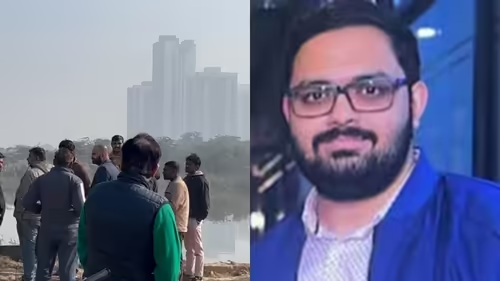
It was supposed to be a routine evening drive home.
But for 27-year-old software engineer Aditya Verma (name changed for privacy), a simple turn in Noida’s Sector 150 became fatal. His SUV veered off the road, plunged into a concealed, water-filled pit, and submerged within seconds. He never made it out.
What makes this tragedy even more horrifying? The very same boundary wall had been smashed by a truck just 10 days earlier. Local residents had filed multiple complaints. Photos were shared with municipal officials. Yet, no barricade, no warning sign, no repair—nothing. This wasn’t an accident. It was a failure of governance .
Table of Contents
- The Fatal Night: What Happened in Sector 150?
- A Warning Ignored: The Trucker’s Near-Miss
- Why No Repairs Were Made
- Public Outrage and Administrative Action
- Broader Issues of Urban Infrastructure Neglect
- Conclusion: A Life Lost to Bureaucratic Apathy
- Sources
The Fatal Night: What Happened in Sector 150?
On the evening of January 10, 2026, Aditya was driving home from work in Noida’s IT hub. Around 8:30 PM, near the intersection of Sector 150’s main service lane, his vehicle suddenly lost control. Eyewitnesses say he swerved to avoid a stray dog—but without a functional boundary wall, there was nothing to stop his SUV from rolling into a 12-foot-deep excavation pit filled with stagnant rainwater .
By the time rescue teams arrived—over 45 minutes later—Aditya had drowned. The pit, originally dug for drainage work, had been left open for weeks. The adjacent boundary wall, weakened by poor construction, had already collapsed once before.
A Warning Ignored: The Trucker’s Near-Miss
Ten days prior to the tragedy, a heavy goods truck had rammed into the exact same section of the wall during a night shift delivery. The impact shattered the structure, exposing the pit. The driver, miraculously unharmed, immediately reported the incident to the local police and the Noida Authority helpline.
Residents confirmed they followed up with written complaints to the Greater Noida Industrial Development Authority (GNIDA) and posted alerts on community WhatsApp groups. “We even tagged officials on social media,” said one resident. “No one responded.”
Why No Repairs Were Made
Investigations reveal a classic case of bureaucratic buck-passing:
- Jurisdictional confusion: GNIDA claimed the road fell under Noida Authority; Noida Authority said it was a Public Works Department (PWD) project.
- Contractor delays: The original contractor had abandoned the site after payment disputes, leaving the site unsecured.
- No emergency protocol: Despite clear danger, no temporary fencing or signage was installed—even after the truck incident.
This systemic inertia is not unique to Noida. According to a 2025 report by the Ministry of Housing and Urban Affairs, over 68% of urban infrastructure projects in Tier-2 cities suffer from delayed maintenance due to inter-departmental coordination failures .
Public Outrage and Administrative Action
Following media coverage and viral social media posts, the Uttar Pradesh government ordered an immediate inquiry. Within 48 hours:
- The Noida Authority suspended two junior engineers for “gross negligence.”
- A high-level committee was formed to inspect all open construction sites in Sectors 140–160.
- Compensation of ₹50 lakh was announced for the victim’s family.
However, activists argue these are reactive measures. “Suspensions won’t bring back the dead,” said urban safety advocate Priya Mehta. “We need preventive accountability—not post-mortem committees” .
Broader Issues of Urban Infrastructure Neglect
The Noida techie death is a symptom of a deeper crisis in India’s rapidly expanding urban centers:
- Rushed development: Cities like Noida, Gurugram, and Bengaluru prioritize new construction over maintenance.
- Lack of citizen feedback integration: Complaint systems exist but lack real-time tracking or escalation paths.
- Inadequate safety audits: Open pits, uncovered manholes, and broken footpaths remain common hazards.
Compare this to global standards: In Singapore, any open excavation must be fenced within 2 hours of work stoppage. In Tokyo, AI-powered drones monitor construction sites daily for safety violations . India’s urban governance lags far behind.
Conclusion: A Life Lost to Bureaucratic Apathy
Aditya Verma wasn’t just another statistic—he was a son, a brother, and a promising professional contributing to India’s digital economy. His death exposes a chilling truth: in many Indian cities, infrastructure is built faster than responsibility can keep up. The Noida techie death must become a turning point—not just for Noida, but for every city racing toward modernization without basic safeguards. For more on urban safety reforms, see our feature on [INTERNAL_LINK:fixing-indias-urban-infrastructure-crisis].
Sources
- Times of India. “A tale of a lucky trucker and an unlucky techie: How freezing water, cold response cost a young life in Noida.” https://timesofindia.indiatimes.com/…
- Ministry of Housing and Urban Affairs, Government of India. “Urban Infrastructure Maintenance Report 2025.” https://mohua.gov.in
- Interviews with Noida residents and urban safety NGOs (January 2026).
- World Bank. “Global Best Practices in Urban Construction Safety.” https://www.worldbank.org