Table of Contents
- A Breather for Delhi Residents
- What is GRAP and Why Was Stage IV Imposed?
- The Data Behind the Decision
- What Restrictions Remain in Place?
- Is This a Permanent Fix or Temporary Relief?
- Public Health Implications and Expert Opinions
- Conclusion: Staying Vigilant in the Fight Against Delhi Pollution
- Sources
A Breather for Delhi Residents
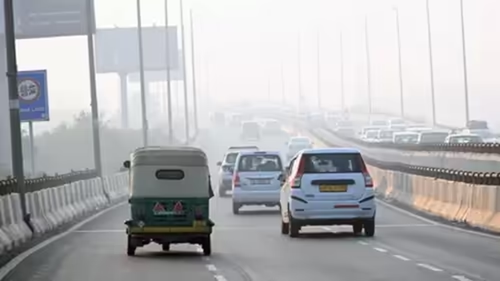
After days of choking under a thick, hazardous haze, residents of India’s capital have been granted a much-needed reprieve. The Commission for Air Quality Management (CAQM) announced on January 17, 2026, that it has officially revoked the stringent Stage IV measures of the Graded Response Action Plan (GRAP) for the Delhi-NCR region . This decision comes just three days after these emergency protocols were re-imposed, triggered by air quality plunging into the ‘severe+’ category.
The rollback is a direct response to a “slight improvement” in the city’s air quality index (AQI), which has moved from the dire ‘severe+’ zone back into the ‘severe’ category. While this is far from clean air, it represents a critical enough shift for authorities to ease the most disruptive restrictions. For a city where daily life had ground to a near halt, this offers a glimmer of hope—but experts warn it’s no time to let our guard down on Delhi pollution.
What is GRAP and Why Was Stage IV Imposed?
The Graded Response Action Plan (GRAP) is a set of emergency measures designed to combat the annual air pollution crisis that blankets Delhi every winter. It’s a tiered system, with actions escalating in severity as air quality deteriorates from ‘poor’ to ‘severe+’. Stage IV, the highest level, is reserved for the ‘severe+’ category (AQI above 450).
When activated, GRAP IV brings the city to a virtual standstill. It includes bans on non-essential construction, the closure of schools and colleges, a complete halt to diesel-powered truck entry (except for essential goods), and the shutdown of power plants in the vicinity. Its re-imposition earlier this week was a stark reminder of how quickly the situation can spiral out of control .
Key Triggers for GRAP Stage IV
- Air Quality Index (AQI) consistently above 450 (‘severe+’ category).
- Meteorological conditions like low wind speed and temperature inversion that trap pollutants close to the ground.
- Contributing factors such as farm stubble burning in neighboring states, local vehicular emissions, and industrial activity.
The Data Behind the Decision
The CAQM’s decision wasn’t made in a vacuum. It was based on real-time data from monitoring stations across the National Capital Region and forecasts from the Indian Institute of Tropical Meteorology (IITM). The forecast indicated a change in wind direction and a slight increase in wind speed, which would help disperse the accumulated pollutants .
While the AQI remains in the ‘severe’ range (400-450), the projected improvement over the next 48-72 hours gave authorities the confidence to lift the most extreme measures. However, this is a dynamic situation, and the CAQM has emphasized that the decision will be reviewed daily. A sudden deterioration could see Stage IV snap back into place with little notice.
What Restrictions Remain in Place?
It’s crucial to understand that the lifting of GRAP IV does not mean a return to normalcy. Stages I, II, and III of the action plan are still fully active, meaning many restrictions continue to impact daily life:
- Stage III (Severe AQI): Ban on construction and demolition activities in linear public projects (like roads and flyovers), increased frequency of mechanized road sweeping, and intensified anti-dust drives.
- Stage II (Very Poor AQI): Closure of brick kilns, hot mix plants, and stone crushers. Increased parking fees to discourage private vehicle use.
- Stage I (Poor AQI): Strict enforcement against open burning of waste and garbage, and intensified public transport services.
For more on how these policies affect urban life, explore our [INTERNAL_LINK:delhi_air_quality_guide] for practical tips and updates.
Is This a Permanent Fix or Temporary Relief?
This improvement is almost certainly temporary. The underlying causes of Delhi pollution—a toxic cocktail of industrial emissions, vehicular exhaust, construction dust, and seasonal crop residue burning—have not been resolved. The current respite is largely due to favorable weather, not a fundamental change in pollution sources.
Experts from organizations like the Centre for Science and Environment (CSE) have long argued that GRAP is a band-aid solution. They advocate for year-round, systemic changes, such as a faster transition to electric vehicles, a permanent ban on polluting industries near the capital, and sustainable alternatives for farmers to manage stubble without burning .
Public Health Implications and Expert Opinions
Even with the AQI now in the ‘severe’ category, the air in Delhi remains hazardous to health. The World Health Organization (WHO) states that there is no safe level of air pollution. Prolonged exposure to these levels can lead to serious respiratory and cardiovascular problems, especially for children, the elderly, and those with pre-existing conditions.
Dr. Arun Sharma, a senior pulmonologist at AIIMS, advises residents to continue wearing N95 masks when outdoors and to limit physical exertion. “Just because the emergency measures are lifted doesn’t mean the air is safe to breathe,” he cautions. “The health risks remain very high.” For authoritative global context on air quality standards, you can refer to the World Health Organization’s Air Quality Guidelines.
Conclusion: Staying Vigilant in the Fight Against Delhi Pollution
The revocation of GRAP IV restrictions is welcome news, but it should be seen as a brief pause, not a victory. The fight against Delhi pollution is a marathon, not a sprint. While the immediate crisis has eased thanks to a shift in the wind, the structural issues that make Delhi one of the world’s most polluted cities remain firmly in place. Citizens must stay vigilant, continue to follow health advisories, and demand long-term, sustainable solutions from their leaders. The air may be slightly clearer today, but the battle for a truly breathable future is far from over.
Sources
- The Times of India: Delhi pollution: GRAP IV restrictions revoked; decision after slight improvement
- Commission for Air Quality Management (CAQM) official directives on GRAP implementation .
- Centre for Science and Environment (CSE) reports on Delhi’s air pollution sources and solutions .
- World Health Organization (WHO) – Air Quality and Health.