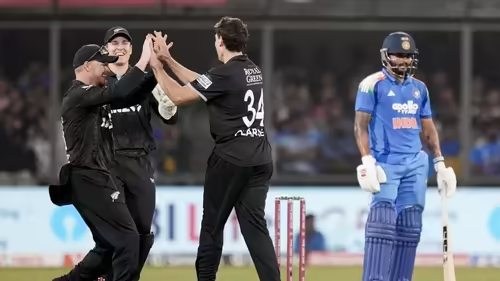
When New Zealand lifted the ODI series trophy on Indian soil in January 2026, it wasn’t just a victory—it was a seismic shift in cricketing history. For the first time ever, the Black Caps won a multi-game ODI series in India. And one man made sure the Indian team didn’t forget how it happened: Ravichandran Ashwin.
In a rare public critique, the veteran off-spinner pulled no punches. “We played very soft cricket,” Ashwin declared, his words echoing through stunned fan forums and newsrooms alike. “There was no pressure. No fight. Just… flat.”
Coming from a player known for his fierce competitiveness and tactical brilliance, this wasn’t just disappointment—it was an indictment. And it raises urgent questions: What went wrong? Why did a depleted New Zealand side—missing Kane Williamson, Trent Boult, and Tim Southee—outplay a full-strength Indian squad on home turf?
Table of Contents
- Historic Defeat: India’s First Home ODI Loss to NZ
- Ashwin’s Scathing Assessment: What He Said
- Why Was India’s Cricket ‘Soft’? An Analysis
- New Zealand’s Underdog Triumph
- Fan and Expert Reactions
- What Next for Team India?
- Conclusion: A Wake-Up Call, Not Just a Loss
- Sources
Historic Defeat: India’s First Home ODI Loss to NZ
Before this 3-match series, India had never lost an ODI series to New Zealand at home. Ever. Across 12 previous bilateral contests since 1988, the hosts were unbeaten .
But in January 2026, that streak ended—not with a whimper, but with a worrying pattern of passivity. New Zealand won the first two ODIs convincingly (by 5 wickets and 42 runs), sealing the series before the dead rubber in Mumbai.
What made it more shocking? The Kiwis were without their captain Kane Williamson (rested), spearhead Trent Boult (injury), and veteran Tim Southee (personal reasons). Yet their young core—led by Tom Latham and Rachin Ravindra—played with clarity, aggression, and purpose.
Ashwin’s Scathing Assessment: What He Said
Speaking on a post-series panel, Ashwin minced no words:
“I don’t think we applied any pressure. At no stage did New Zealand feel like they were under siege. We batted softly, bowled softly, fielded softly. It was very soft cricket.”
He emphasized that home advantage means nothing without intent. “You can’t just show up and expect the pitch or the crowd to win it for you. You have to earn it. And we didn’t.”
Ashwin also noted the contrast in body language: “Their players ran between wickets like their careers depended on it. Ours looked like they were waiting for the game to end.”
Why Was India’s Cricket ‘Soft’? An Analysis
Ashwin’s “soft cricket” label points to deeper systemic issues:
- Lack of Aggression in Bowling: Indian pacers bowled too many short balls on flat pitches, allowing NZ batters to settle. Death bowling lacked yorkers and variations.
- Passive Field Placements: Captains set defensive fields even during middle overs, inviting boundaries instead of building pressure.
- Batting Complacency: Top-order collapses were followed by slow rebuilds instead of counter-attacks. Only Shubman Gill showed urgency.
- Mental Fatigue: After a packed 2025 schedule (World Test Championship, Champions Trophy, T20 World Cup), the team may be suffering from burnout.
As [INTERNAL_LINK:indian-cricket-psychology] explores, mental sharpness often declines when teams assume dominance is guaranteed.
New Zealand’s Underdog Triumph
While India faltered, New Zealand executed a masterclass in disciplined cricket:
- Rachin Ravindra scored 218 runs in the series, including a match-winning 112 in Pune.
- Mitchell Santner led the spin attack with economy under 4.5 in all three games.
- Their fielding saved 15+ runs per match—dives, run-outs, and clean pick-ups were constant.
Coach Gary Stead called it “a testament to our culture—no matter who’s playing, the standards don’t drop.”
Fan and Expert Reactions
Indian fans expressed outrage on social media, with #SoftCricket trending for 48 hours. Former captain Sourav Ganguly echoed Ashwin: “This isn’t about talent. It’s about hunger.”
However, some defended the team, citing workload management and the need to blood young players. But as Ashwin countered: “You can rotate players—but not standards.”
What Next for Team India?
With the 2027 ODI World Cup on the horizon, this loss must be a catalyst. Key steps include:
- Reinstating aggressive captaincy—possibly re-evaluating leadership roles.
- Investing in death-bowling specialists through domestic tournaments.
- Implementing mental conditioning programs focused on high-pressure scenarios.
The upcoming tour of South Africa will be the first real test of whether this series was a wake-up call—or just another stumble.
Conclusion: A Wake-Up Call, Not Just a Loss
The India vs New Zealand ODI series loss is more than a statistical anomaly. It’s a mirror held up to a team that may have grown too comfortable in its own aura. Ashwin’s blunt truth—“very soft cricket”—isn’t criticism for its own sake. It’s a plea for pride, intensity, and the kind of relentless cricket that once defined Indian greats.
Because on home soil, against a second-string opponent, anything less than total commitment isn’t just disappointing—it’s unacceptable.
Sources
- Times of India: ‘Played very soft cricket’: Ashwin pulls no punches
- ESPNcricinfo Statsguru: India vs New Zealand ODI Series History
- International Cricket Council (ICC): Player Performance Standards & Conduct Guidelines
- New Zealand Cricket Official Report: Tour of India 2026 Summary