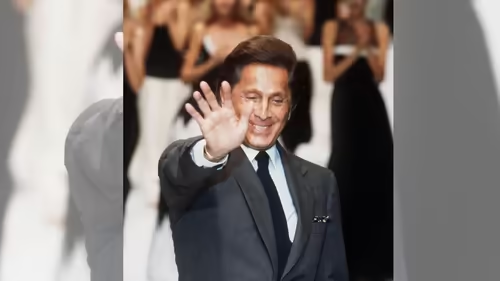
The world of high fashion has lost its most regal architect. Valentino Garavani, the Italian maestro who draped royalty, movie stars, and first ladies in timeless elegance, has died at the age of 93. His passing isn’t just the end of a life—it’s the closing of a golden chapter in fashion history, one defined by precision, romance, and that unmistakable shade of crimson known simply as ‘Valentino Red.’
But beyond the sequins and silk lies a deeper question: In an age of fast fashion, influencer trends, and AI-designed collections, was Garavani the last true couturier—a craftsman who believed fashion was art, not content? Let’s revisit the life, legacy, and lasting impact of a man who didn’t just make clothes—he made legends.
Table of Contents
- Who Was Valentino Garavani?
- The Birth of a Fashion Empire
- Valentino Garavani Death and Legacy
- Iconic Moments Dressed in Valentino
- The Secret of ‘Valentino Red’
- Was He the Last True Couturier?
- Conclusion: An Enduring Silhouette
- Sources
Who Was Valentino Garavani?
Born in Voghera, Italy, in 1932, Valentino Clemente Ludovico Garavani showed an early obsession with design—reportedly sketching dresses as a child and declaring his dream to become a couturier by age nine. He studied in Paris under Jean Dessès before launching his own label in Rome in 1959 .
Unlike many designers who chased trends, Valentino built his brand on consistency: clean lines, opulent fabrics, and an unwavering commitment to craftsmanship. He wasn’t flashy; he was foundational. And that quiet confidence made him the go-to for women who wanted to command a room without shouting.
The Birth of a Fashion Empire
Valentino’s big break came in 1.964 when Elizabeth Taylor wore his designs during the filming of The Sandpiper. But it was his relationship with Jacqueline Kennedy Onassis that cemented his status. She famously wore a white Valentino gown to her wedding to Aristotle Onassis—a look that became iconic .
By the 1980s, the Valentino fashion house was a global powerhouse, with boutiques from Milan to Manhattan. In 2002, he staged a farewell show in Rome attended by supermodels like Naomi Campbell and Gisele Bündchen—a tribute to his influence across generations.
Valentino Garavani Death and Legacy
With the news of Valentino Garavani death, tributes poured in from across the globe. Anna Wintour called him “a giant of fashion,” while Pierpaolo Piccioli, current creative director of Maison Valentino, described him as “a father, a mentor, and a legend” .
Though he retired in 2008, his aesthetic continues to shape the brand. The house remains one of the few luxury labels where haute couture is still produced in-house, honoring his belief that fashion should be handmade, not mass-produced.
Iconic Moments Dressed in Valentino
From royal weddings to Oscar nights, Valentino’s gowns have defined history:
- Julia Roberts’ 2001 Oscar Dress: That black-and-white vintage Valentino gown—paired with her radiant smile—became one of the most memorable red carpet looks ever.
- Gwyneth Paltrow’s 1999 Oscars Look: A pale pink taffeta gown that epitomized minimalist glamour.
- Meghan Markle’s 2018 Wedding Reception Dress: A sleek, boat-neck white gown that blended modernity with classicism.
- Lady Gaga’s 2021 Inauguration Performance: A dramatic red Schiaparelli-inspired look (designed under Piccioli) paid homage to Valentino’s love of bold color.
These aren’t just outfits—they’re cultural artifacts, preserved in the collective memory of style.
The Secret of ‘Valentino Red’
No discussion of Valentino is complete without mentioning his signature hue. ‘Valentino Red’ wasn’t just a color—it was a philosophy. He once said, “Red is the color of passion, but also of control.”
He used it sparingly, deliberately—on a single gown in a sea of neutrals, or as a final flourish in a couture collection. It became so iconic that Pantone considered naming a shade after him (though it never officially happened). Today, the brand still uses this exact red in its logos, packaging, and runway shows—a silent tribute to its founder’s vision.
Was He the Last True Couturier?
In today’s fashion landscape—dominated by viral TikTok trends, sustainability debates, and algorithm-driven design—Valentino’s approach feels almost archaic. He spent weeks perfecting a single seam. He rejected licensing deals that diluted quality. He believed fashion should elevate, not follow.
Compare that to today’s “see-now-buy-now” cycles or AI-generated mood boards. While innovation is vital, something sacred has been lost: the idea that clothing can be heirloom-worthy, emotionally resonant, and crafted with soul. In that sense, yes—Valentino may well have been the last of the old-world couturiers.
Conclusion: An Enduring Silhouette
The Valentino Garavani death marks more than the loss of a designer—it signals the end of an era where fashion was slow, intentional, and deeply human. Yet his legacy lives on, not just in museum archives or celebrity closets, but in every young designer who chooses needle and thread over code and clicks.
As long as there are women who want to feel powerful, graceful, and unforgettable, Valentino’s vision will never truly fade. It will simply be reborn—in red, in white, in silence, in splendor.
Sources
- Times of India: Italian designer Valentino Garavani dies at 93
- Vogue: Valentino – Fashion Shows & History
- The Metropolitan Museum of Art – Costume Institute: Historical Valentino Garments
- CFDA Tribute Archive: Council of Fashion Designers of America