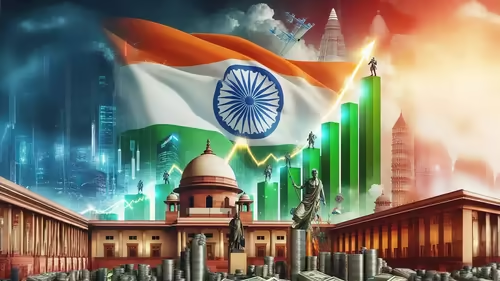
For decades, India’s economic story was one of slow, grinding progress. It took nearly 60 years just to crawl out of the “low-income” category defined by the World Bank. But now, something remarkable is happening. Growth has accelerated—and fast. Experts predict that by around 2030, India will officially cross into upper-middle income status, while simultaneously becoming the world’s third-largest economy.
On paper, it sounds like a triumph. But here’s the uncomfortable question no one’s asking: Does this label actually improve the lives of ordinary citizens? Or is it just a shiny new badge on a system still riddled with inequality, jobless growth, and regional disparities?
In this deep dive, we’ll cut through the headlines, examine the real numbers, and explore what India’s economic ascent truly means—for you, your family, and the nation’s future.
Table of Contents
- What Is Upper-Middle Income Status?
- India’s Economic Journey: A 60-Year Climb
- The 2030 Milestone: Key Drivers
- Why the Label Doesn’t Tell the Whole Story
- Challenges Ahead: Job Creation and Inequality
- What This Means for Indian Households
- Conclusion: Progress With Caution
- Sources
What Is Upper-Middle Income Status?
The World Bank classifies economies based on Gross National Income (GNI) per capita, updated annually using the Atlas method. As of 2024, the thresholds are:
- Low income: $1,135 or less
- Lower-middle income: $1,136 – $4,465
- Upper-middle income: $4,466 – $13,845
- High income: $13,846+
India’s current GNI per capita hovers around $2,400—firmly in the lower-middle bracket. But with sustained GDP growth of 6–7% annually, projections suggest it could cross the $4,466 threshold by 2029–2031 .
India’s Economic Journey: A 60-Year Climb
India gained independence in 1947 as a low-income nation. Despite early industrialization efforts, growth remained sluggish due to the “Hindu rate of growth”—a term coined for the paltry 3.5% annual expansion that characterized much of the post-independence era.
It wasn’t until the 1991 economic liberalization that things began to shift. Still, the move from low-income to lower-middle-income status didn’t happen until 2008—61 years after independence. The next leap, however, is projected to take just 22 years—a dramatic acceleration fueled by digitalization, manufacturing push, and a young workforce.
The 2030 Milestone: Key Drivers
Several forces are propelling India toward India upper-middle income status:
- Digital Public Infrastructure: UPI, Aadhaar, and CoWIN have created a globally admired tech backbone that boosts financial inclusion and efficiency.
- Manufacturing Resurgence: Initiatives like PLI (Production-Linked Incentive) schemes are attracting billions in FDI, especially in electronics and semiconductors.
- Demographic Dividend: With a median age of 28, India’s working-age population is larger than China’s—a potential engine for productivity if properly skilled.
- Services Dominance: IT, fintech, and business process outsourcing continue to be major export earners, contributing over 50% of India’s services GDP.
According to IMF forecasts, India’s nominal GDP could surpass Japan and Germany by 2030, making it the third-largest economy after the U.S. and China .
Why the Label Doesn’t Tell the Whole Story
Here’s the catch: national income classifications are averages. They mask vast inequalities. For example:
- The top 10% of Indians hold over 57% of the nation’s wealth (Credit Suisse, 2023).
- Rural per capita income is less than half of urban levels.
- Over 40% of the workforce is still engaged in low-productivity agriculture.
So while the *average* Indian may soon qualify as “upper-middle income,” millions will still live on less than $5 a day. This is the paradox of aggregate growth without inclusive distribution.
Challenges Ahead: Job Creation and Inequality
Achieving India upper-middle income status isn’t the finish line—it’s a new starting point. Critical hurdles remain:
1. The Jobs Crisis
Economic growth hasn’t translated into enough formal, quality jobs. India needs to create 10–12 million new jobs annually just to absorb new entrants into the labor force. Automation and global trade shifts make this even harder.
2. Human Capital Gaps
Despite high enrollment, learning outcomes in schools remain poor. The ASER 2023 report shows only 42% of Grade 5 students can read a Grade 2 text. Without skilling, the demographic dividend could turn into a liability.
3. Regional Imbalances
States like Tamil Nadu and Gujarat are already functioning at upper-middle income levels, while Bihar and Jharkhand lag far behind. National averages obscure this internal divergence.
What This Means for Indian Households
For the average family, this transition could mean:
- Better access to credit and insurance as financial systems mature.
- More consumer choices as domestic markets expand.
- Higher cost of living as urbanization accelerates.
- Potential for social mobility—if education and healthcare keep pace.
But without deliberate policy focus on equity, many will be left behind—even as the country celebrates its new economic status.
Conclusion: Progress With Caution
India’s impending entry into upper-middle income status is undeniably historic. It reflects decades of reform, resilience, and rising ambition. Yet, true development isn’t measured by GDP rankings alone—it’s measured by whether a farmer in Odisha, a street vendor in Mumbai, or a student in Assam can live with dignity, security, and hope.
The next decade must shift from chasing labels to building lives. Because an economy is only as strong as its weakest citizen.
Sources
- Times of India: India on cusp of upper-middle income status
- World Bank: Country Income Classifications
- International Monetary Fund (IMF): World Economic Outlook Database
- Credit Suisse Global Wealth Report 2023
- ASER Centre: Annual Status of Education Report