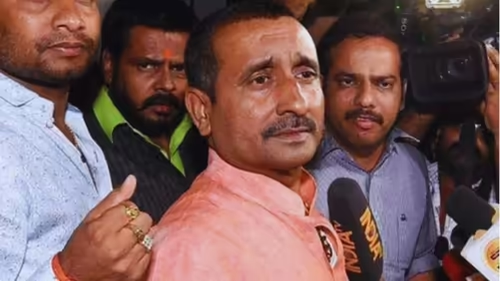
Justice delayed is justice denied—but what happens when the delay is engineered by the accused themselves? In a landmark ruling that reaffirms judicial integrity, the Delhi High Court has flatly refused to suspend the jail term of expelled BJP leader Kuldeep Singh Sengar in the Kuldeep Sengar custody death case. The decision isn’t just procedural; it’s a powerful statement about accountability, especially for those who once wielded political power.
The case centers on the 2018 death of the father of the Unnao rape survivor—a man who died in police custody after being allegedly beaten on Sengar’s orders. Now, with the High Court shutting the door on Sengar’s latest legal maneuver, the message is clear: privilege won’t shield you from consequences forever.
Table of Contents
- Background: The Unnao Tragedy
- The Kuldeep Sengar Custody Death Case Explained
- Why the High Court Refused Bail
- Sengar’s Pattern of Legal Delay
- Broader Implications for Indian Justice
- Public and Activist Reactions
- Conclusion: A Firm Stand for Accountability
- Sources
Background: The Unnao Tragedy
In 2017, a 17-year-old girl from Unnao, Uttar Pradesh, accused Kuldeep Sengar—a then-powerful BJP MLA—of raping her. What followed was a harrowing saga of intimidation, institutional failure, and state violence. Her family faced relentless harassment. When her father tried to seek justice, he was arrested on trumped-up charges and brutally assaulted in custody. He died days later, bearing injuries so severe that even prison authorities couldn’t hide them .
The case sparked national outrage and forced the CBI to take over the investigation. It also exposed how political clout could manipulate local law enforcement—a chilling reality for countless marginalized citizens.
The Kuldeep Sengar Custody Death Case Explained
In March 2023, a Delhi court convicted Sengar under Sections 302 (murder) and 34 (common intention) of the IPC for orchestrating the custodial killing of the survivor’s father. He was sentenced to life imprisonment—the same punishment he received in the separate rape case .
Sengar immediately appealed, seeking suspension of his sentence while his appeal is heard—a common legal tactic that often results in de facto freedom for the accused. But this time, the court wasn’t buying it.
Why the High Court Refused Bail
The Delhi High Court’s refusal was grounded in three critical factors:
- Gravity of the Offense: The court emphasized that the crime wasn’t just murder—it was a calculated act of retribution against a family seeking justice, carried out through abuse of state machinery.
- Sengar’s Criminal History: Already serving a life sentence for rape, Sengar has a documented pattern of using power to silence victims. The court noted this history as a risk to public order and witness safety.
- Deliberate Trial Delays: Perhaps most damning, the judges pointed out that much of the “delay” Sengar cited in his appeal was actually caused by his own legal team filing repeated adjournments and procedural motions .
“One cannot be permitted to take advantage of their own wrong,” the bench observed—a legal principle known as *in pari delicto*.
Sengar’s Pattern of Legal Delay
This isn’t the first time Sengar has used the legal system as a shield. During his rape trial, his lawyers filed over a dozen applications for medical parole, venue changes, and evidence reviews—many of which were dismissed as frivolous. Legal experts argue this is a classic strategy among powerful defendants: drag out proceedings until public attention fades.
But the High Court’s recent ruling signals a growing judicial intolerance for such tactics—especially in cases involving vulnerable victims and custodial violence.
Broader Implications for Indian Justice
This decision could set a vital precedent for future cases involving custodial deaths and politically connected accused. Key takeaways include:
- No Special Treatment: Even former lawmakers aren’t above the law when crimes involve abuse of state power.
- Accountability for Trial Delays: Courts are now scrutinizing who is truly responsible for procedural delays—a shift that could speed up justice in high-profile cases.
- Victim-Centric Justice: The ruling prioritizes the trauma of survivors and families over the convenience of the accused, aligning with India’s evolving human rights jurisprudence.
For context, India reports over 1,700 custodial deaths between 2018–2022, yet convictions remain rare. The NHRC has repeatedly flagged systemic impunity . Sengar’s continued incarceration may serve as a rare but necessary corrective.
Public and Activist Reactions
Women’s rights groups and legal activists have welcomed the verdict. “This is a victory for every survivor who’s been told to ‘wait’ while their abuser walks free,” said a spokesperson from [INTERNAL_LINK:womens-rights-india].
Meanwhile, political commentators note that the BJP’s swift expulsion of Sengar in 2019 likely insulated the party from direct fallout—but the case remains a stain on Uttar Pradesh’s governance during that period.
Conclusion: A Firm Stand for Accountability
The Delhi High Court’s refusal to suspend the sentence in the Kuldeep Sengar custody death case is more than a legal outcome—it’s a moral reckoning. By rejecting attempts to exploit procedural loopholes and highlighting the accused’s role in delaying justice, the judiciary has sent a resounding message: power may buy time, but it can’t buy immunity.
For the Unnao family, and for countless others fighting for dignity in the face of state violence, this ruling offers a sliver of hope that the system can, at last, work for them too.
Sources
- Times of India: HC refuses to suspend Sengar jail term in custody death case
- Supreme Court of India: Judgments on Custodial Violence
- National Human Rights Commission (NHRC): Annual Reports on Custodial Deaths
- CBI Chargesheet in Unnao Case (Public Record via PRS India)