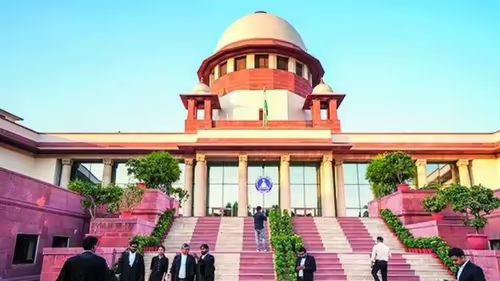
Imagine surviving one of the most brutal forms of violence imaginable—only to be denied affordable access to the very medical care that could help you heal. That’s the harsh reality for many acid attack survivors in India, who often require repeated, specialized treatments across cities or even states. Now, the Supreme Court is stepping in, asking the central government to explain why these survivors shouldn’t be granted AC rail fare concession for acid attack survivors—a move that could dramatically improve their quality of life and access to justice.
The issue came to light through a Public Interest Litigation (PIL) filed by the NGO Atijeevan Society, which works directly with survivors. Their argument is simple yet powerful: if people with certain disabilities get discounted train tickets, why not those whose injuries are just as severe—and often far more complex?
Table of Contents
- What Is the PIL About?
- Why AC Class Matters for Survivors
- Current Indian Railways Concession Policy
- The NGO Behind the Movement
- Legal and Social Implications
- What Happens Next?
- Conclusion: A Question of Dignity and Access
- Sources
What Is the PIL About?
The Supreme Court recently issued a notice to the Union Ministry of Railways, seeking its official position on a PIL that demands AC rail fare concession for acid attack survivors. The petition, filed by the Delhi-based NGO Atijeevan Society, argues that survivors—many from economically disadvantaged backgrounds—face immense financial strain when traveling for reconstructive surgeries, psychological counseling, and follow-up care .
Currently, Indian Railways offers fare concessions to several categories of passengers, including persons with benchmark disabilities (under the Rights of Persons with Disabilities Act, 2016). However, acid attack survivors are not automatically included in this list, despite often suffering from permanent facial disfigurement, vision loss, and mobility issues that meet or exceed the criteria for disability classification .
Why AC Class Matters for Survivors
At first glance, one might wonder: why specifically AC coaches? Isn’t a general or sleeper class ticket enough?
The answer lies in the unique medical and psychological needs of survivors:
- Temperature Sensitivity: Many survivors have severely damaged skin and nerve endings, making them extremely sensitive to heat, dust, and humidity—common in non-AC compartments.
- Infection Risk: Open wounds or recent surgical sites are highly vulnerable to airborne infections in crowded, poorly ventilated coaches.
- Psychological Trauma: Staring, whispers, and unwanted attention in open compartments can retraumatize survivors. AC coaches offer more privacy and a controlled environment.
- Long-Distance Travel: Specialized hospitals like AIIMS (Delhi), Sankara Nethralaya (Chennai), or CURE International (Hyderabad) are often hundreds of kilometers away—making overnight AC travel a medical necessity, not a luxury.
As one survivor told researchers at [INTERNAL_LINK:survivor-stories], “Taking a sleeper class train feels like walking into a courtroom where everyone is judging you before you’ve even spoken.”
Current Indian Railways Concession Policy
Indian Railways does provide concessions—up to 75% off—for persons with benchmark disabilities (40% or more) in AC and non-AC classes. But here’s the catch: acid attack survivors must first obtain a disability certificate from a government medical board, a process that can be slow, inconsistent, and emotionally taxing .
Even then, the concession applies only to specific disability types. Many survivors are classified under “locomotor disability” or “multiple disabilities,” but the system lacks a dedicated category for acid attack-related trauma, leading to arbitrary denials.
This gap is what the PIL seeks to close—not by creating a new welfare scheme, but by ensuring existing policies are interpreted inclusively and compassionately.
The NGO Behind the Movement
Atijeevan Society, founded by acid attack survivor and activist Laxmi Agarwal, has been at the forefront of advocating for survivors’ rights since 2014. Their work includes legal aid, rehabilitation support, and policy advocacy .
“This isn’t about privilege—it’s about dignity,” said a representative from the NGO. “If the state recognizes our pain in law, it must also recognize it in practice.”
Their petition cites precedents: in 2018, the Supreme Court directed all states to provide free treatment to acid attack survivors. In 2021, it mandated faster trials. Now, they’re pushing for mobility justice—a critical but overlooked aspect of recovery.
Legal and Social Implications
If the Court rules in favor of the petition, it could set a powerful precedent:
- It would affirm that acid attack injuries constitute a recognized form of disability deserving of state support.
- It could pressure other ministries (Health, Social Justice) to expand benefits like education scholarships, job reservations, and housing assistance.
- Most importantly, it would send a message: survivors are not invisible. Their daily struggles matter.
Conversely, if the government resists, it may face public backlash—especially given India’s international commitments under the UN Convention on the Rights of Persons with Disabilities, which it ratified in 2007.
What Happens Next?
The Union government now has time to file its affidavit in the Supreme Court. Legal experts expect the Railways Ministry to either propose a new concession category or clarify how existing rules can be applied more equitably.
Meanwhile, survivor groups are mobilizing public support, urging citizens to demand compassionate policy-making. After all, as the Court itself has noted in past judgments, “compensation without rehabilitation is an empty promise.”
Conclusion: A Question of Dignity and Access
The fight for AC rail fare concession for acid attack survivors is more than a transportation issue—it’s a test of India’s commitment to restorative justice. These individuals have already endured unimaginable pain. Denying them safe, affordable travel to heal is a second injury inflicted by bureaucracy.
As the Supreme Court weighs its next move, the nation watches. Will policy finally catch up with empathy?
Sources
- Times of India: SC seeks govt stand on AC rail fare cut for acid attack survivors
- Atijeevan Foundation: Official Website
- Ministry of Social Justice & Empowerment: Rights of Persons with Disabilities Act, 2016
- Indian Railways – Passenger Reservation Enquiry: Concession Guidelines