Introduction
In a heart-wrenching incident that has exposed dangerous lapses in urban planning and civic accountability, a young software engineer lost his life after his car plunged into a deep, waterlogged trench in Noida’s Sector 150. The tragedy—now widely known as the Noida techie death—has sparked public outrage and swift political action. Within hours, Uttar Pradesh Chief Minister Yogi Adityanath ordered the formation of a Special Investigation Team (SIT) with a strict five-day deadline to submit its findings. In a rare show of administrative accountability, Lokesh M., the CEO of the Noida Authority, was immediately removed from his post.
Table of Contents
- What Happened: The Night of the Noida Techie Death
- Why the Public Is Furious: Infrastructure and Negligence
- CM Yogi Adityanath’s Response: Swift and Severe
- The Broader Crisis of Urban Planning in Indian Cities
- What Needs to Change to Prevent Future Tragedies
- Conclusion: A Call for Accountability and Action
- Sources
What Happened: The Night of the Noida Techie Death
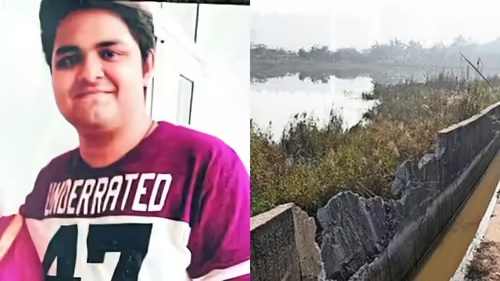
The victim, a 30-year-old software professional, was returning home late at night when his vehicle veered off the road near a sharp, unmarked turn in Sector 150—a rapidly developing but poorly maintained area on Noida’s outskirts. Unbeknownst to him, a large construction trench—dug for utility work—lay just beyond the edge of the road, completely filled with rainwater and lacking any barricades, warning signs, or reflective markers .
The car plunged into the trench, submerging instantly. Despite frantic calls from witnesses, rescue efforts were critically delayed. Local residents reported that emergency services took over 45 minutes to arrive, and even then, lacked proper equipment to extract the vehicle quickly. By the time divers reached the scene, it was too late—the techie had drowned .
Why the Public Is Furious: Infrastructure and Negligence
This wasn’t just an accident—it was a preventable tragedy rooted in systemic negligence. Citizens and activists are demanding answers:
- Why was the trench left open and unmarked? Standard safety protocols require all open excavations to be fenced and illuminated, especially near roads.
- Who authorized this construction without traffic management? Multiple agencies often operate in Noida—municipal, private developers, and state utilities—with little coordination.
- Why did emergency response fail? Noida’s disaster response infrastructure remains underdeveloped despite its status as a tech hub.
Sector 150, though part of a “planned” city, has long suffered from inadequate lighting, missing signage, and haphazard construction—issues repeatedly flagged by residents but ignored by authorities .
CM Yogi Adityanath’s Response: Swift and Severe
Facing mounting public pressure and media scrutiny, Chief Minister Yogi Adityanath acted decisively. He announced two major measures within 24 hours of the incident:
- Immediate removal of Lokesh M., the CEO of the Noida Authority, who was held responsible for the overall safety and maintenance of the region’s infrastructure.
- Formation of a three-member SIT comprising senior IAS and IPS officers, tasked with investigating the causes of the accident, identifying lapses, and recommending punitive and preventive actions. The team must submit its report within five days—a highly unusual and accelerated timeline indicating the gravity of the situation .
The CM also directed all district magistrates across Uttar Pradesh to conduct immediate safety audits of all open trenches, construction sites, and drainage systems near public roads—a move aimed at preventing similar incidents statewide.
The Broader Crisis of Urban Planning in Indian Cities
The Noida techie death is not an isolated case. It reflects a nationwide crisis in India’s urban development model. According to a 2023 World Bank report, rapid urbanization has outpaced governance capacity in most Indian cities, leading to fragmented planning, poor enforcement of safety norms, and a culture of impunity among contractors and officials .
Cities like Gurugram, Bengaluru, and Hyderabad have seen similar incidents—cars falling into open manholes, pedestrians tripping into uncovered drains, and buildings collapsing due to illegal construction. The common thread? A lack of integrated urban management and weak citizen grievance redressal mechanisms.
For more on systemic failures in Indian infrastructure, see our analysis on [INTERNAL_LINK:urban-safety-crisis-india].
What Needs to Change to Prevent Future Tragedies
To honor the victim’s memory and prevent future loss of life, experts recommend these critical reforms:
- Mandatory Real-Time Construction Mapping: All excavation sites should be geo-tagged and displayed on public dashboards accessible to citizens and emergency services.
- Strict Liability for Contractors: Firms that fail to secure sites should face heavy fines, blacklisting, and even criminal charges in cases of death.
- Integrated Emergency Response: Cities need unified command centers that can dispatch fire, police, and medical teams simultaneously to such incidents.
- Citizen-Led Safety Audits: Empower local communities to report hazards via mobile apps with guaranteed response timelines.
Conclusion: A Call for Accountability and Action
The Noida techie death is a stark reminder that development without safety is not progress—it’s peril. While the removal of the Noida Authority CEO and the fast-tracked SIT probe are welcome steps, they must lead to systemic change, not just symbolic punishment. As India races to build smart cities, it must first ensure its basic infrastructure doesn’t become a death trap for its own citizens. The five-day SIT report will be a crucial test of whether this tragedy becomes a turning point—or just another forgotten headline.
Sources
- Times of India: Noida techie death: CEO removed, CM Yogi Adityanath orders SIT probe; report due in 5 days
- World Bank: India Urbanization Review – Challenges of Urban Growth
- Local Resident Complaints & Media Reports from Noida (Sept 2025)