Introduction
The landscape of global defence is shifting, and India is no longer just watching from the sidelines. In a powerful statement of its growing military-industrial prowess, Defence Minister Rajnath Singh recently flagged off the first batch of guided Pinaka rocket systems destined for Armenia. This isn’t just another arms deal; it’s a definitive milestone in India’s ambitious journey to become a top-tier player in the international defence exports market. From being one of the world’s largest importers of weapons, India is now confidently exporting its own cutting-edge, homegrown technology to strategic partners.
Table of Contents
- The Armenia Deal: A Landmark for Indian Defence Exports
- Inside the Pinaka Rocket System: India’s Artillery Powerhouse
- From Importer to Exporter: India’s Defence Manufacturing Revolution
- Strategic Implications of the India-Armenia Partnership
- Conclusion: The Future of Indian Defence Exports
- Sources
The Armenia Deal: A Landmark for Indian Defence Exports
This export deal, valued at approximately ₹2,000 crore (around $250 million), was signed back in September 2022 . It covers the supply of four complete Pinaka multi-barrel rocket launcher batteries, which include a mix of unguided, longer-range, and the newly exported guided variants . While initial deliveries of the unguided systems began in mid-2023 and were completed by late 2024, the recent shipment of the guided rockets marks the final and most technologically advanced phase of the contract . This makes Armenia the first known foreign customer for India’s sophisticated guided Pinaka system, a significant vote of confidence in its capabilities .
Inside the Pinaka Rocket System: India’s Artillery Powerhouse
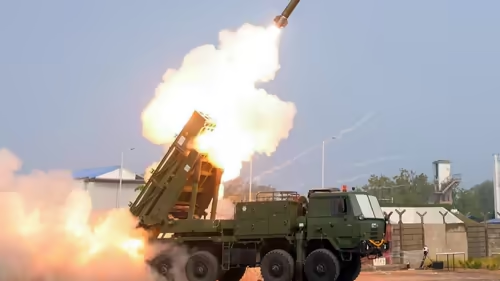
Developed by India’s Defence Research and Development Organisation (DRDO), the Pinaka system has evolved from a basic artillery platform into a formidable long-range strike weapon. The version being exported to Armenia is the guided variant, a true testament to India’s indigenous engineering.
Here’s what makes the guided Pinaka so impressive:
- Range & Precision: It can engage targets at distances of up to 75-90 kilometers with remarkable accuracy, reportedly achieving a Circular Error Probable (CEP) of just 2-3 meters during user trials, far exceeding the army’s requirement of 40 meters .
- Advanced Guidance: The system uses a combination of a ring laser gyro inertial navigation system and satellite guidance from both GPS and India’s own NavIC constellation, ensuring reliability even in contested environments .
- Rapid Firepower: A single launcher can fire a salvo of 12 high-explosive rockets in under a minute, effectively neutralizing a large area target .
This blend of range, precision, and firepower makes the Pinaka a highly sought-after asset for any modern military, perfectly aligning with the needs of a nation like Armenia.
From Importer to Exporter: India’s Defence Manufacturing Revolution
The Pinaka export to Armenia is a shining example of the success of the ‘Make in India’ initiative in the defence sector. This transformation is backed by staggering numbers. India’s defence exports have skyrocketed from less than ₹1,000 crore a decade ago to a record-breaking ₹23,622 crore in the fiscal year 2024-25 alone—a 12% year-on-year increase . The momentum continues, with exports already reaching ₹9,000 crore in just the first half of FY26 .
The government has set an ambitious target of achieving $5 billion (roughly ₹41,000 crore) in annual defence exports by 2029, and deals like the one with Armenia are critical to hitting that mark . This shift isn’t just about economics; it’s about strategic autonomy and establishing India as a reliable, technology-forward partner on the global stage. For more on India’s industrial growth, see our analysis on [INTERNAL_LINK:make-in-india-success-stories].
Strategic Implications of the India-Armenia Partnership
This deal goes beyond a simple buyer-seller relationship. For Armenia, acquiring a potent, long-range artillery system like the Pinaka is a crucial step in modernizing its armed forces and bolstering its deterrence capabilities, particularly in a complex regional security environment. For India, it represents a strategic foothold in the strategically important Caucasus region.
Notably, in the 2022-2023 period, a staggering 43% of India’s total arms exports went to Armenia, highlighting the depth of this new partnership . This successful transaction paves the way for future sales of other Indian platforms, such as the Akash air defence system or even the Tejas fighter jet, to Yerevan and potentially other nations in the region who are now taking notice of India’s reliable and cost-effective defence solutions.
Conclusion: The Future of Indian Defence Exports
The flagging off of the guided Pinaka rockets to Armenia is far more than a ceremonial event. It is a concrete symbol of India’s arrival as a serious, credible, and technologically advanced player in the global defence market. This landmark deal validates years of investment in indigenous R&D and manufacturing, proving that ‘Made in India’ can compete with the best in the world. As India continues to refine its systems and build its reputation for reliability, we can expect to see many more such defence exports announcements, fundamentally reshaping its role in global security architecture.
Sources
- Times of India: Boost for defence exports as Rajnath flags off 1st batch of Pinaka guided rockets for Armenia
- Indian Defence Review: Details on Pinaka system capabilities and export strategy [[15], [16]]
- Ministry of Defence, Government of India: Official data on defence production and exports [[22], [21]]
- Various news reports on the Armenia-India defence deal [[1], [2], [8], [9]]