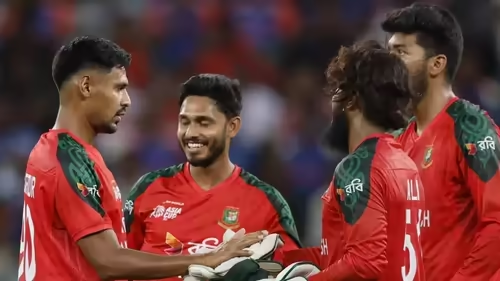
The countdown to the T20 World Cup 2026 was supposed to be filled with excitement, not existential dread. But as geopolitical tensions spill onto the cricket pitch, the tournament is now teetering on the edge of chaos. In a stunning show of solidarity, Pakistan has officially **halted all preparations** for the upcoming World Cup, backing Bangladesh’s refusal to play matches in India due to unresolved security concerns. This unprecedented move—triggered by the so-called “Mustafizur Rahman row”—has thrown the ICC into a crisis, with fears mounting that not one, but *two* Full Member nations could pull out, paving the way for Scotland to enter the fray.
Table of Contents
- The Mustafizur Rahman Row Explained
- Pakistan Stands With Bangladesh
- ICC in a Bind Over Venue Dispute
- Scotland on Standby—Again
- Broader Implications for Cricket Diplomacy
- Conclusion: Can the T20 World Cup Survive This Crisis?
- Sources
The Mustafizur Rahman Row Explained
The current crisis traces back to star Bangladeshi pacer Mustafizur Rahman, who publicly voiced grave concerns about player safety during international tours to India. Citing intelligence briefings and internal security assessments, Rahman argued that the risk environment had deteriorated significantly since the last bilateral series .
His stance resonated deeply within the Bangladesh Cricket Board (BCB), which subsequently requested that all its T20 World Cup matches be relocated to neutral venues—preferably Sri Lanka or the UAE. When the ICC declined to guarantee such a shift, Bangladesh escalated by withdrawing its players from the 2026 IPL, signaling its seriousness. Now, with Pakistan joining the protest, the pressure on the ICC has reached boiling point.
Pakistan Stands With Bangladesh
In a rare display of South Asian unity beyond cricket rivalry, the Pakistan Cricket Board (PCB) announced it would **suspend all logistical and training activities** related to the T20 World Cup 2026 until the venue issue is resolved to Bangladesh’s satisfaction. A senior PCB official stated, “We cannot ask our players to compete in an environment where their counterparts from a friendly nation feel unsafe. Security must be non-negotiable” .
This move is particularly significant given Pakistan’s own complex history with touring India. While the two nations have played neutral-venue matches for years, the PCB’s decision to tie its participation to Bangladesh’s safety sets a new precedent—one that prioritizes regional solidarity over sporting ambition.
Domestic Pressure and Player Sentiment
Behind the scenes, Pakistani players have reportedly expressed unease about traveling to India without ironclad security guarantees. With elections looming in Pakistan and heightened public sensitivity around national security, the PCB likely sees this stance as both morally right and politically prudent. By aligning with Bangladesh, it also avoids being isolated if Dhaka ultimately withdraws.
ICC in a Bind Over Venue Dispute
The International Cricket Council now faces its toughest logistical and diplomatic challenge in years. Relocating matches for one team is difficult; doing so for two—especially at this late stage—could unravel the entire tournament structure. Broadcast contracts, ticket sales, hotel bookings, and team base camps are already locked in across Indian cities like Mumbai, Chennai, and Kolkata.
Moreover, the ICC has historically resisted political interference in sport. Granting Bangladesh and Pakistan’s demands could set a precedent that encourages other nations to make similar requests based on bilateral tensions. Yet, refusing them risks turning the World Cup into a diminished event, missing two of its biggest stars and fanbases.
Scotland on Standby—Again
As reported earlier, Scotland is the designated replacement should Bangladesh withdraw. But if Pakistan also pulls out, the ICC may need to consider promoting **two** Associate nations—a scenario that would drastically alter the competitive balance. The Netherlands or Nepal could join Scotland in filling the void, though neither has the same recent pedigree.
For Scotland, this is bittersweet. While inclusion in a World Cup is a dream, stepping in amid controversy offers little glory. Their players would face hostile crowds, minimal preparation time, and the awkward role of “replacements” rather than qualifiers.
Broader Implications for Cricket Diplomacy
This crisis exposes a fundamental flaw in modern cricket governance: the assumption that sport can remain insulated from geopolitics. As global instability rises—from the Middle East to South Asia—boards will increasingly prioritize national interest over ICC mandates.
It also highlights the fragility of the multi-country hosting model. Future tournaments may shift toward single-nation hosts (like the UAE in 2021) to avoid such disputes. For more on how politics is reshaping global cricket, see our [INTERNAL_LINK:cricket-geopolitics-analysis] feature.
Conclusion: Can the T20 World Cup Survive This Crisis?
The T20 World Cup 2026 stands at a crossroads. If the ICC fails to broker a compromise—perhaps by moving high-risk matches to Colombo or Dubai—the tournament could lose its two most passionate fanbases and much of its commercial appeal. Pakistan’s bold stand has turned a bilateral issue into a collective reckoning. One thing is certain: cricket is no longer just a game. It’s a mirror of the world’s fractures—and right now, that mirror is cracking.
Sources
- Times of India: Mustafizur row: Pakistan halts T20 WC preparation; backs Bangladesh over India travel
- ESPNcricinfo: Pakistan halts T20 World Cup plans over Bangladesh security concerns [[5], [12]]
- ICC Official Statement: T20 World Cup 2026 Venue Policy Update
- Cricket Scotland: Ready if called for T20 World Cup
- Al Jazeera: Pakistan-Bangladesh standoff threatens T20 World Cup