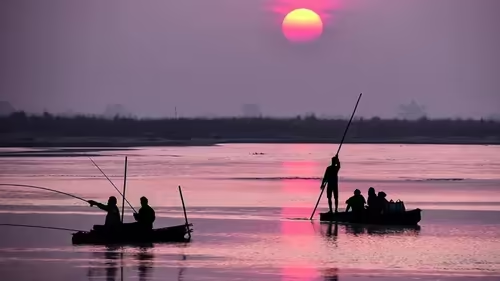
It wasn’t just a routine diplomatic visit—it was a calculated geopolitical signal. Chinese Ambassador Yao Wen’s recent tour of a Teesta project site in northern Bangladesh, perilously close to India’s strategically sensitive ‘Chicken’s Neck’ corridor, has sent ripples through New Delhi’s security and foreign policy circles. At a time when India-Bangladesh relations are already strained over trade, border management, and political friction, Beijing’s visible push into the heart of one of South Asia’s most contentious water disputes marks a significant escalation.
Table of Contents
- The Teesta Dispute: A Long-Standing Stalemate
- Why the Chicken’s Neck Location Matters
- China’s Strategic Play in Bangladesh
- India’s Diplomatic and Security Concerns
- What Comes Next for the Teesta Master Plan?
- Conclusion: A New Front in the Indo-Pacific Rivalry
- Sources
The Teesta Dispute: A Long-Standing Stalemate
The Teesta project centers on the Teesta River, which originates in Sikkim, flows through West Bengal, and enters Bangladesh before merging with the Brahmaputra. For decades, Dhaka has demanded a fair share of the river’s waters—especially during the dry season—arguing that upstream Indian diversions have devastated agriculture in its northern regions.
Despite multiple rounds of talks since the 1980s, and a near-final agreement in 2011 under then-Indian PM Manmohan Singh, the deal collapsed due to opposition from West Bengal Chief Minister Mamata Banerjee. Since then, the issue has remained frozen, becoming a symbol of unfulfilled promises in bilateral relations .
Now, with China stepping in to fund and potentially implement a “Teesta Master Plan”—a comprehensive water resource development strategy—Bangladesh is signaling it may no longer wait for India to act.
Why the Chicken’s Neck Location Matters
Ambassador Yao Wen’s visit wasn’t just to any part of Bangladesh—it was to the Rangpur region, just **20–30 kilometers** from the Siliguri Corridor, infamously known as the “Chicken’s Neck.” This narrow 22-kilometer-wide strip of Indian territory connects mainland India to its northeastern states and is flanked by Bangladesh on one side and Nepal/Bhutan (and beyond them, China) on the other.
Strategically, the Chicken’s Neck is India’s most vulnerable geographical point. Any external power gaining influence in this vicinity—especially through infrastructure, surveillance, or hydrological projects—raises serious national security concerns. The fact that a Chinese envoy is now inspecting water projects so close to this corridor is not lost on Indian defense planners .
The Symbolism of the Visit
This isn’t merely about irrigation canals or dams. It’s about **presence**. By publicly touring the site alongside Bangladeshi officials and discussing “development cooperation,” China is embedding itself in a core bilateral issue between India and Bangladesh. It’s a classic example of using economic and technical assistance to gain political leverage—a hallmark of Beijing’s Belt and Road Initiative (BRI) playbook .
China’s Strategic Play in Bangladesh
China has been steadily expanding its footprint in Bangladesh for over a decade. It is now Dhaka’s largest trading partner and a major arms supplier. Recent agreements include:
- Funding for the $1 billion Padma Bridge Rail Link
- Construction of the proposed Bangladesh-China Friendship Hospital
- Joint ventures in port development, including at Chittagong and Mongla
The Teesta Master Plan fits neatly into this broader strategy. By offering an alternative to Indian cooperation, China positions itself as a reliable partner—one that doesn’t come with domestic political roadblocks like those in West Bengal. For Bangladesh, this is both a bargaining chip and a potential lifeline.
India’s Diplomatic and Security Concerns
New Delhi now faces a dual challenge. On one hand, it must urgently revive stalled talks on the Teesta water-sharing agreement to prevent Bangladesh from fully pivoting to China. On the other, it must assess whether Chinese involvement in hydrological projects near the Chicken’s Neck could enable dual-use infrastructure—such as monitoring stations disguised as meteorological outposts.
Historically, India has viewed water-sharing as a sovereign, bilateral matter. But with China’s entry, the issue is no longer confined to hydrology—it’s become a **geopolitical flashpoint**. Experts warn that if Beijing gains control over data collection, dam construction, or even satellite imagery related to the Teesta basin, it could indirectly influence India’s water security and regional dominance .
What Comes Next for the Teesta Master Plan?
While details of the plan remain scarce, reports suggest it includes reservoirs, barrages, and flood management systems—all areas where Chinese engineering firms have extensive experience. If implemented, it could reduce Bangladesh’s dependence on India for dry-season flows. However, without upstream coordination with India, such projects risk being inefficient or even counterproductive.
For India, the path forward is clear but difficult: either resolve the Teesta issue through political consensus at home, or accept a diminished role in its own neighborhood. The ball is now firmly in New Delhi’s court.
Conclusion: A New Front in the Indo-Pacific Rivalry
The Teesta project is no longer just about water—it’s about influence, sovereignty, and strategic space. China’s move to embed itself in this decades-old dispute, right on the edge of India’s most vulnerable corridor, marks a new front in the broader Indo-Pacific contest. As Bangladesh navigates its relationships with both giants, the Teesta River may soon become more than a source of irrigation—it could become a symbol of shifting power in South Asia.
Sources
- Times of India: Bangladesh lets China envoy go close to Chicken’s Neck
- The Diplomat: China’s Growing Role in the Teesta River Dispute [[5], [18]]
- Observer Research Foundation: The Siliguri Corridor and India’s Strategic Vulnerability
- Ministry of External Affairs, India: India-Bangladesh Bilateral Relations
- South Asia Monitor: China-Bangladesh Deepen Cooperation on Teesta and Health Projects