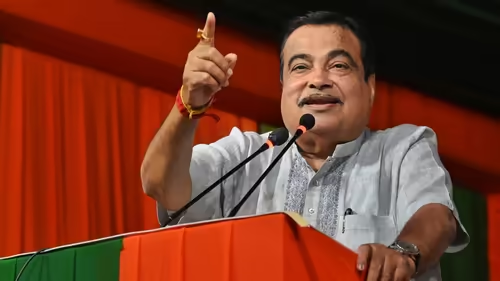
Gadkari’s Bold Call: Should the Old Guard Step Aside for a Youth-Led India?
In a move that has sent ripples across the Indian political ecosystem, Union Minister Nitin Gadkari has made a powerful and provocative statement. Speaking on January 18, 2026, he declared that the old generation should step aside to allow the younger generation to take charge of the nation’s leadership reins . This isn’t just a casual remark; it’s a direct call for a fundamental shift in how power and responsibility are distributed in the world’s largest democracy.
At a time when India is celebrating its demographic dividend—a vast population of young, energetic, and tech-savvy citizens—Gadkari’s comments have landed with significant weight. His message is clear: the era of gerontocracy may be coming to an end, and a new chapter of youth leadership is ready to begin.
Table of Contents
- Gadkari’s Statement and Its Context
- Why Youth Leadership Matters for India
- The Challenges of a Generational Shift
- Existing Platforms for Young Leaders
- Conclusion: The Future is Young
- Sources
Gadkari’s Statement and Its Context
Gadkari’s remarks were made during a public address where he emphasized the need for a smooth and natural transition of power. He didn’t call for an abrupt ousting but rather a graceful passing of the torch. “When things start running smoothly, the old generation should step aside,” he was quoted as saying . This sentiment aligns with his long-standing reputation as a forward-thinking minister who champions innovation and modernization, particularly in infrastructure and sustainable development.
The timing of his statement is also noteworthy. It comes on the heels of the second edition of the Viksit Bharat Young Leaders’ Dialogue (VBYLD) 2026, a government initiative designed to create a national platform for young people aged 15–29 to translate their ideas into action for a developed India . By making this statement now, Gadkari is effectively linking his personal view to a larger, official national strategy focused on empowering the next generation.
Why Youth Leadership Matters for India
The push for youth leadership isn’t just about fairness or representation; it’s a strategic necessity for India’s future. Here’s why:
- Digital Natives: Today’s youth have grown up in a hyper-connected world. They understand digital technologies, data, and global trends in a way that many older leaders simply cannot. This fluency is critical for navigating the 21st-century economy.
- New Perspectives on Old Problems: Decades-old challenges like climate change, unemployment, and social inequality require fresh, innovative solutions. Young leaders are often less bound by traditional thinking and more willing to experiment with bold, unconventional ideas.
- Demographic Reality: With over 65% of its population under the age of 35, India’s future is intrinsically tied to its youth. A government and leadership that doesn’t reflect this reality risks becoming disconnected from the very people it serves.
This focus on the next generation is not isolated to Gadkari. The Indian government has been actively building an ecosystem to support this transition through platforms like MY Bharat and the National Service Scheme (NSS), which enable massive youth participation in volunteering and nation-building activities .
The Challenges of a Generational Shift
While the idea of a youth-led future is inspiring, the path to get there is fraught with challenges.
First, there’s the question of experience. Critics argue that while young people bring energy and new ideas, they often lack the seasoned judgment and political acumen that comes from years of navigating complex systems. The key, as Gadkari seems to imply, is not a complete replacement but a structured mentorship model where experienced leaders guide the newcomers before stepping back.
Second, entrenched power structures are notoriously difficult to dismantle. Political parties, corporate boards, and bureaucratic institutions are often dominated by individuals who have spent decades climbing the ladder. Convincing them to voluntarily cede their hard-won positions is a monumental task.
Finally, there’s a risk of tokenism. Simply placing a few young faces in visible roles without granting them real decision-making power is a hollow gesture. True next-gen leadership in India requires a systemic overhaul of how opportunities are created and distributed.
Existing Platforms for Young Leaders
Fortunately, the groundwork for this transition is already being laid. The government’s flagship program, the Viksit Bharat Young Leaders Dialogue, is a prime example. The 2026 edition alone witnessed participation from over 50 lakh (5 million) young people, providing them with a direct channel to ideate, deliberate, and propose solutions for national development .
These initiatives are crucial because they move beyond rhetoric and provide tangible pathways for young talent to engage with the system. They serve as incubators for the very leaders Gadkari is calling for, helping to bridge the gap between youthful idealism and practical governance.
Conclusion: The Future is Young
Nitin Gadkari’s call for the old generation to step aside is more than just a political soundbite; it’s a reflection of a growing global and national imperative. The world is changing at an unprecedented pace, and the leaders of tomorrow must be equipped to handle its complexities. By championing youth leadership, Gadkari is not only advocating for a fairer distribution of power but also for a more resilient, innovative, and representative future for India. The real test will be whether this vision can move from words to concrete, systemic action. For a nation sitting on a demographic goldmine, the time to act is now.
Sources
- Times of India. (2026, January 19). ‘Old generation should step aside’: Nitin Gadkari backs leadership shift; pitches youth to take charge. Retrieved from https://timesofindia.indiatimes.com/india/old-generation-should-step-aside-nitin-gadkari-backs-leadership-shift-pitches-youth-to-take-charge/articleshow/126668372.cms
- Various News Outlets. (2026, January 18-19). Reports on Nitin Gadkari’s youth leadership comments [[1], [2], [3], [8], [9]].
- Press Information Bureau, Government of India. (2026, January). Information on Viksit Bharat Young Leaders’ Dialogue (VBYLD) 2026 [[4], [6], [10]].
- Ministry of Youth Affairs & Sports. (2026, January 11). National Youth Day 2026 .