Table of Contents
- The Latest Ruling: No Mercy for a Convicted Rapist
- Who is Kuldeep Sengar? A Timeline of Infamy
- The Custodial Death Case: A Father’s Tragic End
- Sengar’s Legal Arguments and Why the Court Rejected Them
- Broader Implications for Justice in India
- Conclusion: A Landmark Moment for Accountability
- Sources
The Latest Ruling: No Mercy for a Convicted Rapist
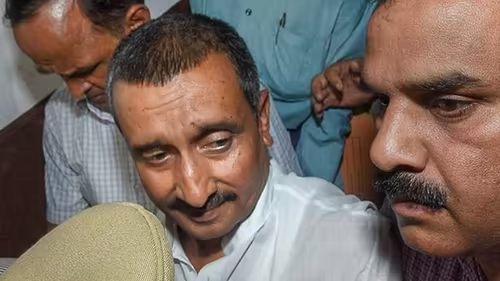
In a firm and decisive judgment, the Delhi High Court has rejected former BJP MLA Kuldeep Singh Sengar’s plea to suspend his 10-year prison sentence in the Unnao rape case . The court’s decision, delivered on January 19, 2026, is a powerful reaffirmation that those in positions of power are not above the law .
Sengar, who is already serving a life sentence for the rape of a minor in 2017, had sought relief from his additional 10-year term, which was handed down for his role in the custodial death of the victim’s father . His legal team argued that he had already served nearly nine years of his combined sentences, but the court found no grounds to grant him leniency .
Who is Kuldeep Sengar? A Timeline of Infamy
Kuldeep Singh Sengar was once a powerful political figure in Uttar Pradesh, representing the Bangermau constituency as a BJP MLA. His world began to unravel in 2017 when a 17-year-old girl from Unnao accused him of raping her. The case quickly became a national scandal, exposing a web of political influence, police apathy, and systemic failure.
The victim’s family faced relentless intimidation. Her father was arrested on what many believe were trumped-up charges and died in police custody under suspicious circumstances—an event that would later lead to Sengar’s second major conviction .
Key milestones in this saga include:
- June 2017: The survivor attempts to immolate herself outside the Chief Minister’s residence, alleging police inaction.
- April 2018: The victim’s father dies in custody, allegedly after being brutally beaten by Sengar’s brother and others.
- December 2019: A Delhi court convicts Sengar for rape and sentences him to life imprisonment.
- March 2020: Sengar is sentenced to 10 years in prison for the custodial death of the victim’s father.
The Custodial Death Case: A Father’s Tragic End
The 10-year sentence that Sengar sought to suspend stems from a separate but deeply connected crime. In April 2018, the Unnao rape survivor’s father was arrested and taken into custody. While in jail, he was allegedly assaulted by Sengar’s brother, Atul Sengar, and an accomplice, leading to fatal injuries .
The court found Kuldeep Sengar guilty of criminal conspiracy in this act, holding him responsible for orchestrating the attack that led to the father’s death. This conviction was a critical part of the justice process, acknowledging the full scope of the terror inflicted upon the victim’s family.
Sengar’s Legal Arguments and Why the Court Rejected Them
Sengar’s legal team built their plea for sentence suspension on two main points. First, they claimed he had already served a significant portion—nearly nine years—of his combined life and 10-year sentences. Second, they likely argued for his right to a fair appeal process without being incarcerated.
However, the Delhi High Court was unmoved. The judges recognized the gravity of Sengar’s crimes, which involved not just a heinous sexual assault but also the abuse of political power to destroy a family. Granting suspension in such a high-profile case of custodial violence and rape could have sent a dangerous message about impunity for the powerful . The court’s refusal underscores its commitment to upholding the original verdict’s integrity.
Broader Implications for Justice in India
This ruling in the Unnao rape case has far-reaching implications beyond Sengar’s personal fate. It serves as a crucial precedent in India’s ongoing struggle against sexual violence and the misuse of authority.
According to data from the National Crime Records Bureau (NCRB), crimes against women in India remain alarmingly high. The Unnao case, with its elements of political clout and police complicity, highlighted how vulnerable victims can be when their attackers are influential. The Delhi High Court’s decision is a step toward dismantling that culture of impunity. For more on legal protections for survivors, see [INTERNAL_LINK:womens-legal-rights-india].
Conclusion: A Landmark Moment for Accountability
The Delhi High Court’s rejection of Kuldeep Sengar’s plea is more than just a legal formality; it’s a landmark moment for accountability in India. By refusing to suspend his sentence, the court has sent a clear and unambiguous message: no one, regardless of their political stature, is exempt from the consequences of their actions. For the Unnao survivor and countless other victims of power-based violence, this decision offers a measure of hard-won justice.
Sources
- Times of India: Unnao rape: Delhi HC rejects Kuldeep Sengar’s plea to suspend 10-year jail term
- NDTV: Unnao Rape Case: Delhi High Court Rejects Kuldeep Sengar’s Plea To Suspend Sentence
- Hindustan Times: Delhi HC refuses to suspend Kuldeep Sengar’s 10-year sentence in Unnao custodial death case
- National Crime Records Bureau (NCRB): Crime in India Statistics